Pure 8.3 - Definite integrals and area under a curve
Can a region have positive area when its definite integral is zero? You will distinguish signed accumulation from geometric area, choose the boundaries of a region, and integrate the height of a vertical strip. The same idea works below the axis, between two curves and with parametric equations.
Definite integrals give signed area
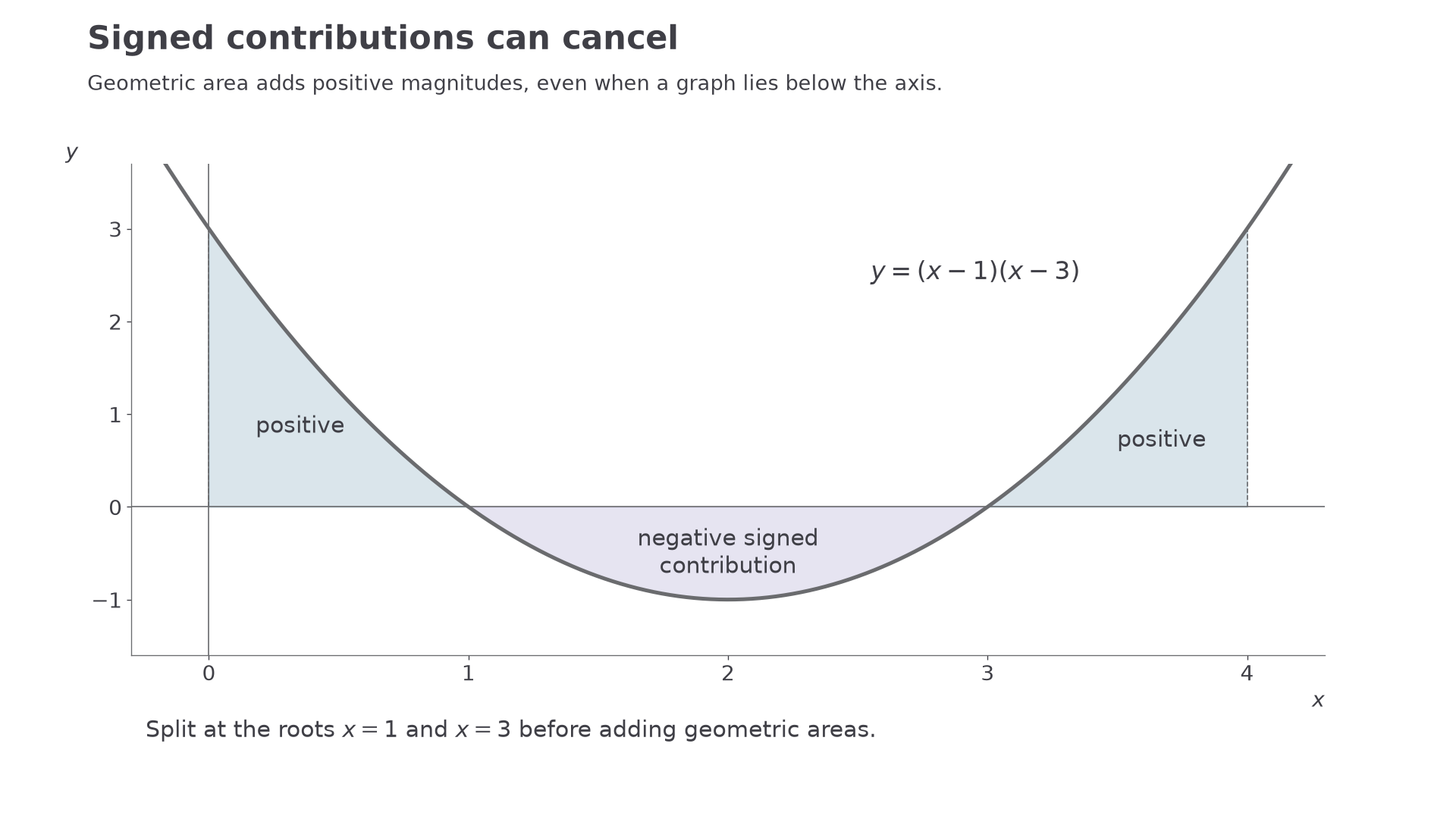
For between and , the integral is zero. Is the enclosed area zero too? The curve passes through , so there is plainly some region above the axis. The puzzle is what happens after it crosses the axis.
You already know
If , the Fundamental Theorem gives for continuous . Constants cancel in this subtraction.
A thin vertical strip has signed contribution . Above the axis, is positive; below it, is negative. Adding these contributions can cause cancellation.
Signed integral and geometric area
A definite integral with increasing limits measures signed area: regions above the horizontal axis contribute positively and regions below contribute negatively. Geometric area adds their positive magnitudes. For example, equal regions on opposite sides can give integral zero while their total area is positive.
The signs describe the calculation, rather than negative physical pieces of a region.
[DIAGRAM: asset_slug: p1_8_3_evaluate_definite_integrals_to_find_area_under_a_curve__diagram_01; asset_name: Signed integral versus total area; caption: Split at roots before adding geometric areas; description: The parabola y=(x-1)(x-3) is shaded from x=0 to x=4, with positive contributions outside the roots 1 and 3 and a negative signed contribution between them]
Endpoint order also affects a definite integral.
Evaluating and reversing limits
For continuous and ,
Not in the formula booklet: learn it.
First practise evaluating the integral exactly, before asking whether it equals a geometric area.
Worked example 1: an integral with both signs
Question. Evaluate .
Plan. Integrate term by term and subtract endpoint values.
Why this step? The question asks for the signed integral, so cancellation is part of the requested value.
Answer. .
Check. Differentiating gives the integrand. Its roots are and , so a below-axis portion exists; should not automatically be called total area.
Change only the order of the endpoints. The antiderivative stays fixed and the answer changes sign.
Worked example 2: reversing the endpoints
Question. Evaluate .
Plan. Subtract values in the order specified by the limits.
Why this step? The upper-position limit is , even though it is the smaller number; follow the written orientation.
Answer. .
Check. Reversing the first example must negate , which it does.
Keep the distinction between evaluating an integral and finding an area explicit.
Watch out
Wrong: every definite integral is a positive area. Right: a definite integral can be negative or zero; geometric area cannot be negative.
Try another endpoint while keeping the integrand unchanged.
Area under one curve
For area bounded by a curve, the axis and two vertical lines, decide where the curve is above or below the axis before integrating. A root inside the interval is a possible place to split.
Area between a curve and the axis
For continuous and ,
If throughout, . If the sign changes, split into intervals and add the positive magnitudes.
Not in the formula booklet: learn it.
A curve entirely below the axis still bounds a positive region. For example, between and gives integral , while the rectangle's area is square units.
Worked example 3: the opening region
Question. Find the total area between , the axis and the lines , .
Plan. Find the roots, split where the sign changes, and add the magnitudes.
Why this step? Splitting prevents the negative contribution from subtracting a genuine geometric area.
Answer. square units.
Check. The signed integral is , exactly the opening puzzle. The total area is positive: cancellation explains the apparent paradox.
Change only the right boundary from to . A third, positive piece appears beyond the second root.
Worked example 4: extending beyond another crossing
Question. Find the total area between the same curve and the axis for .
Plan. Keep the splits at both roots and add the extra piece from to .
Why this step? The second root is now inside the interval, so the sign changes again there.
Answer. square units.
Check. The curve is symmetric about , so the pieces from to and to have equal area, as the calculation shows.
The signed integral over the whole interval would be only . Taking its absolute value afterwards would still lose the cancelled pieces.
Watch out
Wrong: total area is always . Right: split at sign changes first, then take each piece's positive magnitude.
Extend the right boundary once more, keeping the same roots and antiderivative.
Area between two curves
A vertical strip between two graphs has height equal to their difference. You need to know which graph is higher, even when both lie below the axis.
Area between two curves
If continuous and satisfy for , where , then
Not in the formula booklet: learn it.
Find intersections if the limits are hidden. Then use a sketch or an interior test value to identify the upper graph.
[DIAGRAM: asset_slug: p1_8_3_evaluate_definite_integrals_to_find_area_under_a_curve__diagram_02; asset_name: Area between two curves; caption: Each strip has height equal to upper curve minus lower curve; description: The parabola y=6x-x squared and line y=2x meet at x=0 and x=4, with the region shaded and a vertical strip showing their height difference]
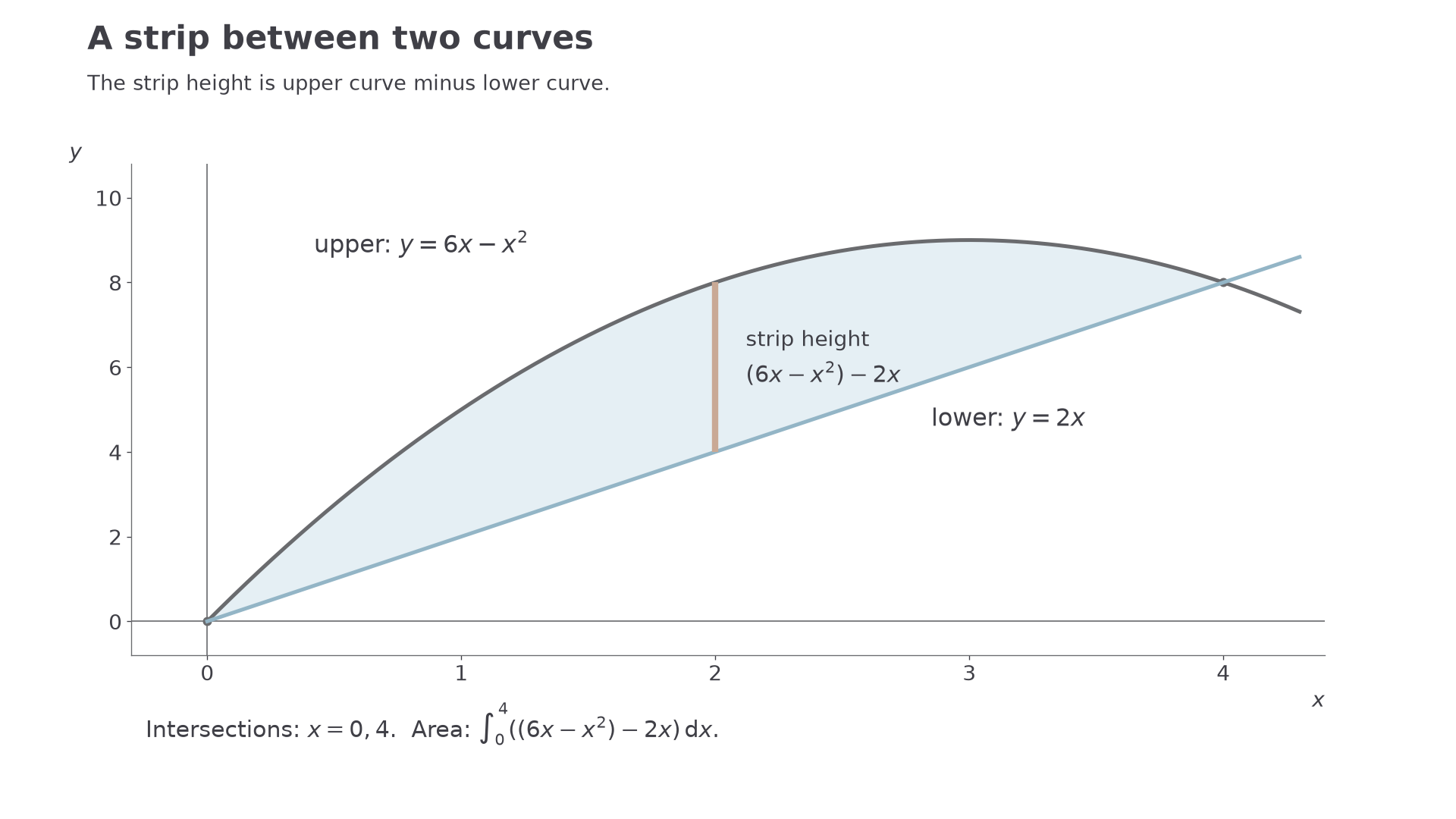
The strip method turns the whole region into one integrand.
Worked example 5: a curve and a line
Question. Find the finite area bounded by and .
Plan. Solve for intersections, identify the upper curve, then integrate their difference.
Why this step? At , the parabola has height and the line height ; this confirms the subtraction order.
Answer. square units.
Check. The strip height is non-negative on , so the answer must be positive.
Change only the line's gradient from to . The region becomes narrower, so a smaller answer is expected.
Worked example 6: a steeper lower line
Question. Find the finite area bounded by and .
Plan. Recalculate the intersections and integrate the new height difference.
Why this step? Changing a boundary changes both the integrand and the intersection limits; retaining the old upper limit would include another region.
Answer. square units.
Check. , consistent with the smaller enclosed region.
Continue this lesson.
You’re previewing NovaLearn without an account. Create a free account to read the rest.
Create free account