Mechanics 9.1 - Moments in simple static contexts
A force can make a body turn as well as move. You will calculate moments, balance rods and ladders, and find when a support loses contact. The same few equilibrium equations handle a sloping ladder, an uneven beam and a load about to tip a platform.
Moment as turning effect
How far can a load travel along a beam before one support lifts clear? Picture a horizontal beam of length , weight , supported at its left end and from that end. A load moves towards the right end. Balancing the downward forces is only half the puzzle: their positions matter too. We will find the exact tipping position later.
Start with a door. A push near the hinge has less turning effect than the same perpendicular push near the handle. A push directly towards the hinge has no turning effect at all, even if it is strong.
You already know
Resolve a force into perpendicular components using trigonometry. In equilibrium the resultant force is zero. Weight is ; use unless another value is given.
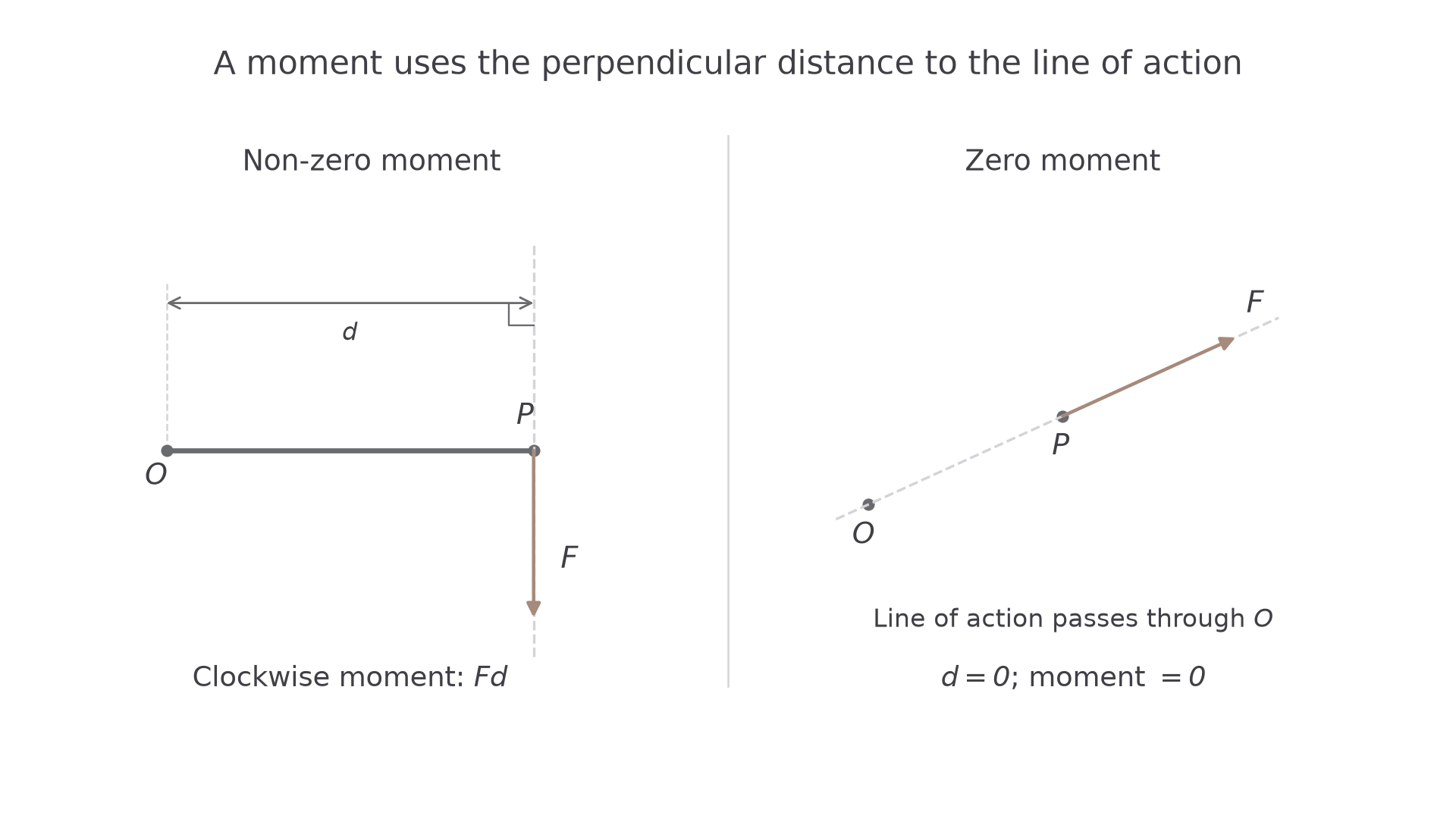
The distance that matters is measured to the force's entire line of action, rather than just to the point where the force is applied.
Moment of a force
The moment of a force about a point is its turning effect about that point. Its magnitude is the force multiplied by the perpendicular distance from the point to the force's line of action. The line of action is the straight line through the force in its direction. A force whose line of action passes through the point has zero moment about it.
Choose clockwise or anticlockwise as positive and keep that choice throughout an equation. The chosen point need not be a physical hinge.
[DIAGRAM: asset_name: Perpendicular distance and zero moment; asset_slug: p3_9_1_understand_and_use_moments_in_simple_static_contexts__diagram_01; caption: Measure to the line of action at a right angle; description: Two panels show a downward force to the right of O with a horizontal perpendicular distance and clockwise tendency, and a force whose line of action passes through O giving zero moment]
Moment about a point
For a force of magnitude , perpendicular distance , and distance to its application point making angle with the force:
Give the direction separately, or assign a consistent sign. The unit is . Not in the formula booklet: learn it.
The angle form follows because the perpendicular distance is . You can instead resolve the force perpendicular to the rod; both routes give the same moment.
Worked example 1: opposite turning effects
Question. A horizontal rod is pivoted at . Downward and upward forces of and act respectively and to the right of . Find their resultant moment about .
Plan. Take anticlockwise moments as positive and add the two signed moments.
Why these signs? A downward force to the right of turns the rod clockwise; the upward force turns it the other way.
Answer. The resultant moment is anticlockwise.
Check. The anticlockwise moment exceeds the clockwise moment by .
Worked example 2 changes only the direction of the force. Its magnitude and application point stay the same, but less of it now turns the rod.
Worked example 2: an oblique force
Question. In Worked example 1, the force now acts upwards and to the right at to the horizontal. Find the new resultant moment about .
Plan. Use the upward component of the oblique force; its horizontal component acts through .
Why ignore the horizontal component? Its line of action is along the rod and passes through , so its moment is zero.
Answer. The resultant moment is clockwise.
Check. The oblique force's moment is also , as required.
A moment calculation always needs a force, a perpendicular length and a direction.
Watch out
Wrong: use for the oblique force in Worked example 2. The length is not perpendicular to that force. Right: use , or the perpendicular component .
Try another angle-controlled moment, keeping the sign visible until the last line.
Rigid-body equilibrium
A rigid body in static equilibrium has no resultant force and no resultant moment. Two equal opposite forces at different positions can balance as forces while still turning a beam, so neither condition can replace the other.
Uniform rod
A uniform rod has its mass evenly distributed along its length, so its weight acts at its midpoint. A non-uniform rod need not have its centre of mass at the midpoint: use the stated position, or deduce it from the equilibrium information.
For example, the weight of a uniform beam acts from either end. A load placed on it is an additional force; it does not replace the beam's own weight.
Rigid-body equilibrium in a plane
For a rigid body at rest under coplanar forces:
The moment condition holds about any point . Not in the formula booklet: learn it.
Choose a moment point on the line of action of an unknown force. That force then contributes zero moment, making the equation shorter.
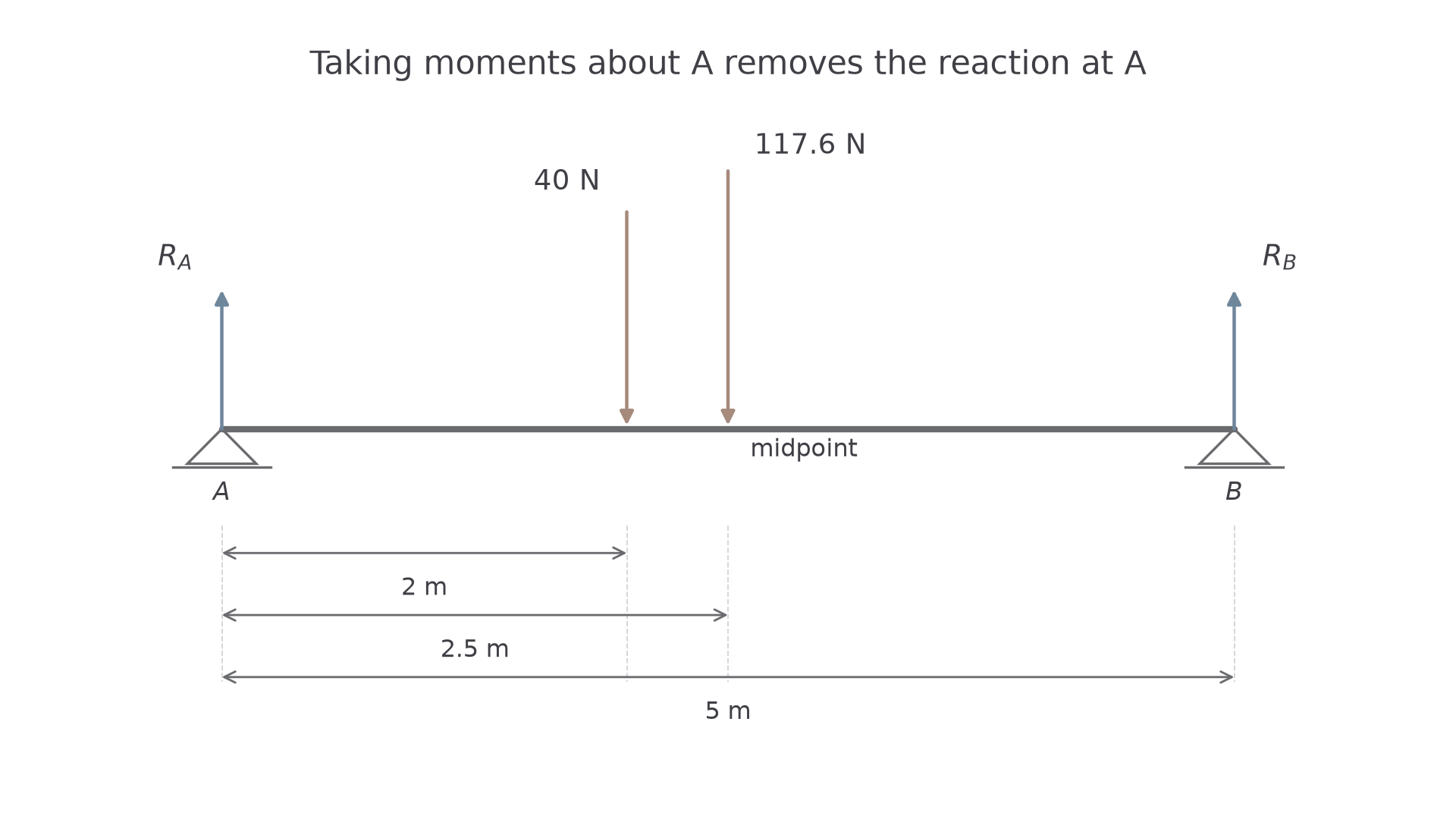
[DIAGRAM: asset_name: Reactions supporting a uniform beam; asset_slug: p3_9_1_understand_and_use_moments_in_simple_static_contexts__diagram_02; caption: Moments about A remove the unknown reaction at A; description: A five metre uniform beam has reactions at both ends, its weight 117.6 newtons at 2.5 metres and a 40 newton downward load at 2 metres from A, with clearly separated distance guides]
Worked example 3: two supporting reactions
Question. A uniform beam has length and mass . It rests on supports at both ends. A load acts downwards from . Find the support reactions.
Plan. Take moments about to find , then resolve vertically to find .
Why choose ? The unknown acts through it, so the moment equation contains only one unknown.
Answer. and , both upwards.
Check. About , . The forces also sum to zero.
Worked example 4 changes only the load's position, from to from . Predict which support will carry more before calculating.
Worked example 4: moving a load towards a support
Question. The load on the same beam now acts from . Find the new reactions.
Plan. Use the same moment point and total weight; change only the load's moment arm.
Why does increase? The load now has a larger clockwise moment about , so must supply a larger opposing moment.
Answer. and , upwards.
Check. increased by and decreased by the same amount; their sum is still .
Notice that a support reaction is a force exerted on the beam, rather than a fixed share of the weight.
Watch out
Wrong: because the beam is uniform. Uniformity locates the beam's own weight; the extra load destroys the symmetry. Right: take moments and then balance forces.
Your next beam has different dimensions and loading, but the choice of pivot is unchanged.
Perpendicular distances on sloping rods
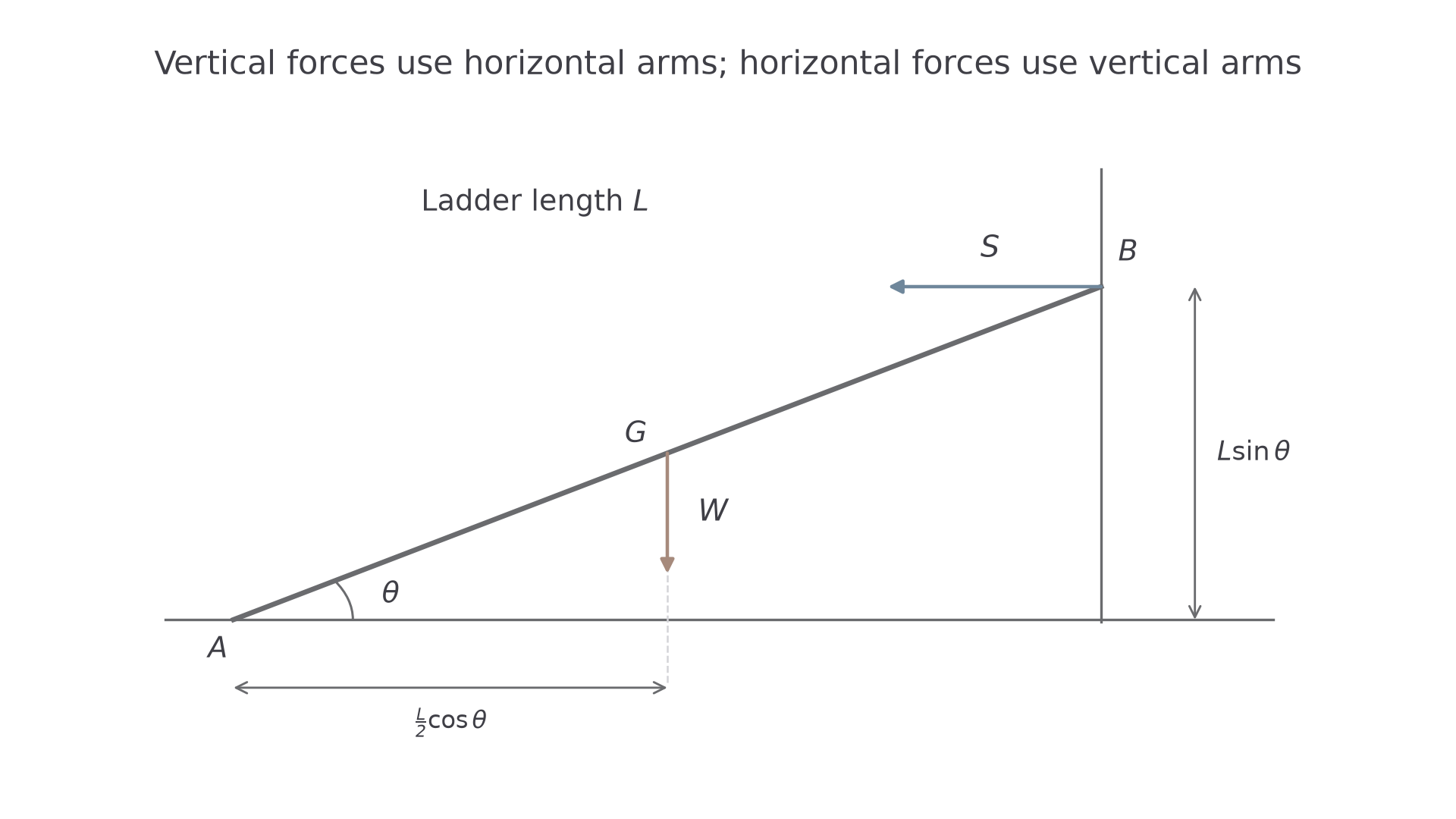
A length along a sloping rod is usually not a moment arm. For a vertical weight you need a horizontal distance; for a horizontal reaction you need a vertical distance.
Take a rod making an acute angle with horizontal ground. A point along it is horizontally and vertically from the base. Those projections, rather than itself, supply the appropriate moment arms.
[DIAGRAM: asset_name: Moment arms on a sloping ladder; asset_slug: p3_9_1_understand_and_use_moments_in_simple_static_contexts__diagram_03; caption: A vertical force uses a horizontal arm and a horizontal force uses a vertical arm; description: A ladder of length L at angle theta to the horizontal has its weight at the midpoint, a leftward smooth-wall reaction at the top and labelled perpendicular distances L sin theta and one half L cos theta from A]
Moment arms on a sloping rod
For a force acting at distance along a rod making acute angle with the horizontal:
A force perpendicular to the rod has arm . These distances are measured from the rod's lower end. Not in the formula booklet: learn it.
At a smooth wall the reaction is perpendicular to the wall, so it is horizontal. It is not perpendicular to the ladder.
Worked example 5: angle to the ground
Question. A uniform ladder has length and weight . Its foot rests on rough horizontal ground and its top rests against a smooth vertical wall. The ladder makes angle with the ground. Find the wall reaction in terms of .
Plan. Take moments about , using the vertical height of and horizontal distance of the midpoint.
Why choose ? Both the ground reaction and friction act there and have zero moment about it.
Answer. .
Check. At , the reaction is ; its arm is twice the weight's arm, so half the force balances the weight.
Worked example 6 changes only where the angle is measured: it is now to the vertical. Draw that angle before choosing sine or cosine.
Worked example 6: angle to the wall
Question. The same ladder makes acute angle with the vertical wall. Express in terms of .
Plan. Find the height and horizontal midpoint distance using the angle at the top.
Why has cotangent become tangent? The physical model is unchanged, but .
Answer. .
Check. If , then and both forms give .
For a uniform ladder of length and weight , the first calculation reads , giving . This is a derived result, not a formula printed in the booklet.
Watch out
Wrong: keep as the height when is the angle to the vertical. Right: sketch the triangle and use . The name of the angle alone does not determine the projection.
Use the vertical-angle version in this check and show the moment arms explicitly.
Ladders with friction
A rough floor supplies a normal reaction and a friction force. A smooth wall supplies only a normal reaction. Draw both contacts before writing equations: a rough contact does not magically make its friction limiting.
For a ladder rising to the right against a smooth wall, the wall pushes its top left. Friction at the foot acts right to oppose the tendency of the foot to slip left. The ladder is at rest; describe a tendency to slip rather than actual motion.
Static friction at a contact
For normal reaction , coefficient of friction and friction magnitude :
At limiting equilibrium, . In a general equilibrium position, the required friction may be smaller. Not in the formula booklet: learn it.
Moments often give the wall reaction first. Horizontal and vertical equilibrium then give the friction and floor normal reaction.
Worked example 7: limiting equilibrium
Question. A uniform ladder of weight rests on rough horizontal ground against a smooth vertical wall. Its angle to the ground satisfies . The ladder is in limiting equilibrium. Find .
Plan. Use the moment result for , resolve the forces, then apply limiting friction at the floor.
Why use equality here? The statement “limiting equilibrium” says the available static friction is fully used.
Answer. .
Check. , exactly the friction required to balance the wall reaction.
Worked example 8 changes only the friction information: the same ladder has a stated coefficient, and you must decide whether equilibrium is possible.
Worked example 8: enough friction, without limiting friction
Question. For the same ladder and angle, the coefficient of friction is . Determine whether the ladder can remain in equilibrium and whether friction is limiting.
Plan. Compare the friction required by force balance with the maximum available friction.
Why not set ? Static friction supplies the amount needed for equilibrium, up to its bound; an extra horizontal force would upset equilibrium.
Answer. Equilibrium is possible. Friction is not limiting, since .
Check. The least possible coefficient is still , below .
If the wall is rough as well, draw a vertical wall-friction force in addition to its horizontal normal reaction. When the top tends to slip down, that friction acts up and supports some weight, reducing the floor reaction. Include its moment too; the smooth-wall formulas cannot be reused unchanged.
Watch out
Wrong: use , where is the wall reaction, for friction at the floor. Right: friction at each contact uses that contact's own normal reaction, so floor friction satisfies .
The next question asks for the smallest coefficient, so equality applies at its boundary.
Continue this lesson.
You’re previewing NovaLearn without an account. Create a free account to read the rest.
Create free account