Pure 5.7 - Simple trigonometric equations
Find every solution of a trigonometric equation in a stated interval. You will handle shifted and multiplied angles in degrees or radians, solve quadratics in trig functions, and explain why careless cancellation or an incomplete interval can lose solutions.
Why intervals create more than one answer
A calculator says . How can have four answers before ? The inverse function returns one principal value; the sine graph keeps repeating. We will use that distinction to find a complete answer.
Start with one turn: . The same height appears on the rising and falling sides of the wave.
You already know
Sine and cosine have period , or radians. Tangent has period , or radians, and is undefined at odd multiples of .
A repeated value does not make the inverse function wrong. Its restricted output range is what makes it a function.
Solution in an interval
A solution is an input that makes the original equation true and lies inside the stated interval. A closed endpoint, as in , is included; an open endpoint, as in , is excluded. For example, solves on , but is outside that interval.
Read intersections with a horizontal line, and use the graph's symmetry to find all of them.
[DIAGRAM: asset_slug: p1_5_7_solve_simple_trigonometric_equations_in_a_given_interval__diagram_01; asset_name: Repeated values on sine, cosine and tangent graphs; caption: One inverse value is a starting point, not a complete solution list; description: Three panels over a full turn show sine equal to one half at 30 and 150 degrees, cosine equal to minus one half at 120 and 240 degrees, and tangent equal to 1 at 45 and 225 degrees, with its asymptotes clearly separated from roots.]
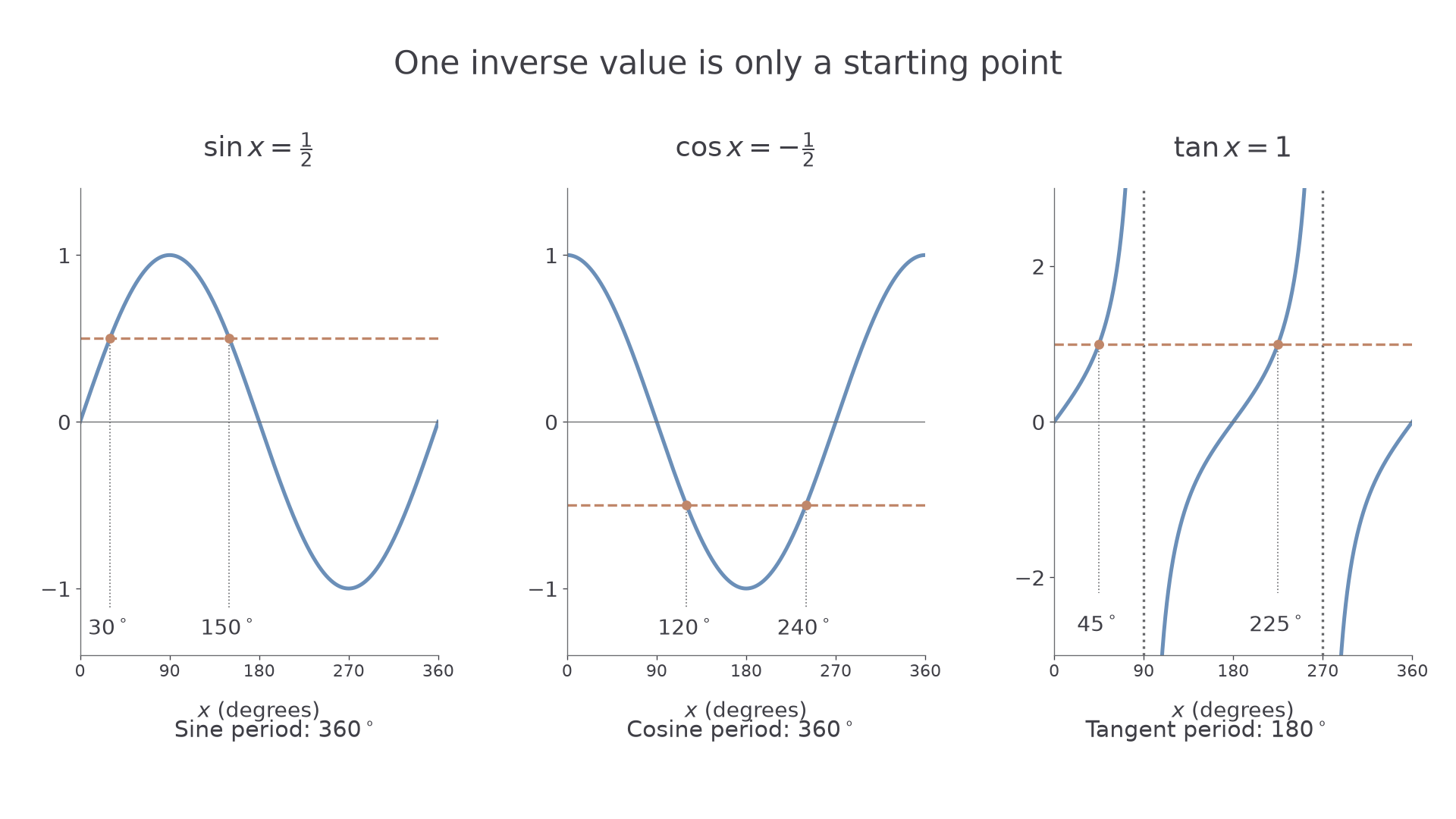
These graph symmetries and the following solution families are recall knowledge, rather than a printed formula-booklet method.
Repeated solution families
If is one inverse value, all possible solutions are
for integers , retaining only values in the stated interval. For sine and cosine, ; repeated branches at a maximum or minimum count only once. In radians replace by and by .
Not in the formula booklet: learn it.
A sketch often makes the two sine branches easier to remember than a formula does.
Worked example 1: positive sine
Question. Solve for .
Plan. Find the principal angle and reflect it in .
Why two branches? The horizontal line crosses both sides of the positive sine arch.
Answer. .
Check. Both angles give , and neither endpoint is a root.
Change only the sign of the required sine value. The intersections move into the lower half of the graph.
Worked example 2: negative sine
Question. Solve for .
Plan. Use the reference angle in quadrants III and IV.
Why not list ? It is a valid principal value but is outside the required interval.
Answer. .
Check. Both sine values equal ; the signs agree with the graph.
The same idea works when the reference angle is not a familiar exact angle: retain its full calculator precision.
Watch out
Wrong: , with no interval check. Right: use that principal value to generate all repeated branches, then select the allowed angles.
Try the negative sine method with a new exact value.
Shifted angles
In , the sine function acts on the whole angle . Name that angle , and move the interval along with it.
For , adding gives . This interval crosses the end of the usual first turn: the solution at matters.
Worked example 3: shift the interval too
Question. Solve for .
Plan. Solve for in its own interval, then subtract .
Why include ? It equals , so its sine is still .
Answer. .
Check. The original inputs are and , both with sine .
Change only the shift from to . Keep the same two branches before shifting back.
Worked example 4: a smaller shift
Question. Solve for .
Plan. Transform the interval to , then solve in .
Why is excluded? It lies below the transformed lower bound, and would produce a negative .
Answer. .
Check. Adding recovers the same two valid sine inputs as before.
A negative shift can produce a negative lower bound. That is an ordinary part of the interval, not an instruction to discard all negative inputs.
Watch out
Wrong: solve for only between and regardless of the shift. Right: transform both bounds before generating the branches.
Apply that rule to cosine and a negative shift.
Multiples and radians
Multiplying the input changes how many cycles the interval contains. If and , then : the cosine input covers two turns.
[DIAGRAM: asset_slug: p1_5_7_solve_simple_trigonometric_equations_in_a_given_interval__diagram_02; asset_name: Doubling the input doubles the interval; caption: Four cosine intersections in the transformed interval give four original angles; description: Number lines map open endpoints minus 180 and 180 degrees to minus 360 and 360 degrees for u equal to 2x. Below, a cosine graph and level minus 0.4 label the four u roots and their halved x roots.]
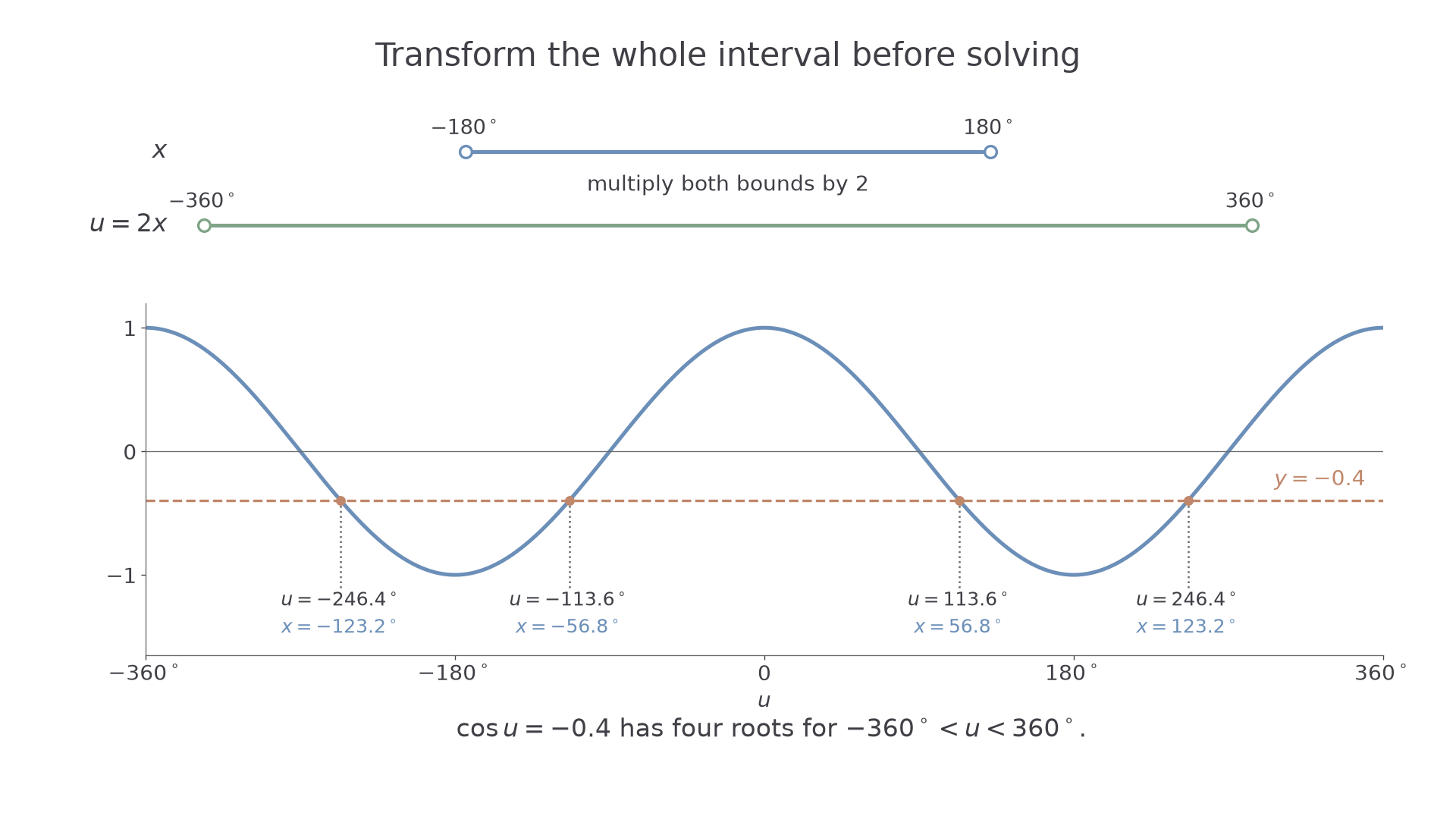
The period belongs to the function's input, so work in that input before dividing back to .
Worked example 5: two cosine cycles
Question. Solve for , to decimal place.
Plan. Isolate cosine, solve for across two turns, then halve each solution.
Why four values? The level lies strictly between and , giving two intersections in each full cycle.
Answer. After dividing unrounded values by , .
Check. All four give , hence .
Continue this lesson.
You’re previewing NovaLearn without an account. Create a free account to read the rest.
Create free account