Pure 3.1 - Equation of a straight line
A straight-line equation describes every point on a line with just a few constants. You will connect those constants to gradients, intercepts and perpendicular directions, then build and interpret straight-line models.
Gradient, intercept and equation forms
Can the Celsius and Fahrenheit readings ever be the same number? Their conversion graph is a straight line, but its intercept is not zero. We will build that line and find the meeting temperature by the end.
Start with a simpler line: from to , moving units right raises the height by . That is a rise of for every unit right.
You already know
A coordinate pair gives horizontal position first and vertical position second. Substitution checks whether a point lies on a graph: satisfies , because .
The same rise-to-run ratio applies between any two distinct points on a non-vertical straight line.
Gradient and intercept
The gradient is the change in divided by the change in . The -intercept is the value of at . For example, has gradient and intercept . A vertical line has no finite gradient.
The picture links the ratio to the graph. A negative gradient descends as you move right; zero gradient gives a horizontal line.
[DIAGRAM: asset_slug: p1_3_1_understand_and_use_the_equation_of_a_straight_line_in_the_x_y_plane__diagram_01; asset_name: Gradient as rise over run; caption: A rise of 2 for a run of 4 gives gradient one half; description: Coordinate graph of y equals one half x plus 1 with points (2, 2) and (6, 4), a rise-run triangle and y-intercept (0, 1)]
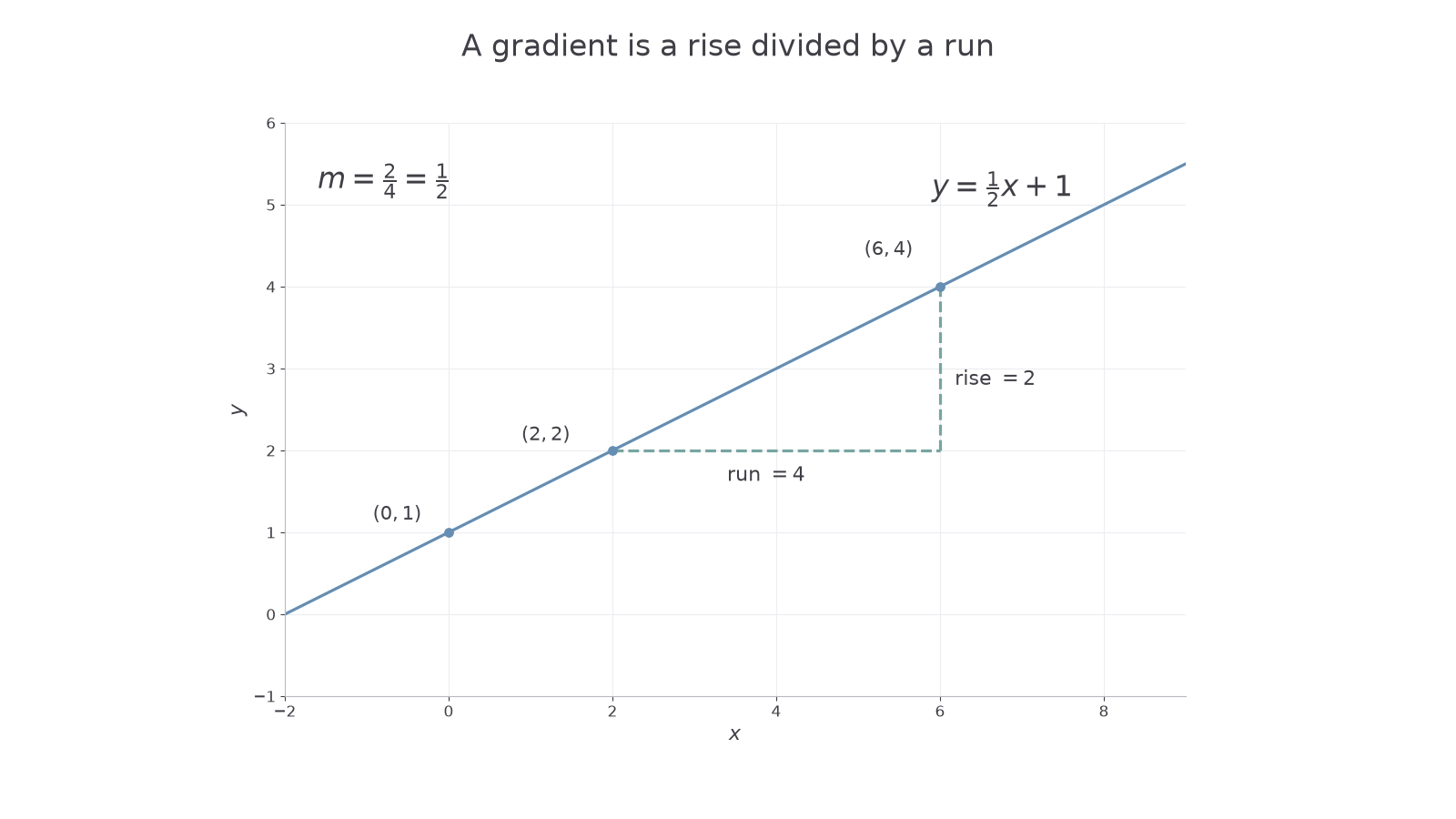
Gradient and equation forms
For distinct points with ,
In the second form, is the -intercept. The general form is , where and are not both zero. Its constant is generally not the intercept. Not in the formula booklet: learn it.
To read a finite gradient from general form, make the subject first.
Worked example 1: reading an expanded equation
Question. Find the gradient and -intercept of .
Plan. Rearrange into , then read the two constants.
Why this step? The coefficient of is the gradient only when the coefficient of is .
Answer. Gradient , -intercept .
Check. At , the original equation gives , so .
Change only the sign of the term. This reverses both signs after rearrangement, so watch the whole equation.
Worked example 2: a changed sign
Question. Find the gradient and -intercept of .
Plan. Isolate before interpreting the coefficients.
Why this step? Reading straight from the original equation would ignore the rearrangement.
Answer. Gradient , -intercept .
Check. The points and both satisfy the original equation and give gradient .
The exceptional lines still fit general form: is vertical and is horizontal. Only the second has a finite gradient.
Watch out
Wrong: “ has intercept .” Right: , so its intercept is . The constant in general form is not automatically the intercept.
Try the same reading method with one changed constant.
Finding a line through points
Two distinct points fix exactly one straight line. For a non-vertical line, find its gradient and attach it to one of the points.
Take and . Their horizontal separation is , so the gradient calculation is possible. Any other point on their line must share that same gradient from .
Point-gradient form
A non-vertical line through with gradient has equation
It follows by multiplying by ; the resulting equation also includes the known point. Not in the formula booklet: learn it.
Either known point works. Choose the one whose signs make the substitution easiest.
Worked example 3: two points to general form
Question. Find the line through and in the form .
Plan. Calculate the gradient, use , then clear the denominator.
Why this step? Point-gradient form uses both the direction and the position; a gradient alone describes many parallel lines.
Answer. .
Check. Substitution gives at and at .
Change only the height of , from to . The line now falls, but the method stays put.
Worked example 4: a negative gradient
Question. Find the line through and in general form.
Plan. Keep the subtraction order consistent, then use .
Why this step? Both coordinate differences must run from the same first point to the same second point.
Answer. .
Check. At , ; at , .
If the two -coordinates agree, stop before dividing: points such as and give the vertical line . Two identical points do not determine a unique line.
Watch out
Wrong: , mixing point orders. Right: . A quick sketch would also expose the wrong sign.
Now change the second point's height again and keep the requested final form.
Parallel and perpendicular lines
Sliding a line without rotating it keeps its gradient. Turning its direction through a right angle swaps the roles of rise and run and reverses one sign.
For instance, direction steps and give gradients and . Their product is .
[DIAGRAM: asset_slug: p1_3_1_understand_and_use_the_equation_of_a_straight_line_in_the_x_y_plane__diagram_02; asset_name: Parallel and perpendicular directions; caption: Parallel lines share a gradient while perpendicular finite gradients multiply to minus one; description: Two panels show parallel lines of gradient three quarters and perpendicular lines of gradients three quarters and minus four thirds]
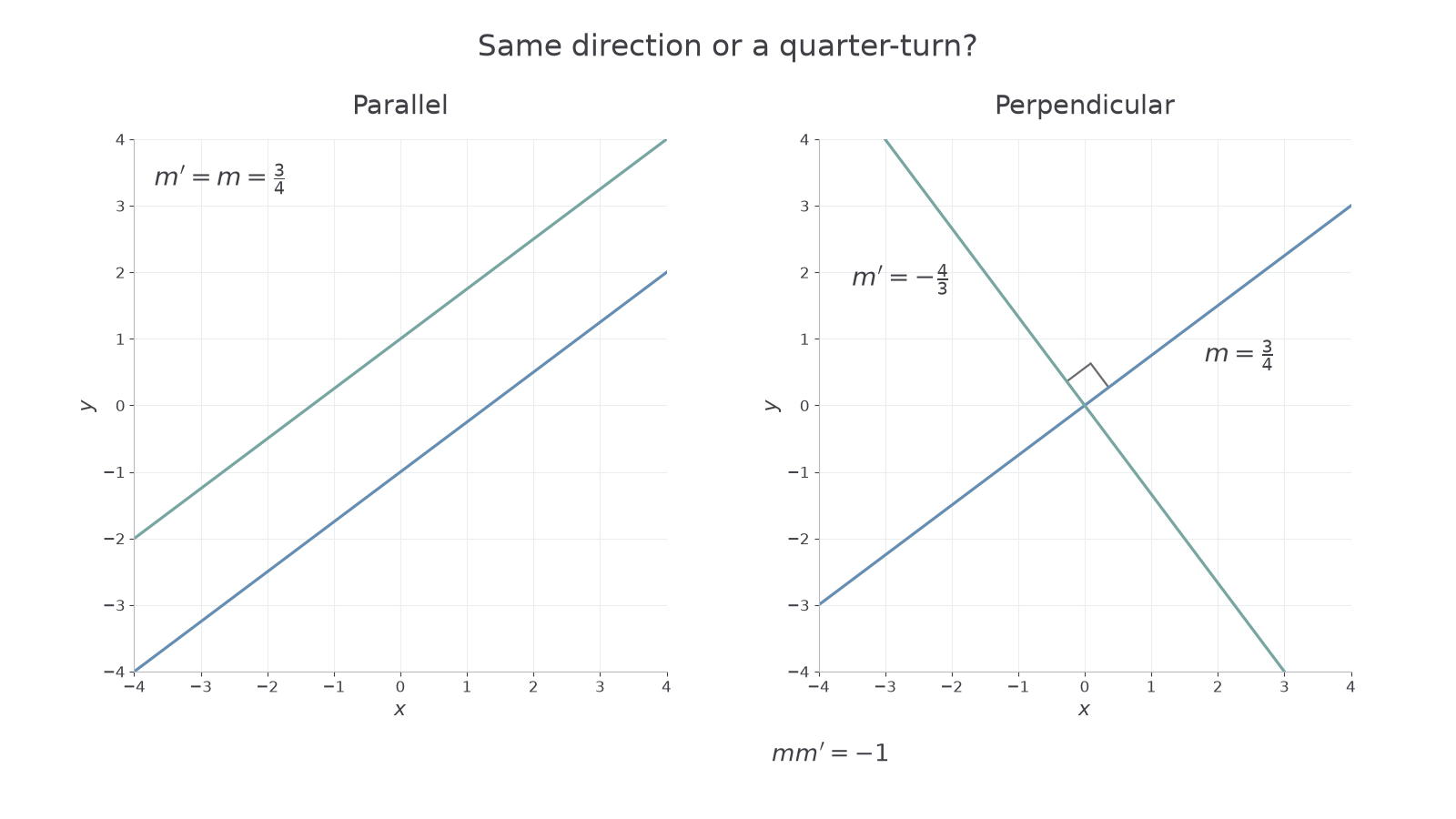
Parallel and perpendicular gradients
For distinct non-vertical parallel lines, . For perpendicular lines with finite gradients,
A horizontal line is perpendicular to a vertical line; handle that case directly. Not in the formula booklet: learn it.
First identify the given gradient, then decide which relationship the question needs. Equal gradients can also describe the very same line, so check the point if distinct parallel lines are required.
Worked example 5: perpendicular to a given line
Question. Find the line perpendicular to through .
Plan. Read the original gradient, take its negative reciprocal and use the new point.
Why this step? The perpendicular line needs the reciprocal gradient, not the original direction.
Answer. .
Check. , and at the point.
Change only the relationship from perpendicular to parallel. The same original line and point now lead to a different answer.
Worked example 6: parallel instead
Question. Find the line parallel to through .
Plan. Keep the gradient and use point-gradient form.
Why this step? Changing “perpendicular” to “parallel” changes the direction rule, not the line-through-a-point method.
Answer. .
Check. Both lines have gradient ; the new equation gives .
For a vertical starting line such as , a parallel line through is , and a perpendicular one is .
Watch out
Wrong: a perpendicular to gradient has gradient . Right: it has gradient . Change the sign and invert the fraction.
Change the point and retain the parallel requirement.
Straight-line models
A sensor that gives at and at rises by over . Assuming a straight response between these readings turns that rate into the gradient of a model.
Straight-line model
A straight-line model assumes one quantity changes at a constant rate with another: . The gradient is that rate and the intercept is the predicted value at . Two measurements fit a line exactly but do not prove the actual relationship is linear.
A conversion scale and a measured sensor response can share the same algebra while having different reliability. A calibration range belongs with its model.
[DIAGRAM: asset_slug: p1_3_1_understand_and_use_the_equation_of_a_straight_line_in_the_x_y_plane__diagram_03; asset_name: Straight-line models and units; caption: The gradient has units of output per unit input; description: Celsius-Fahrenheit conversion through (0, 32) and (100, 212), beside a distance-time model s equals 8t plus 2 with intercept 2 metres and gradient 8 metres per second]
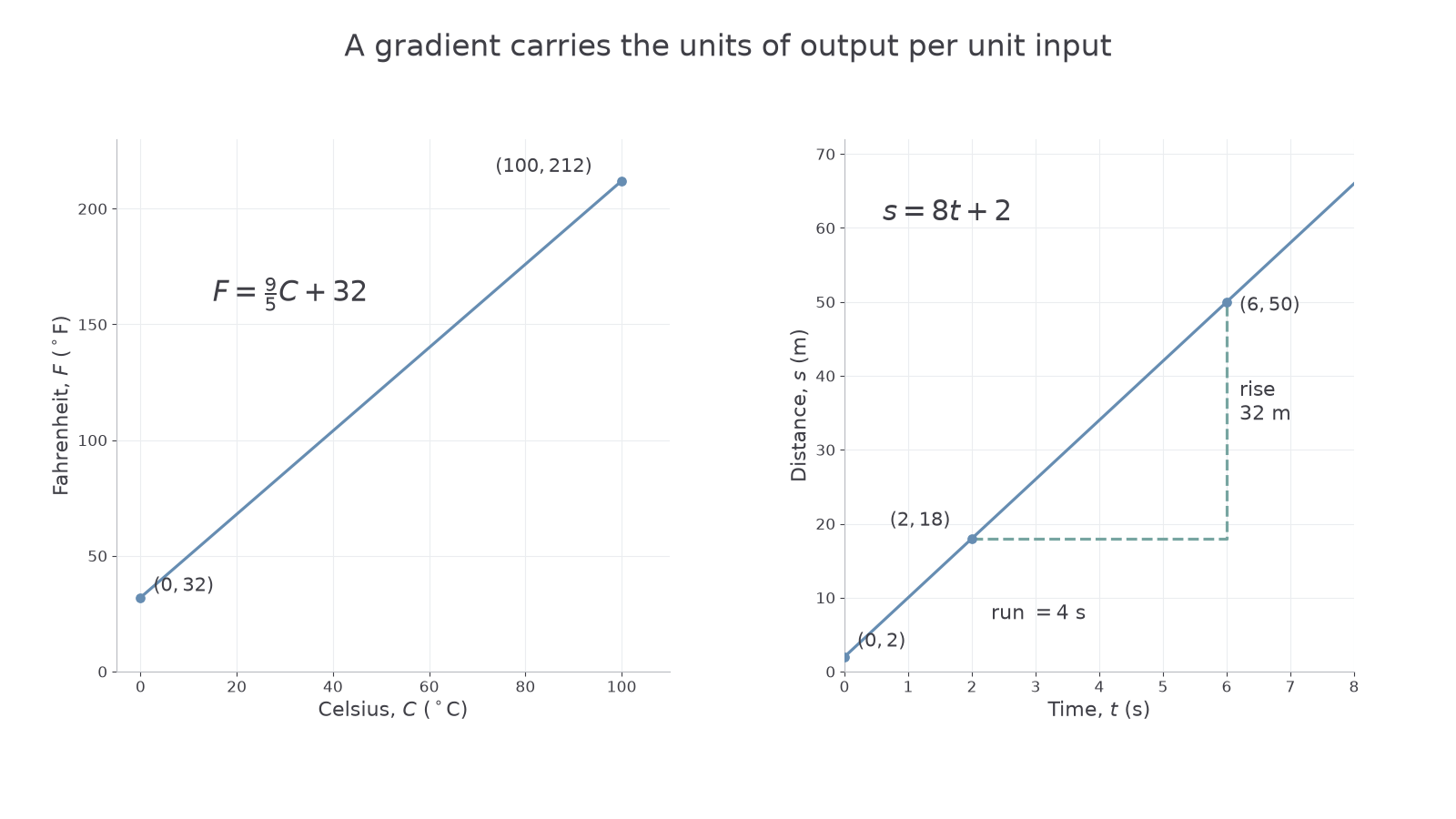
Worked example 7: fitting a sensor model
Question. Model the sensor readings above as . Interpret .
Plan. Divide the output change by the temperature change, then use one reading for .
Why this step? The intercept must be found from a point; it is not the first measured voltage unless its temperature is zero.
Answer. . The voltage rises by per , under the model.
Check. At , . The readings support use between and .
Change only the second voltage, to . The intercept must be recalculated as well as the gradient.
Worked example 8: a changed calibration reading
Question. Fit through and , and predict at .
Plan. Fit both constants, then interpolate inside the measured interval.
Why this step? A new rate through a fixed measured point usually changes the intercept too.
Answer. , predicting .
Check. is halfway between and ; is halfway between and .
The earlier distance model , with in metres and in seconds, gives constant speed and initial distance . In contrast, readings and give : use it over the observed interval, because its negative prediction at cannot be a distance.
Watch out
Wrong: “Two correct predictions prove the sensor is linear at every temperature.” Right: the line fits the readings; extending beyond the measured range requires additional evidence. This extension is extrapolation.
Change only the second calibration voltage again; the prediction is still an interpolation.
Choosing the method
The information in a problem tells you where to begin. Two points determine a direction; a perpendicular condition changes that direction; a supplied point locates the required line.
For , , the line has gradient . A perpendicular through therefore has gradient , giving , or . The point belongs to the new line; the direction comes from the old one.
| Given information | First mathematical decision |
|---|---|
| A point and a gradient | Use point-gradient form |
| Two distinct points | Find the gradient, or recognise a vertical line |
| A parallel or perpendicular condition | Obtain the given gradient before choosing the new one |
| A conversion model and equal readings | Set the two measured numbers equal and solve |
The opening puzzle uses the last row. A linear conversion through and has gradient , so
At equal readings set :
The surprising fact is that and are the same temperature. The algebra verifies it: . Unlike a sensor extrapolation, this follows from the conversion rule itself.
Key idea
Choose a starting equation from the information you actually have, then check that the result satisfies every condition in the question.
A useful check can catch a wrong choice before the algebra becomes long. Decide which line below has the first error.
Quick Recap
- Read gradient and intercept after rearranging to .
- Use two points for the gradient, then one point in .
- Parallel gradients agree; perpendicular finite gradients multiply to , with horizontal/vertical cases handled directly.
- Interpret a model's rate, intercept and valid range in context.
The Celsius and Fahrenheit readings agree at , found by intersecting the conversion line with .