Pure 10.5 - Vectors in pure mathematics and context
Vectors turn geometric statements and directed quantities into equations. You will find missing vertices, divide segments, establish collinearity, combine displacements and forces, and solve problems that need more than one vector route. The central choice is which directed journeys the wording makes equal or parallel.
Translate the problem into vectors
Three consecutive corners of a parallelogram are , and . Where is the missing corner? A sketch suggests it is left of , but an accurate answer needs the directed side relation. We will turn that picture into an equation.
You already know
A displacement is finish minus start: . Nonzero vectors are parallel when one is a nonzero scalar multiple of the other. Magnitude gives a scalar length.
Before calculating, translate the geometric information. Equal directed sides mean equal vectors; parallel sides mean scalar multiples; a resultant means a sum.
| Information | A useful vector statement |
|---|---|
| Travel from to | |
| Travel to , then to | |
| Same direction and same length | Equal vectors |
| Parallel nonzero movements | One is a nonzero scalar multiple of the other |
| Forces in equilibrium | Their vector sum is |
For example, with and ,
Adding the two position vectors would answer a different question. Equally, given directed sides and , subtracting them would fail to follow the route to .
Key idea
Write the directed route or geometric relation before substituting components. The equation carries the meaning of the problem.
Choose a relation whose arrows actually connect.
Find the fourth corner of a parallelogram
Consecutive vertices , , , identify which opposite sides have equal directed movements: . That condition determines the missing position.
[DIAGRAM: asset_slug: p1_10_5_use_vectors_to_solve_problems_in_pure_mathematics_and_in_context__diagram_01; asset_name: Equal directed sides of a parallelogram; caption: AD and BC have the same direction and length; description: A non-rectangular parallelogram ABCD with position arrows from O and equal directed side arrows AD and BC, showing d minus a equals c minus b]
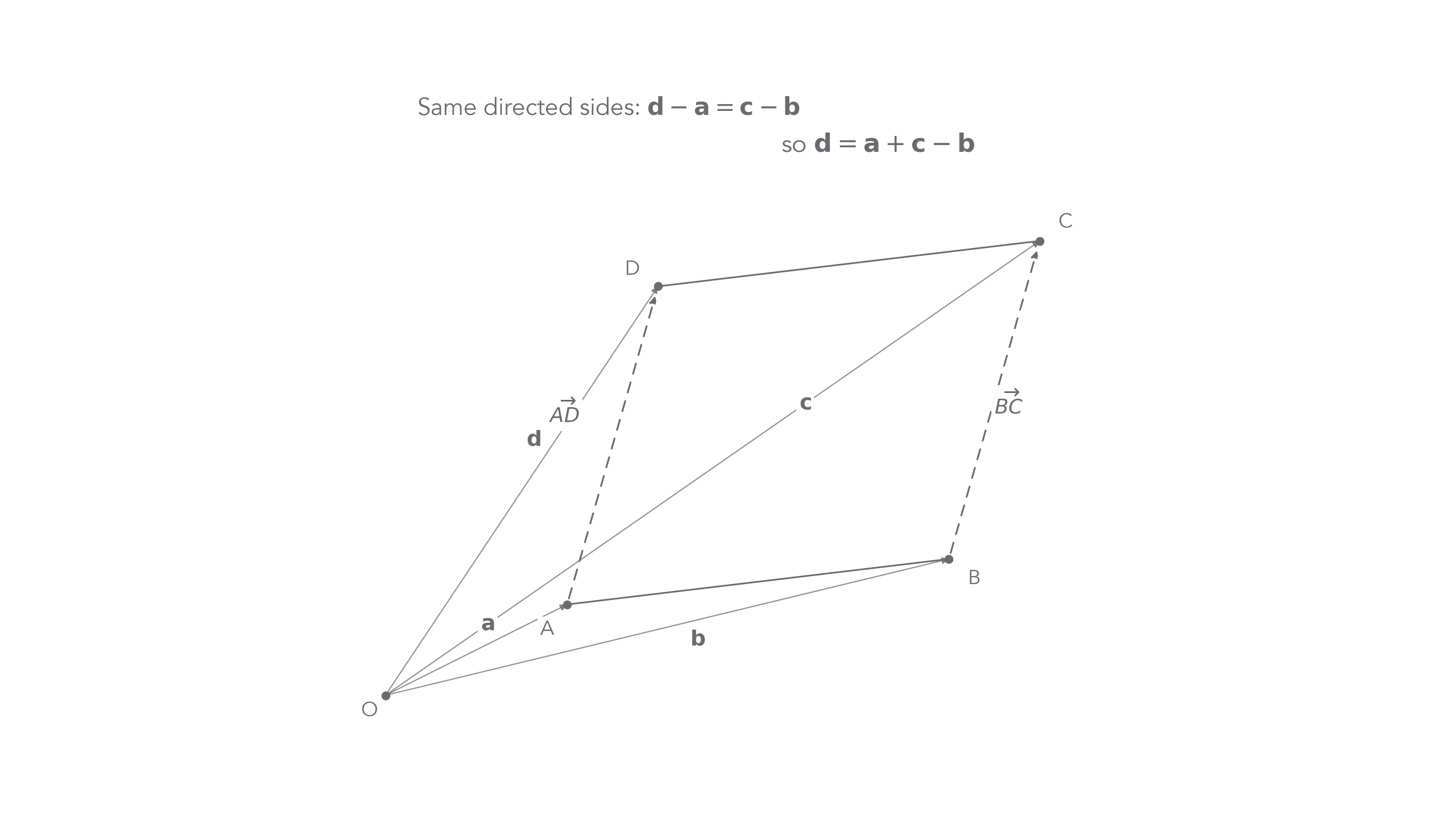
Subtract positions on each side: . Add to isolate the missing position vector.
Fourth consecutive vertex
For a parallelogram with vertices , , , in that order,
All positions refer to the same origin. The order of the vertices is essential.
Not in the formula booklet: learn it.
Use equal directed sides as your starting equation if the vertex lettering is unfamiliar.
Worked example 1: finding the missing position
Question. The consecutive parallelogram vertices , , , have , , . Find .
Plan. Equate and , then collect components.
Why this step? and are opposite vertices, so they are the positions added; is subtracted.
Answer. .
Check. . This answers the opening question: .
Change only the horizontal coordinate of from seven to six. The missing vertex shifts right by one.
Worked example 2: a zero component in the missing position
Question. The consecutive vertices have , , . Find .
Plan. Use the same side equation with the revised position of .
Why this step? A zero component is a valid position, not a missing piece of information.
Answer. .
Check. .
Here is a surprising reason to read “consecutive” carefully. Three distinct non-collinear points, with no vertex order given, allow three possible fourth corners. Their possible position vectors are , , and . For the opening points, these give fourth-corner coordinates , , and , respectively. The stated order selects the first.
Watch out
Wrong: “The missing corner is always the sum of two given positions minus the third, in any order.” Right: first identify opposite vertices or equal directed sides. Different orders describe different parallelograms.
Use the vertex order to identify the right sum in this check.
Divide a segment in a ratio
If and is inside segment , then lies two parts out of five along the journey from to . Start at , then add .
[DIAGRAM: asset_slug: p1_10_5_use_vectors_to_solve_problems_in_pure_mathematics_and_in_context__diagram_02; asset_name: Internal division of a segment; caption: Two parts out of five means two fifths of AB from A; description: A line segment AB with P two fifths of the way along it, AP labelled 2 parts and PB labelled 3 parts, with p equals a plus two fifths of b minus a]
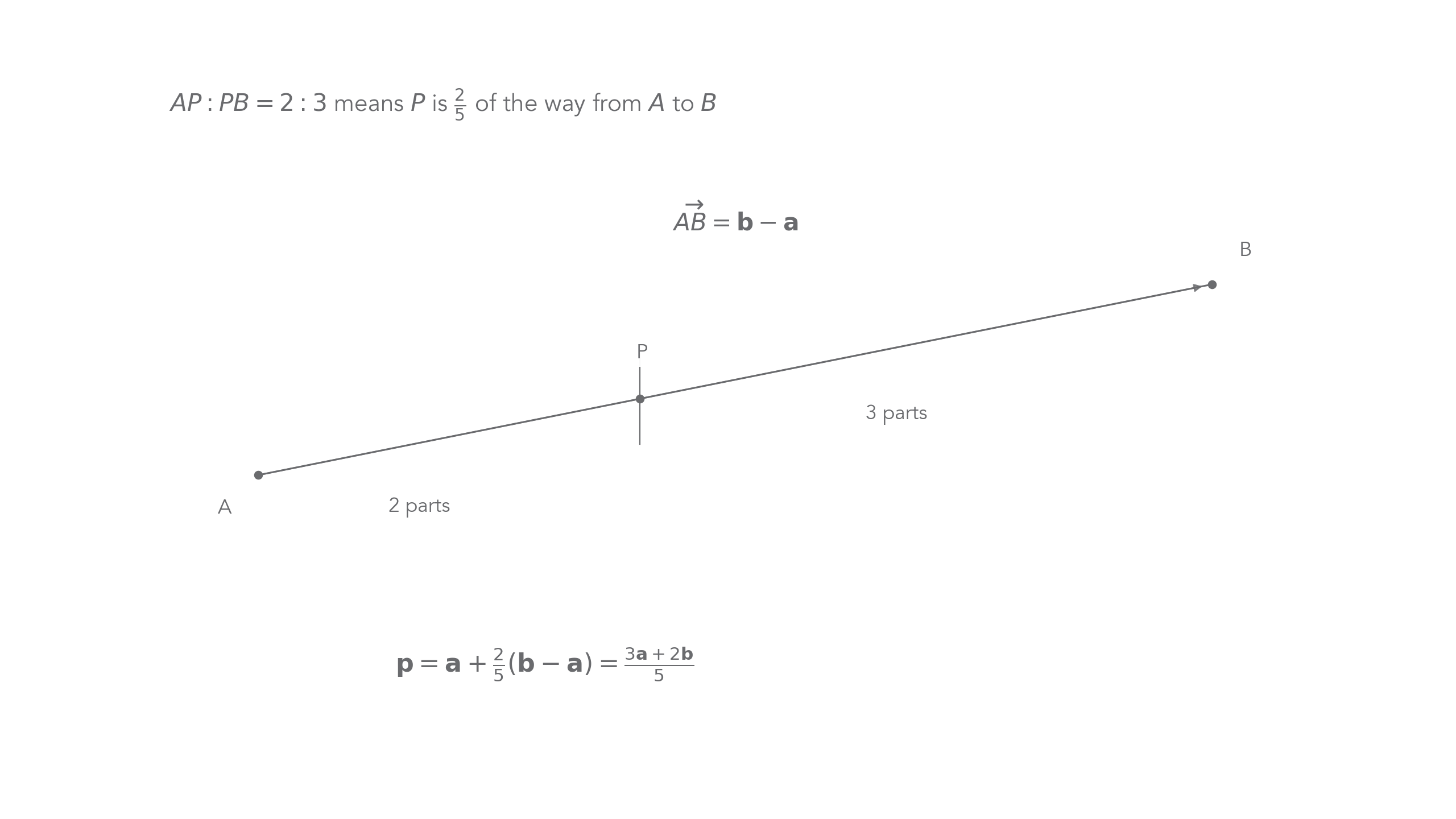
The movement form explains the weights in the usual formula.
Internal division
If divides internally with , where ,
Not in the formula booklet: learn it.
The weight next to is , rather than , because the point is reached by moving parts from .
Worked example 3: internal division
Question. Given , , find when divides internally with .
Plan. Move two fifths of the full displacement from .
Why this step? The fraction describes a movement from ; multiplying alone by would start from the origin instead.
Answer. .
Check. and , so their lengths have ratio .
Remove only the word “internally” in the next example. A ratio of lengths on the whole line can also allow an external point.
Worked example 4: a ratio on the whole line
Question. With , , point lies on the line through and and satisfies . Find all possible .
Plan. Write the movement as and use lengths, allowing either direction.
Then , while . Since , their common nonzero length factor cancels:
For , the preceding calculation gives . For ,
Why this step? Lengths are non-negative, so the ratio contains absolute values. A negative represents a point beyond , opposite to .
Answer. or .
Check. For the external point, and ; the lengths still have ratio .
For internal division, . Beyond , ; beyond , . These conditions come from the picture of a directed journey, without needing a new formula.
Watch out
Wrong: “ makes .” Internally, the total has five parts, so . Also check whether the point is on the segment or anywhere on the line.
Use the same full-line reasoning with new endpoints and a reversed ratio.
Use parallel and collinear vectors
Vectors can be parallel wherever their arrows are placed. To prove points are on the same straight line, use displacement vectors that start from a common point.
Collinear points
Points are collinear when they lie on one straight line. For distinct and , a point is on their line exactly when for some real . Here gives ; a distinct third point needs .
For example, establishes parallel vectors. To establish collinearity, first form the appropriate displacements from the point positions.
Worked example 5: an unknown coordinate on a line
Question. Points have position vectors , , . Given that they are collinear, find .
Plan. Form and , find their scalar multiple from a known component, and use it in the unknown component.
Why this step? A scalar multiple of describes points on the line through , whereas a multiple of alone describes a line through .
Answer. .
Check. The third component also agrees: . Thus in all three components.
Change only the final coordinate of from ten to eleven. Now a matching middle coordinate cannot repair the third-component failure.
Worked example 6: checking consistency in space
Question. Keep , , but take . Determine whether any makes the points collinear.
Plan. Check the two known component comparisons before solving for the unknown.
Why this step? Collinearity needs one scalar for every component; there is no freedom in that can change the failed third equation.
Answer. No value of makes the points collinear.
Check. Even matches only the first two components, leaving the third inconsistent.
For another valid spatial example, positions , , give displacements and . The factor two gives , with both other components checked.
Watch out
Wrong: “The magnitudes have ratio two, so the points are collinear.” Lengths alone give no shared direction. Right: show that the full displacement vectors are scalar multiples.
Test all the known spatial components before finding any unknown.
Continue this lesson.
You’re previewing NovaLearn without an account. Create a free account to read the rest.
Create free account