Pure 9.2 - Iteration, cobweb and staircase diagrams
Build successive approximations to a root, and see the same calculation as a path between a curve and a diagonal. You will rearrange equations, calculate accurately, draw iteration paths and judge whether they approach a fixed point.
Fixed points and iteration formulas
Can pressing the same calculator instruction repeatedly solve ? Start with , apply , and the next value is . Feeding that result back gives . The input and output are beginning to chase a common value.
You already know
A recurrence defines each new term from previous terms. A root of is an input making the original expression zero; rearranging an equation must preserve its domain and the required branch of a root.
We use for the repeated instruction, keeping it distinct from the original equation .
Fixed point
A fixed point of satisfies . For example, is fixed by , whereas is not.
If the sequence settles, its next value and current value tend to the same number.
Fixed-point iteration
If and is continuous at , then . The rearrangement must also make this a solution of the original equation.
Not in the formula booklet: learn it.
A valid rearrangement gives a possible target, but does not guarantee that repeated substitution will reach it.
Worked example 1: selecting the positive root
Question. Rearrange into an iteration for its positive root.
Plan. Collect the terms containing , then take the positive square root.
Why this step? The positive square root matches the requested positive solution; it is not a rearrangement covering negative solutions.
Answer. Use , with a suitable positive starting value.
Check. Squaring a positive fixed point and multiplying by returns .
Change only the constant from to . The domain and branch decision stay the same.
Worked example 2: varying the constant
Question. Form an iteration for the positive root of .
Plan. Isolate in the same way.
Why this step? A positive input makes the denominator positive and produces a positive next input.
Answer. .
Check. A fixed point satisfies , precisely the original equation.
Taking a cube root has no positive/negative branch choice for real inputs. For example, gives . The same rearrange-and-check principle applies.
Watch out
Wrong: a correct fixed-point equation proves convergence. Right: it identifies what a convergent sequence could approach. Inspect the actual iterates or graph before claiming success.
For your turn, change only the constant from to , preserving the positive-root decision.
Calculating the sequence
Use each unrounded answer as the next input. A displayed table can show rounded values, but its next row must come from the stored value. Also follow the given indexing: a start labelled differs from a start labelled .
Worked example 3: repeated substitution
Question. Use , with , to calculate , and an approximate positive root to three decimal places.
Plan. Store each output and continue until the displayed values settle.
Continuing gives , , and . Later, and .
Why this step? Alternating values can still converge; the size of the movement matters.
Answer. The calculation suggests a root of to three decimal places.
Check. Substituting into gives about , close to zero. This is a sense-check, not an accuracy proof.
Keep the same instruction and change only the constant to . Retaining all stored digits matters just as much.
Worked example 4: a second iteration table
Question. Use , with , to find , to four decimal places and the apparent limit to three decimal places.
Plan. Iterate with full precision, rounding only the requested outputs.
Continuing gives , , and eventually .
Why this step? Two early values need not be close to the limit, even when the recurrence ultimately converges.
Answer. , ; the apparent limit is to three decimal places.
Check. and round differently to three decimal places, so stopping at would be premature.
The word “apparent” keeps the evidence honest: a finite list is evidence of convergence rather than a general proof.
Exam tip
If asked for and , give those iterates. A calculator's final root does not replace the requested intermediate values.
The cube-root rule above, with , gives , , eventually . For your turn use the square-root rule, changing only its constant to .
Drawing the iteration on a graph
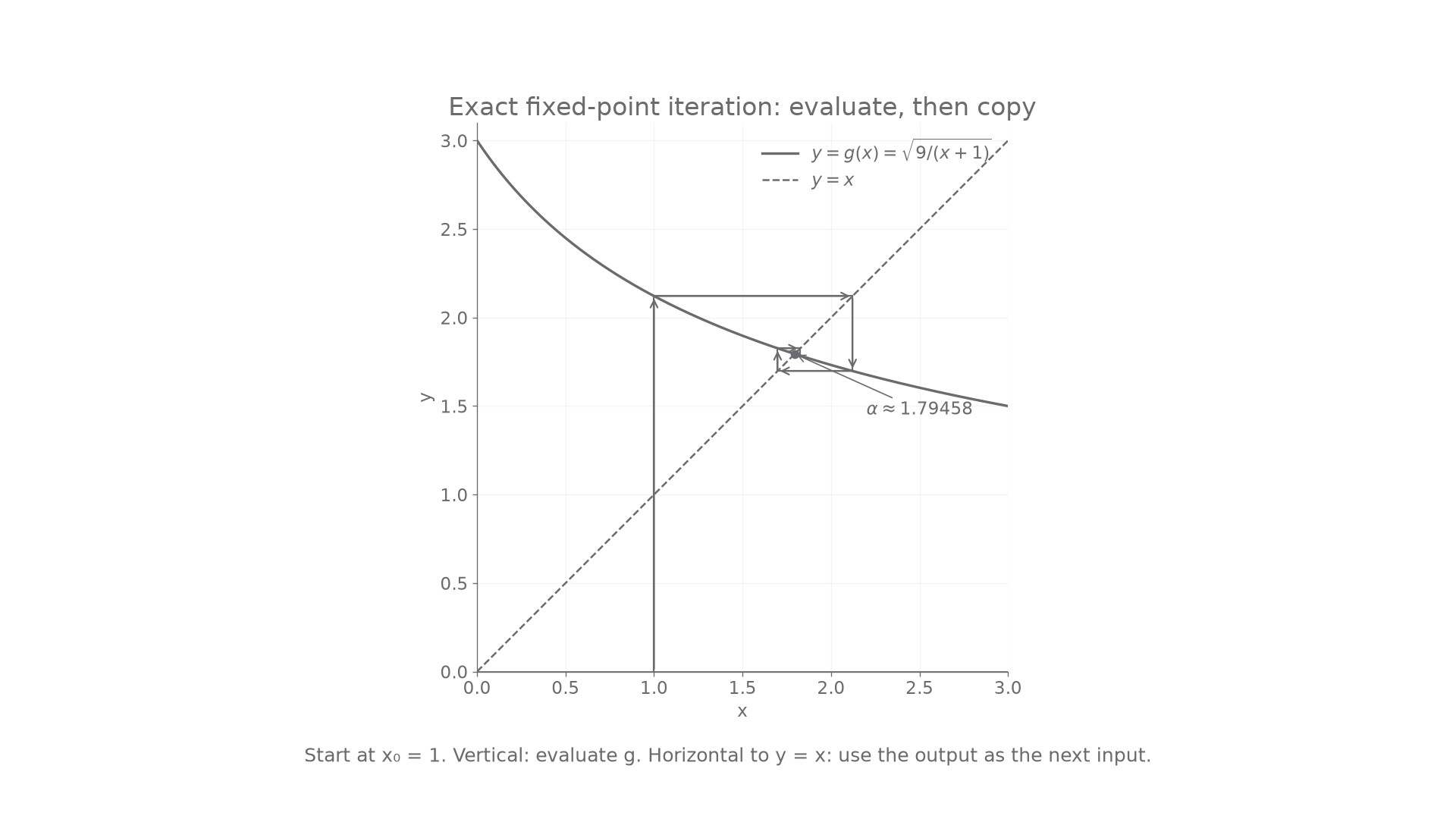
Draw both and . Their intersection is : input and output agree there. Starting on the -axis, move vertically to the curve to evaluate the function, then horizontally to the diagonal to copy that output into the next input.
[DIAGRAM: asset_slug: p1_9_2_solve_equations_approximately_using_iterative_methods_and_draw_associated_cobweb_and_staircase_diagrams__diagram_01; asset_name: Evaluating and copying an iterate; caption: Vertical moves evaluate g; horizontal moves copy the output onto y equals x; description: The curve g(x)=sqrt(9/(x+1)) and the diagonal y=x have fixed point approximately 1.79458. Four evaluate-then-copy pairs start at x0=1 on equal coordinate scales.]
Continue this lesson.
You’re previewing NovaLearn without an account. Create a free account to read the rest.
Create free account