Pure 10.1 - Vectors in two and three dimensions
A vector records a movement, including its direction. You will read and translate column vectors and unit-vector notation in two and three dimensions, keep zero components in their proper places, and use equality of vectors to find unknown components. A reliable order for the components makes all the later vector algebra possible.
Vectors as directed components
Can the same vector start at two different places? Imagine moving a counter four squares right and three squares up. Starting at the origin takes you to ; starting at takes you to . The endpoints differ, but the instructions are identical.
You already know
On Cartesian axes, positive is right and positive is up. A negative coordinate change means movement in the opposite direction.
The movement is described by a column with the horizontal change above the vertical change. It describes the change, rather than the final coordinates.
Vector
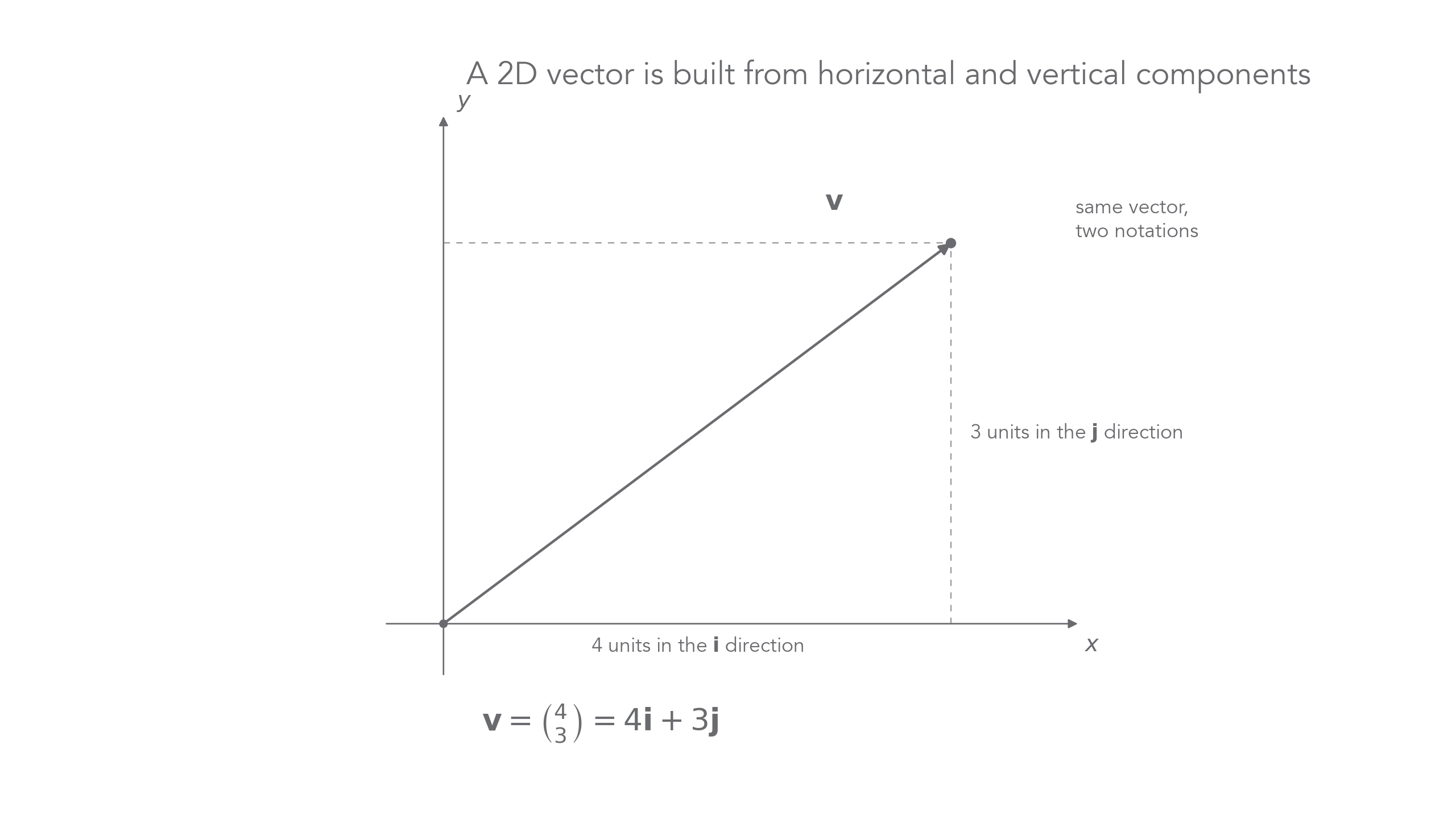
A vector has magnitude and direction. Its Cartesian components are its signed changes along the coordinate axes. For example, means four units right and three up. A length of five units alone is a scalar, not a vector: it gives no direction.
The arrow in the picture joins the start directly to the finish; the dashed guides show its two components.
[DIAGRAM: asset_slug: p1_10_1_use_vectors_in_two_and_three_dimensions__diagram_01; asset_name: Horizontal and vertical components of a vector; caption: Four units right and three units up give one directed movement; description: Cartesian axes with a vector from the origin to (4, 3), dashed component guides, horizontal component 4 and vertical component 3, and equivalent column and unit-vector notation]
For , the negative first component means two units left, while the positive second component means five units up. Changing just the first sign gives , which points in a different direction.
Here is a useful surprise: you can draw infinitely many equal arrows. For any starting point , the arrow ending at still has components . Its location changes; its magnitude and direction do not.
Key idea
Equal vectors have the same signed movement, even when their arrows start at different points.
Use that distinction to decide whether an arrow's location matters.
Unit-vector notation in two dimensions
A one-unit movement right is , and a one-unit movement up is . Combining multiples of these basic movements gives another way to write a column vector.
Coordinate unit vectors
The standard unit vectors in two dimensions are and . Each has magnitude one and points along its positive coordinate axis.
For example, means five units right and two down, so it is . The letters identify the directions; their coefficients give the signed amounts.
Two-dimensional component notation
For real components and ,
Not in the formula booklet: learn it.
Keep the components in the same order when you translate.
Worked example 1: translating a column vector
Question. Write in unit-vector notation.
Plan. Attach the first component to and the second to .
Why this step? The first component is horizontal, so its coefficient belongs to , regardless of its sign.
Answer. .
Check. Both forms describe three units left and seven up.
Change only the sign of the vertical component in the next example. Both directions are now negative, but their positions do not swap.
Worked example 2: two negative components
Question. Write in unit-vector notation.
Plan. Match each signed component to its axis.
Why this step? A negative vertical component is a negative coefficient of , not a reason to reverse the component order.
Answer. .
Check. Converting back gives first component , second component .
A column vector contains the numerical components; the unit vectors sit outside it.
Watch out
Wrong: . Right: . The row positions already identify the axes.
Try the same translation with a different horizontal component.
Three-dimensional vectors
A lift can move vertically while a trolley moves across a floor. To record movement through space, add a third perpendicular direction: the -direction, represented by .
Three-dimensional components
In three dimensions, , and are unit vectors along the positive -, - and -axes. A column lists components in that order: , then , then .
The drawing is a perspective view. The axes are perpendicular in space, even though their projections on the page are not all at right angles.
[DIAGRAM: asset_slug: p1_10_1_use_vectors_in_two_and_three_dimensions__diagram_02; asset_name: Three perpendicular component directions; caption: The third component records movement parallel to the z-axis; description: Perspective axes x, y and z with a vector 2i plus 3j plus k, a three-step component path and clearly separated labels for movement 2 in x, 3 in y and 1 in z]
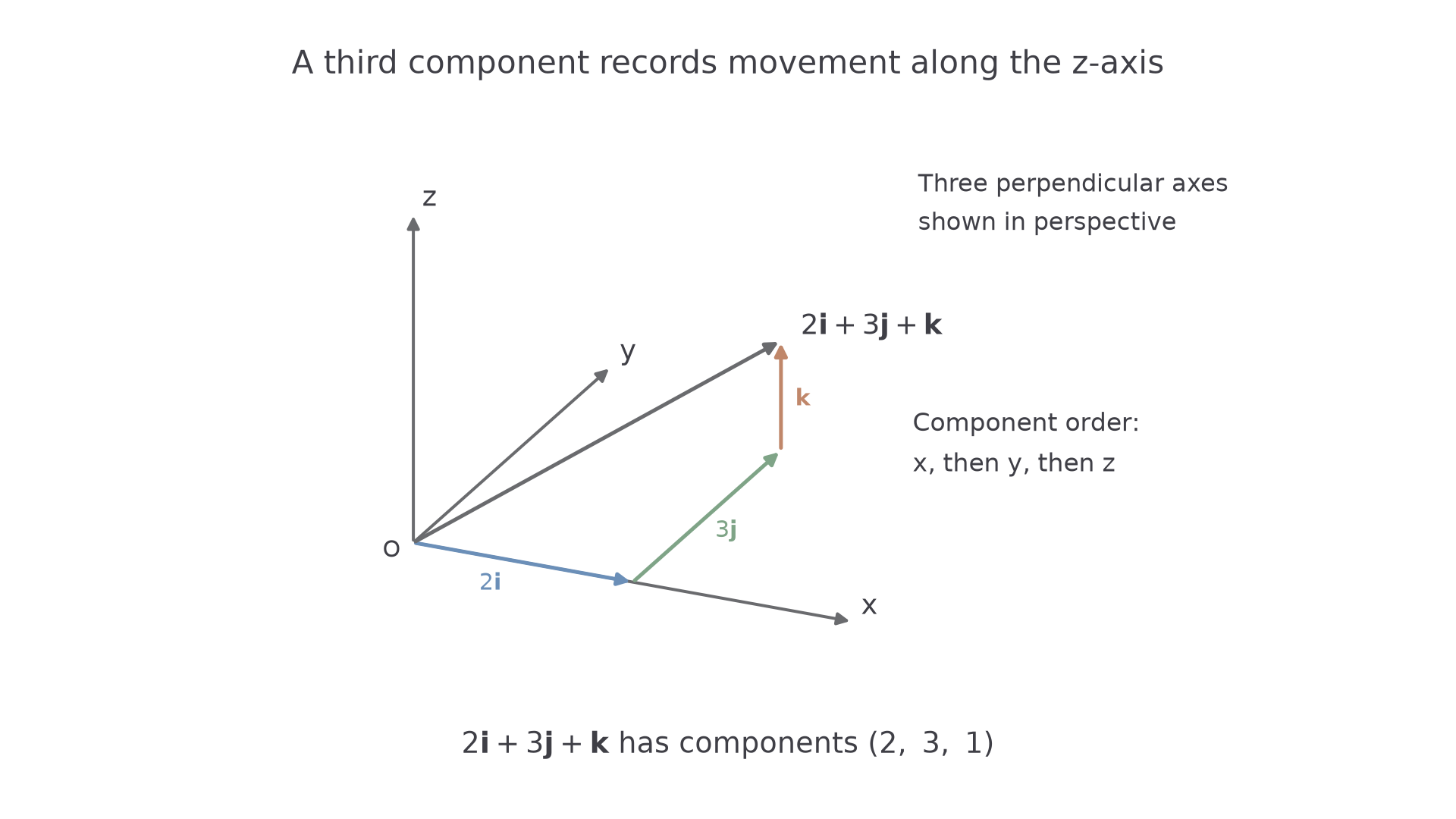
The first two coordinates have not changed their jobs; the third is added after them.
Three-dimensional component notation
For real components , and ,
Not in the formula booklet: learn it.
Translate one component at a time rather than trying to remember a visual pattern of signs.
Continue this lesson.
You’re previewing NovaLearn without an account. Create a free account to read the rest.
Create free account