Mechanics 7.5 - Motion under gravity using vectors
Model a projectile with constant downward acceleration and a shared time for its horizontal and vertical motion. You will derive flight and path results, solve point-passing problems and recognise when launch and landing heights change the equations you need.
Set up the vector model
Can two different launch angles send a ball through the same point at the same launch speed? A low, flat shot and a high, looping shot can both work. We will find the two angles and decide which gives the greater height.
Take horizontally right and vertically upwards. A particle launched with velocity keeps its horizontal component but loses of vertical velocity each second in the usual model.
You already know
For constant acceleration, and . Resolve a launch speed into horizontal and vertical components using cosine and sine.
We model the flight after projection, before any collision with the ground or another object.
Projectile model
A projectile is a particle moving freely under gravity. The ideal model neglects air resistance, spin and size, has no thrust after release, and takes as constant. With upwards positive, .
For launch speed at angle above the horizontal, . The same elapsed time governs both components.
[DIAGRAM: asset_slug: p3_7_5_model_motion_under_gravity_using_vectors__diagram_01; asset_name: Projectile vectors and components; caption: Horizontal motion is uniform while gravity changes vertical velocity; description: A parabolic path has a tangent initial velocity resolved into perpendicular components, a position vector to a later point and a separate downward acceleration arrow.]
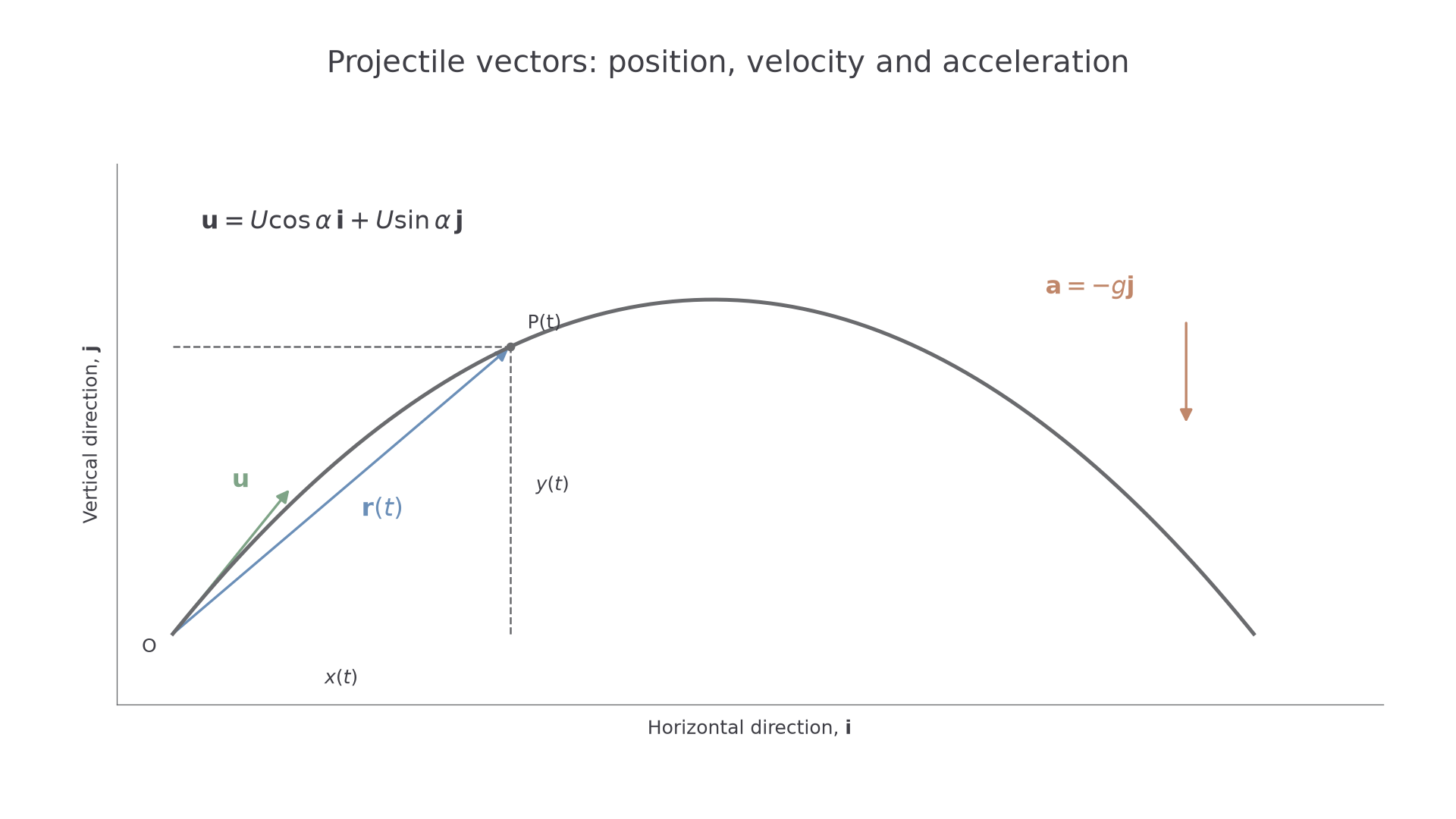
At greatest height only the vertical velocity is zero. A nonvertical projectile still has its horizontal velocity. A useful surprise follows: two particles released at the same height with the same initial vertical velocity reach the same later height at the same time, regardless of their horizontal velocities, under this model.
Key idea
Gravity changes the vertical component; horizontal acceleration is zero. Combine the two motions using one shared time.
Use that distinction at the top of the flight.
Use components without losing the vector
Start with vector SUVAT, then equate components. If the origin is the launch point, the component equations are especially simple.
Projectile position and velocity
These assume constant gravity, no air resistance and launch from the origin at . Add for a different starting position. Not in the formula booklet: learn it.
Use unless the question specifies another value, and keep unrounded values until the final answer.
Worked example 1: position during flight
Question. A particle is projected from with . Using , find its position and vertical velocity at .
Plan. Use horizontal acceleration zero and vertical acceleration .
Answer.
Why is the vertical velocity negative while the height is positive? The particle is descending but has not returned to launch level.
Check. Greatest height occurs at , when horizontal velocity is still .
Change only the requested time to .
Worked example 2: before the top
Question. For the same projectile, find position and vertical velocity at .
Plan. Substitute the new time into the two component functions.
Answer.
Why is the particle rising now? Its vertical velocity is positive, before the top time .
Check. The horizontal displacement is , consistent with constant horizontal velocity.
The height of the top is measured above launch, unless another reference level is specified.
Watch out
At the top, set , not . Both components share the same time even though their accelerations differ.
Change only the time once more.
Derive time of flight, range, and greatest height
The familiar flight time and range assume landing at launch height. Let , with launch and landing on the same horizontal level. Landing has vertical displacement zero:
Reject the launch root , giving . Multiply by constant horizontal velocity for the range:
For greatest height, gives top time . The vertical equation gives .
Flight time, range and greatest height
The and formulae require launch and landing at the same height. is maximum height above launch for an upward launch under the ideal model. Not in the formula booklet: learn it.
A sketch keeps the height reference and range clear.
[DIAGRAM: asset_slug: p3_7_5_model_motion_under_gravity_using_vectors__diagram_02; asset_name: Projectile range, height and path; caption: Same-level flight has a symmetric path; elimination links the components; description: A same-level projectile panel marks range R, maximum height H and zero vertical velocity at the top. A separate panel shows a generic point away from the top and the horizontal-time substitution used to derive the path equation.]
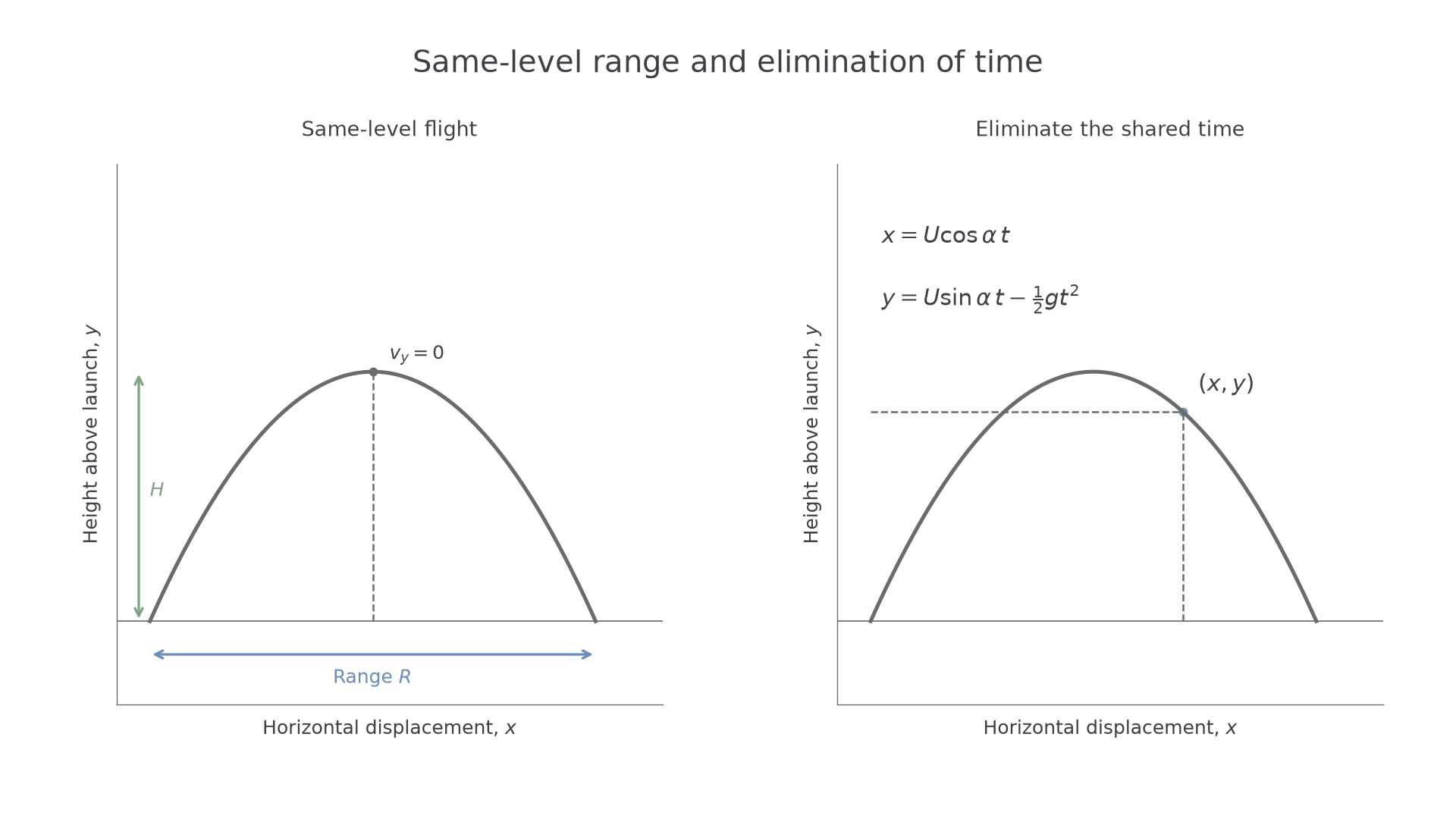
Use the derived results when their conditions hold.
Worked example 3: same-level flight
Question. A projectile is launched from level ground at , with , and lands on that ground. Using , find flight time, range and greatest height.
Plan. Find the cosine, then use the same-level results.
Answer.
Why use horizontal speed for range? Range is horizontal displacement over the flight time.
Check. At , vertical displacement is .
Change only launch speed from to .
Worked example 4: change the speed
Question. With the same angle, level ground and , launch speed is . Find flight time, range and greatest height.
Plan. Use the new horizontal and vertical initial components and .
Answer.
Why do range and height grow more rapidly than flight time? They depend on , while flight time depends on .
Check. The speed scale factor is ; range and height each scale by .
For an exact-value case, and give and . The launch and landing heights must still match.
Continue this lesson.
You’re previewing NovaLearn without an account. Create a free account to read the rest.
Create free account