S1 3.2–S1 3.4 - Conditional probability and independence
Use conditional probability in S1 3.2, independence in S1 3.3, and sum and product laws with Venn diagrams in S1 3.4. Calculate how new information changes a probability and recognise when it leaves the chance unchanged.
Conditioning the sample space
If you learn that a visitor attended workshop B, should you still divide by the number of all visitors? The information changes which visitors remain possible.
Conditional probability
The conditional probability is the probability of given that has occurred. Restrict the sample space to , then find the proportion of that space also in :
The event after the vertical bar supplies the denominator. Conditioning on an event of probability zero is not defined by this rule.
Suppose one of these visitors is selected at random. Each table entry is a count, and the totals include every visitor once.
| Attended B | Did not attend B | Total | |
|---|---|---|---|
| Attended A | 12 | 18 | 30 |
| Did not attend A | 20 | 30 | 50 |
| Total | 32 | 48 | 80 |
The intersection is still “attended both”, but the reference group depends on the information supplied. uses all visitors; uses the who attended B.
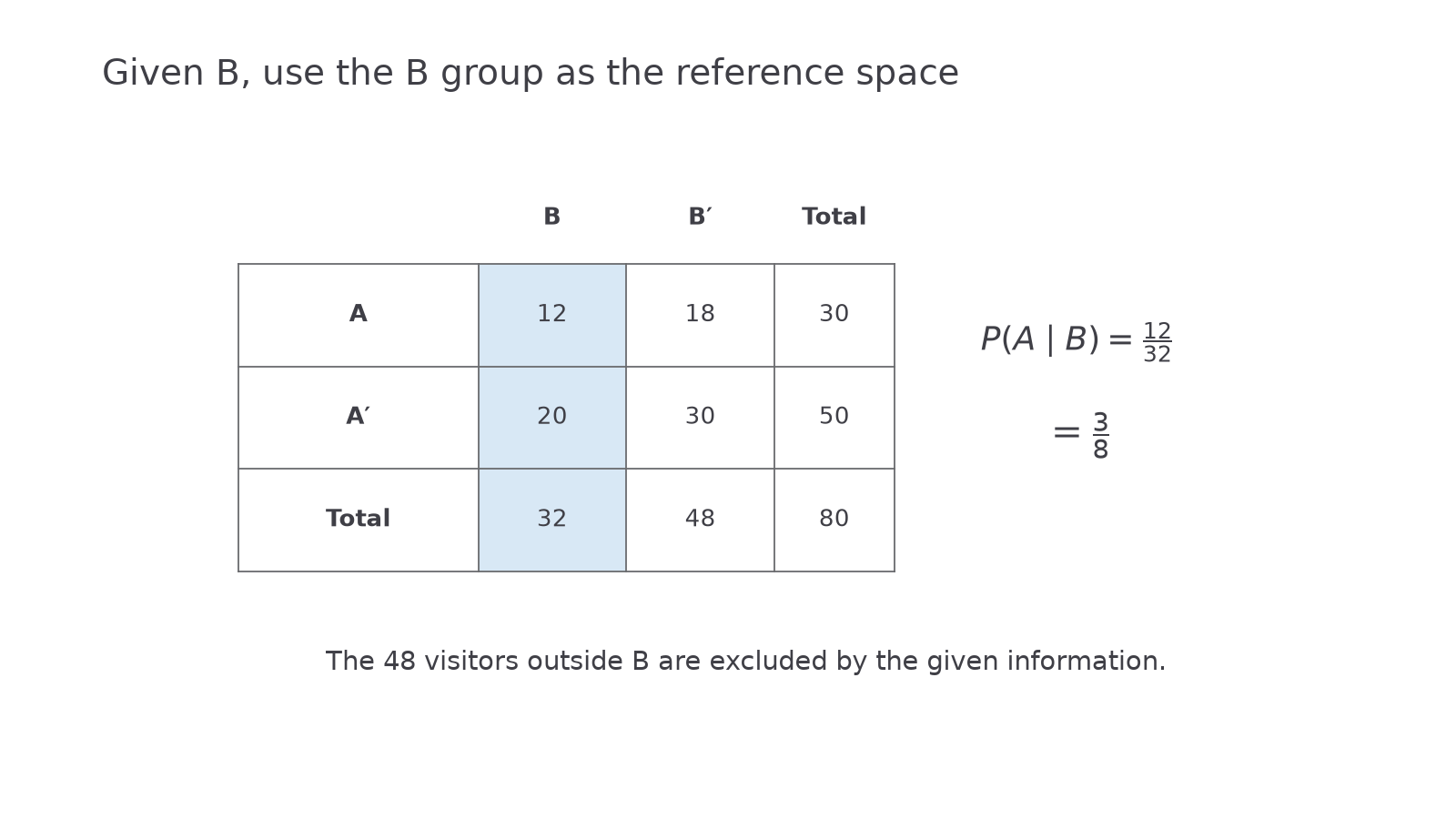
[DIAGRAM: asset_name: Restricting a sample space; asset_slug: conditional-restricted-space; caption: Given B, only the B column remains possible; twelve of its thirty-two visitors also attended A.; description: A two-by-two count table for eighty visitors has cells twelve, eighteen, twenty and thirty. The B column, containing twelve and twenty, is highlighted. A side calculation shows P of A given B equals twelve over thirty-two equals three eighths.]
Worked example 1
Find for the visitors in the table.
Plan. Keep the B column and count its members who also attended A.
Answer. .
Check. Within B, the complementary event A′ has probability ; the two conditional probabilities sum to .
Change only the direction of the question: now the known information is A rather than B.
Worked example 2
For the same visitors, find .
Plan. Keep the A row, whose total is .
Answer. , which differs from .
Check. Using probabilities instead of counts gives . The common original sample size cancels.
The conditional rule follows by rearranging the product rule printed in the S1 formula booklet. A conditional probability is not an instruction to assume independence.
Testing independence
Sometimes the new information leaves the chance unchanged. That is a property of the probability model which must be stated or checked.
Independent events
Events are independent when
For positive conditioning probabilities, equivalent checks are or . These independence identities are expected recall, rather than printed as a separate independence list in the booklet.
Calculate both sides and compare them. Similar-looking event names, different people, or a nonzero intersection do not establish independence.
Worked example 3
Events have , , . Determine whether they are independent.
Plan. Compare the actual intersection with the product of the marginal probabilities.
Answer. A and B are independent.
Check. : knowing B has not changed the probability of A.
Change only the intersection probability, keeping both marginal probabilities fixed.
Worked example 4
Now , while and . Determine whether the events are independent.
Plan. Repeat the comparison using the new joint probability.
Answer. They are not independent.
Check. , different from . All four region probabilities are nonnegative and sum to , so the changed model is possible.
Mutually exclusive events cannot both occur. If both have positive probability, their intersection probability is zero while their product is positive, so they are not independent. Learning that one occurred rules out the other. Independence means no change in probability, not “cannot occur together”.
Sum and product laws
An “and” probability can use a conditional proportion within the first event. An “or” probability must allow for any overlap.
Product and sum laws
For ,
For any two events,
Both laws are printed in the S1 formula booklet. Replace by only when independence is established. Omit the subtraction in the sum law only when the overlap probability is zero.
Continue this lesson.
You’re previewing NovaLearn without an account. Create a free account to read the rest.
Create free account