P1 4.3 - Tangents and normals
Turn a derivative into the equation of a line. Find the tangent gradient at a chosen point, use the point to locate the tangent, and find the perpendicular normal, including the case of a horizontal tangent.
Gradient at a point
A curve and its tangent share a point and a direction there. Is knowing the curve's height enough to find that direction? No: you need the derivative evaluated at the point's input.
For at , the point is , but the tangent gradient comes from , giving . Those two values happen to agree here; they generally do not.
Tangent gradient
For at , the tangent gradient is , provided this derivative exists.
Differentiate before substituting. Substituting into the original equation finds the point's height; substituting into the derivative finds the tangent gradient.
Worked example 1: point and gradient
Question. Find the point and tangent gradient on where .
Plan. Use the original function for , and the derivative for the gradient.
Answer. The point is and the tangent gradient is .
Check. The symmetric chord gradient using is , agreeing with the negative tangent gradient.
Change only the chosen input from to . The curve is the same, but its direction can change.
Worked example 2: a new point on the same curve
Question. Find the point and tangent gradient on where .
Plan. Evaluate the same original function and gradient function at the new input.
Answer. The point is and the tangent gradient is .
Check. The symmetric chord gradient using is , agreeing with . The height is not the gradient.
A gradient is one number at a specified point. Leaving as the final answer has found a gradient function, but has not evaluated the requested gradient.
Watch out
The wrong step is , therefore gradient . The correct step is , therefore gradient . Label the two calculations so they cannot be confused.
Find both pieces of information for a different cubic.
Tangent equations
A gradient fixes a line's direction, and one point fixes which parallel line you need.
If a line has gradient and passes through , then moving from to any other point on it gives . This is the point-gradient form you already use for straight lines.
Tangent equation
At on , with finite derivative ,
Find the point and tangent gradient first, then use them in the straight-line equation.
Not in the formula booklet: learn it.
The line must pass through the actual point on the curve; using the derivative's value as the point's height would usually place it elsewhere.
Worked example 3: locate the tangent
Question. Find an equation of the tangent to at the point where .
Plan. Find the height and derivative at , then use point-gradient form.
Answer. .
Check. The line gives at , and its gradient equals the curve's derivative there. Both required properties hold.
Change only the point's input from to . Recalculate the height as well as the gradient.
Worked example 4: locate a second tangent
Question. Find an equation of the tangent to at the point where .
Plan. Evaluate the curve and derivative at , then form the line.
Answer. .
Check. Substituting gives , and the line's gradient equals . Also, curve minus line is , which is zero at the contact point.
Either point-gradient form or a simplified equivalent equation can describe the line. Keep exact fractions if the gradient is fractional.
Exam tip
Find an equation, not just the gradient. Once you have and , write ; this makes the line-setting method visible even if later arithmetic slips.
Use the same point-and-gradient sequence on a new quadratic.
Normal equations including horizontal tangents
The normal uses the same point as the tangent but runs at right angles to it.
Normal
A normal to a curve at a point is the straight line through that point perpendicular to the tangent there.
For two perpendicular lines with finite, nonzero gradients, their gradients multiply to . Thus a tangent of gradient has a normal of gradient : one line rises steeply while the other falls more gently.
Normal gradient
If the tangent has finite nonzero gradient , the normal gradient is
A horizontal tangent instead has a vertical normal. Through , that normal is , with no finite gradient.
Not in the formula booklet: learn it.
The two cases look different because a vertical line cannot be written as with a finite .
[DIAGRAM: asset_name: Tangents and perpendicular normals; asset_slug: tangent-normal-cases; caption: A sloping tangent has a negative-reciprocal normal gradient; a horizontal tangent has a vertical normal.; description: Equal-scale coordinate panels show the parabola y equals x squared. Left: at one comma one, tangent y equals two x minus one and normal y equals negative one half x plus three halves meet at right angles. Right: at zero comma zero, tangent y equals zero is horizontal and normal x equals zero is vertical.]
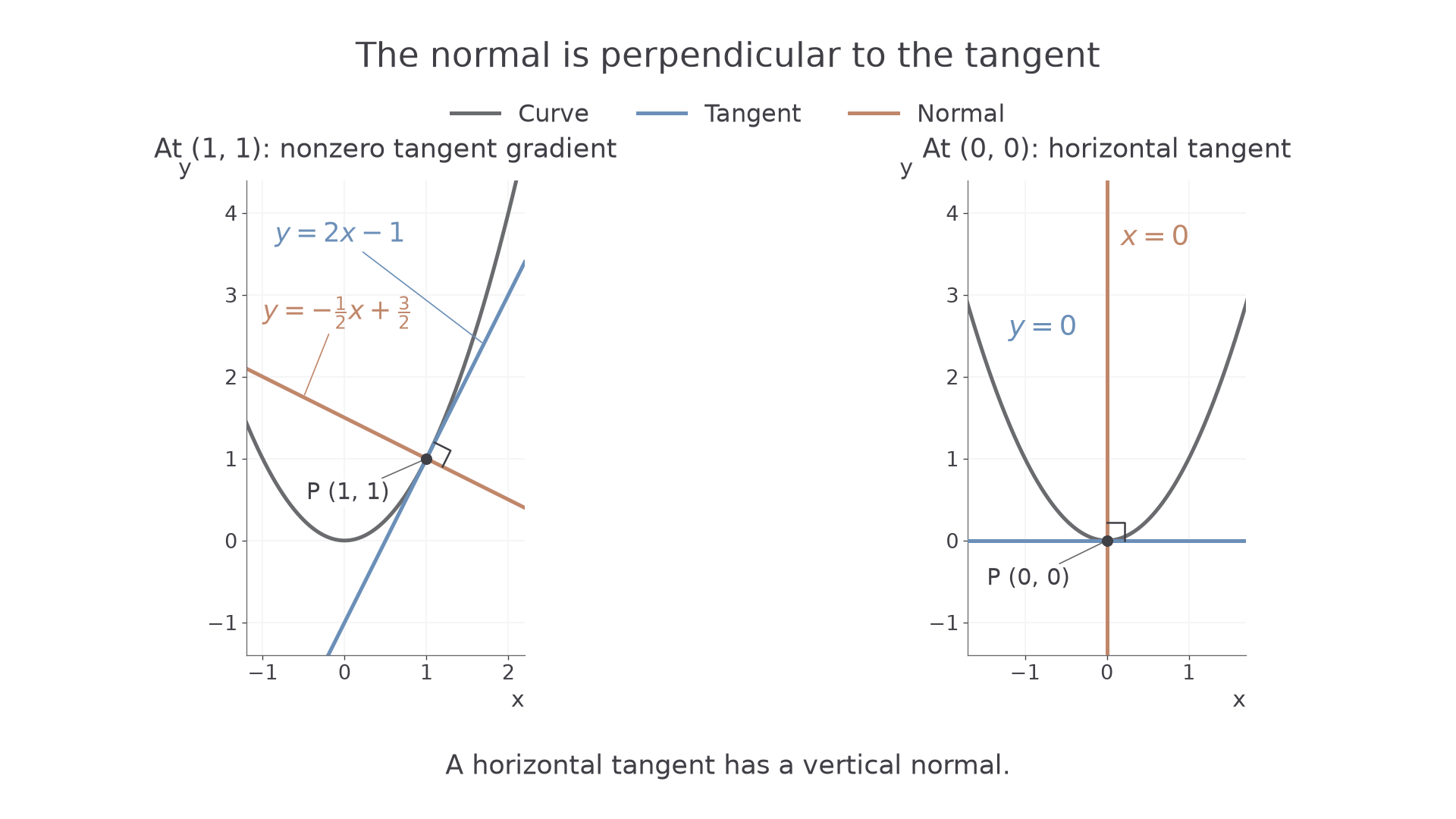
Start with a nonzero tangent gradient.
Worked example 5: a sloping normal
Question. Find an equation of the normal to at the point where .
Plan. Find the tangent gradient, take its negative reciprocal, and use the curve's point.
Answer. .
Check. At , the line gives . Its gradient multiplied by the tangent gradient is , confirming perpendicularity.
Change only the point's input from to . The tangent is now horizontal, so a negative-reciprocal calculation would involve division by zero.
Worked example 6: a vertical normal
Question. Find an equation of the normal to at the point where .
Plan. Evaluate the tangent gradient, then choose the vertical line through the point.
The tangent is . A perpendicular line is vertical, and the vertical line through is
Answer. .
Check. This is the y-axis: it passes through the origin and meets the horizontal tangent at a right angle.
You can now answer the opening question completely. The curve's height locates the point; its derivative fixes the tangent's direction; perpendicularity then fixes the normal's direction.
Watch out
If the tangent gradient is zero, do not write a normal gradient of zero or “infinity”. Write the vertical line's equation . If the gradient is nonzero, change its sign and take its reciprocal; changing only the sign is usually wrong.
Check the horizontal-tangent case on a shifted parabola.
Quick Recap
- Use the original function to find a point's height and the derivative to find its tangent gradient.
- The tangent through is , where .
- A normal passes through the same point and is perpendicular to the tangent.
- Use normal gradient for ; a horizontal tangent at has normal .