P1 2.1, P1 2.2 - Straight-line equations
Use coordinates and direction conditions to determine a straight line exactly. P1 2.1 develops point-gradient and general equations; P1 2.2 supplies the parallel and perpendicular conditions that let you choose the required direction.
Gradient through two points
One point lies on infinitely many straight lines: what extra information chooses just one? A second distinct point fixes the direction, while a gradient can specify that direction directly.
From to , the horizontal change is and the vertical change is . The line rises units for every unit moved to the right. Any right-angled triangle along the same nonvertical line has the same rise-to-run ratio, because the triangles are similar.
Gradient
The gradient of a nonvertical straight line is its change in vertical coordinate divided by its change in horizontal coordinate. Positive gradients rise from left to right; negative gradients fall. A horizontal line has gradient zero.
Use the coordinates in a consistent order.
Gradient through two points
For distinct points and , with ,
Not in the formula booklet: learn it.
The sign is part of the direction, rather than an optional detail.
[DIAGRAM: asset_name: Rise and run for positive and negative gradients; asset_slug: gradient-triangles; caption: The same positive run can give either a positive rise or a negative rise.; description: Two coordinate panels show lines through one comma two and five comma eight, then one comma two and five comma minus four. Right triangles label run four and rises six and minus six, giving gradients three halves and minus three halves.]
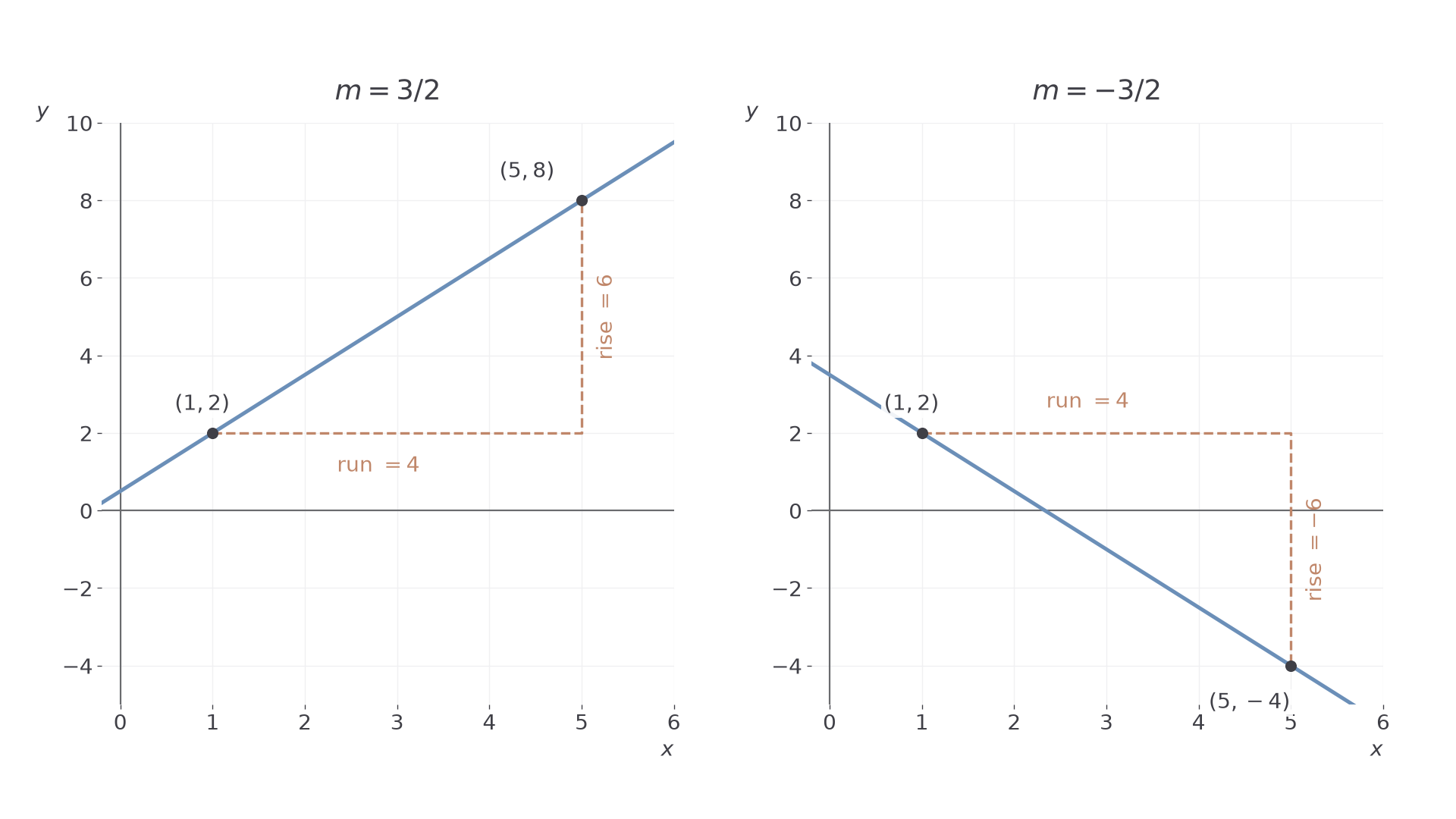
Worked example 1: a rising line
Question. Find the gradient through and .
Plan. Subtract the coordinates of from those of in both numerator and denominator.
Answer. .
Check. A run of at this gradient gives rise , taking height to height .
Change only 's height from to . The run stays , but the rise is now negative.
Worked example 2: a falling line
Question. Find the gradient through and .
Plan. Keep the same coordinate order, including the negative height.
Answer. .
Check. Reverse both subtractions: , the same gradient.
For points with the same horizontal coordinate, the denominator would be zero. Such a line is vertical, has equation , and has no finite gradient. Two identical points do not determine a unique line.
Watch out
Do not reverse only one subtraction. changes the sign and gives the wrong direction.
Read a negative coordinate as a signed value before subtracting.
Point-gradient and general forms
A line's equation says that every point on it has the same rise-to-run relationship with a fixed known point.
If is fixed on the line, its changes to any other point are and . Multiplying the gradient relation by the horizontal change gives . This form also includes the known point itself: both sides are then zero.
Point-gradient equation
A nonvertical line through with gradient has equation
A straight line can also be written in general form
where are constants and are not both zero. General form includes vertical lines, when .
Not in the formula booklet: learn these forms.
In , is the gradient and is the vertical-axis intercept. In general form, the letter is just a constant term; it is not generally the intercept. Equivalent equations can differ by a nonzero overall factor.
Worked example 3: converting to general form
Question. Find the line through and , in the form .
Plan. Calculate the gradient, use either given point in point-gradient form, then clear the fraction and collect terms.
Answer. .
Check. At , . Rearranging gives , confirming the gradient. The other given point also satisfies .
Change only the second point's height, from to . The gradient changes sign; the first point stays fixed.
Worked example 4: a negative gradient
Question. Find the line through and , in general form.
Plan. Calculate the new signed gradient, then use the same point-gradient form.
Answer. .
Check. The point gives ; solving for gives , with the required negative gradient. The second point gives .
For a line through two given points, first calculate its gradient as in Part 1, then use either point here. Check the other point in the final equation: it tests both stages at once.
Watch out
A point with negative horizontal coordinate gives . Preserve the subtraction in the formula before simplifying signs.
Give an equation rather than only a gradient or intercept.
Parallel and perpendicular directions
Parallel lines have the same direction; perpendicular lines meet at a right angle.
Two nonvertical lines with the same gradient have equal rises for every horizontal run. They are parallel if they are distinct; if they also share a point, they are the same line.
For a nonhorizontal line, imagine a direction triangle with horizontal change and vertical change . Rotating its direction through a right angle gives horizontal change and vertical change . The new gradient is . This is why “perpendicular” means a negative reciprocal, rather than just a sign change.
Parallel and perpendicular gradients
For nonvertical lines, parallel directions satisfy
For two nonvertical lines with nonzero gradients, perpendicular directions satisfy
Horizontal and vertical lines are perpendicular to one another; the product rule cannot be used with an undefined vertical gradient.
Not in the formula booklet: learn it.
If the reference line is in general form, isolate before reading its gradient.
Worked example 5: a parallel direction
Question. Find the gradient of a line parallel to .
Plan. Rearrange the given line into , then keep its gradient.
Answer. The parallel gradient is .
Check. Increasing by requires to decrease by to keep constant. This gives .
Change only the direction condition from parallel to perpendicular. The reference line is unchanged.
Worked example 6: a perpendicular direction
Question. Find the gradient of a line perpendicular to .
Plan. Take the negative reciprocal of the reference gradient .
Answer. The perpendicular gradient is .
Check. , as required.
For example, a line perpendicular to is vertical; it cannot be described by setting a finite gradient to the negative reciprocal of zero.
Watch out
The perpendicular gradient to is , not . Change both the sign and the reciprocal; verify the product is .
First identify the reference gradient, then apply the direction condition.
Lines through a point with a direction condition
A point and a direction condition together determine one line, so combine the last two parts in that order: direction first, point second.
A common source of error is to insert the given point into the reference line. That point need not lie on the reference line; it belongs to the new line you are constructing.
Worked example 7: a parallel through a point
Question. Find the equation of the line through parallel to .
Plan. Use the reference gradient , then insert the new point.
Answer. .
Check. gives . Both reference and new line have gradient , but their constant terms differ, so they are distinct parallel lines.
Change only the requirement from parallel to perpendicular. The reference line and new point stay the same.
Worked example 8: a perpendicular through a point
Question. Find the equation of the line through perpendicular to .
Plan. Use gradient , then apply point-gradient form.
Answer. .
Check. gives . The gradients multiply to , checking the direction separately.
For the exceptional directions, write the equation directly: the line through perpendicular to is ; the line through it perpendicular to is .
Problem-solving
Check two independent features in the final equation: does it contain the required point, and does it have the required direction? One check cannot replace the other.
The opening question is now answered: a second point, or an independent direction condition, selects one line through a given point.
Quick Recap
- Gradient is vertical change divided by horizontal change, using a consistent coordinate order.
- Use , then rearrange if general form is requested.
- Parallel directions have equal gradients; perpendicular nonzero finite gradients multiply to .
- Handle horizontal and vertical lines directly and check both point and direction.