P4 6.1 - Volumes of revolution
Find volumes by rotating a region about the x-axis, using either Cartesian or parametric equations. Understand why the radius is squared, how the limits follow the region, and how to keep a physical volume positive and correctly scaled.
Disc slices about the x-axis
If you double the height of a curve and rotate the region beneath it about the x-axis, does the volume double? Think first about a cylinder: doubling its radius makes each circular end four times as large.
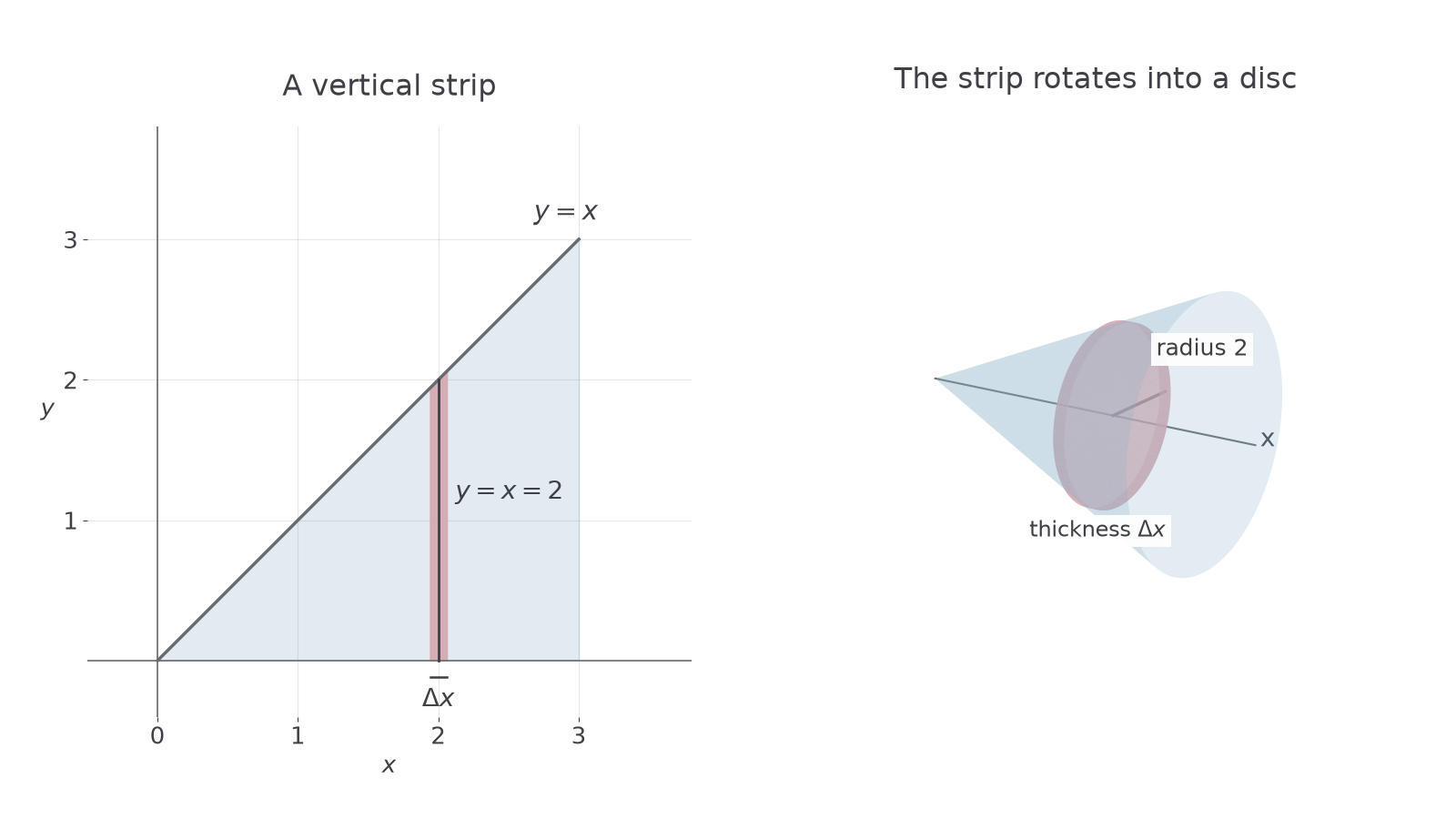
A thin vertical strip between a curve and the x-axis rotates into a thin disc. Its radius is the distance from the curve to the axis, so it is . Its face has area , and its small thickness is . Thus its volume is approximately . Adding increasingly thin discs gives an integral.
[DIAGRAM: asset_name: A strip becomes a disc; asset_slug: p4-volume-disc-slices; caption: A vertical radius becomes a circular cross-section when the region rotates about the x-axis.; description: Left, the region below y equals x from x equals zero to three with a vertical strip at x equals two. Right, the cone generated by rotating the region, with a circular slice at x equals two labelled radius two and thickness delta x.]
Volume about the x-axis
For the region between , the x-axis and , , with ,
Use this for a finite solid with disc cross-sections. Not in the formula booklet: learn it.
The integrand is a cross-sectional area. It is not the area under the original curve.
Worked example 1: a constant radius
Question. Rotate the region between , the x-axis, and through one complete revolution about the x-axis. Find the volume.
Plan. Each slice is a disc of radius ; integrate its constant area along the length.
Answer. cubic units.
Check. The solid is a cylinder, so .
Change the radius from a constant to the function . The cross-sectional area now changes with position.
Worked example 2: a changing radius
Question. Rotate the region between , the x-axis and about the x-axis. Find the volume.
Plan. Use radius on , so each circular face has area .
Answer. cubic units.
Check. This is a cone with radius and height : .
The cone check also explains why using one maximum-radius cylinder would overestimate the volume.
Watch out
misses the square of the radius. Write the disc area before choosing an integration method.
Set up the slices before evaluating this volume.
Cartesian volume integrals
Squaring the radius comes before integration, and it can make a curve simpler or more complicated.
For , the square is . For , it is . For , expand the entire bracket: . Choose an integration method for this squared expression, using the limits of the stated region.
Worked example 3: squaring a sum
Question. Find the volume obtained by rotating the region between , the x-axis, and about the x-axis.
Plan. Expand , then integrate the constant and exponential terms separately.
Answer. cubic units.
Check. Differentiating the antiderivative gives . Also , rather than .
Change only the sign before the exponential. The curve now crosses the axis at , but a negative ordinate still gives a positive disc area.
Worked example 4: a curve below the axis
Question. Rotate the region between , the x-axis, and about the x-axis. Find the volume.
Plan. Square throughout the interval; there is no signed-volume cancellation at .
Answer. cubic units.
Check. The answer is positive, approximately cubic units. The antiderivative differentiates to , so the middle term has the required negative sign.
Each x-position contributes one disc, whether the original region is above or below the axis.
Watch out
. The middle term is . A curve crossing the axis does not require subtracting volumes on the two sides.
Apply the same square-first method with a different constant.
Continue this lesson.
You’re previewing NovaLearn without an account. Create a free account to read the rest.
Create free account