P3 1.4 - Combining graph transformations
Combine familiar graph transformations by tracking inputs, outputs and key points. Use their order to distinguish similar equations, then build transformed trigonometric sketches with exact coordinates and periods.
Order of transformations
Does stretching a graph and then raising it give the same result as raising it and then stretching it? Imagine a point at height : doubling then adding gives , while adding then doubling gives .
The same arithmetic acts on every height of a graph. In , multiply the original output by , then add . In , the added is doubled as well.
You already know
For a point on , maps it to , while maps it to . The first is a vertical stretch of scale factor for ; the second is a vertical translation by .
To describe a sequence, name the original graph, the first transformation and then the second. Brackets show whether a later stretch also scales an earlier shift.
Worked example 1: stretching before translating
Question. Starting with , stretch vertically by scale factor , then translate up . Find the final equation, vertex and image of .
Plan. Multiply each original height by , then add .
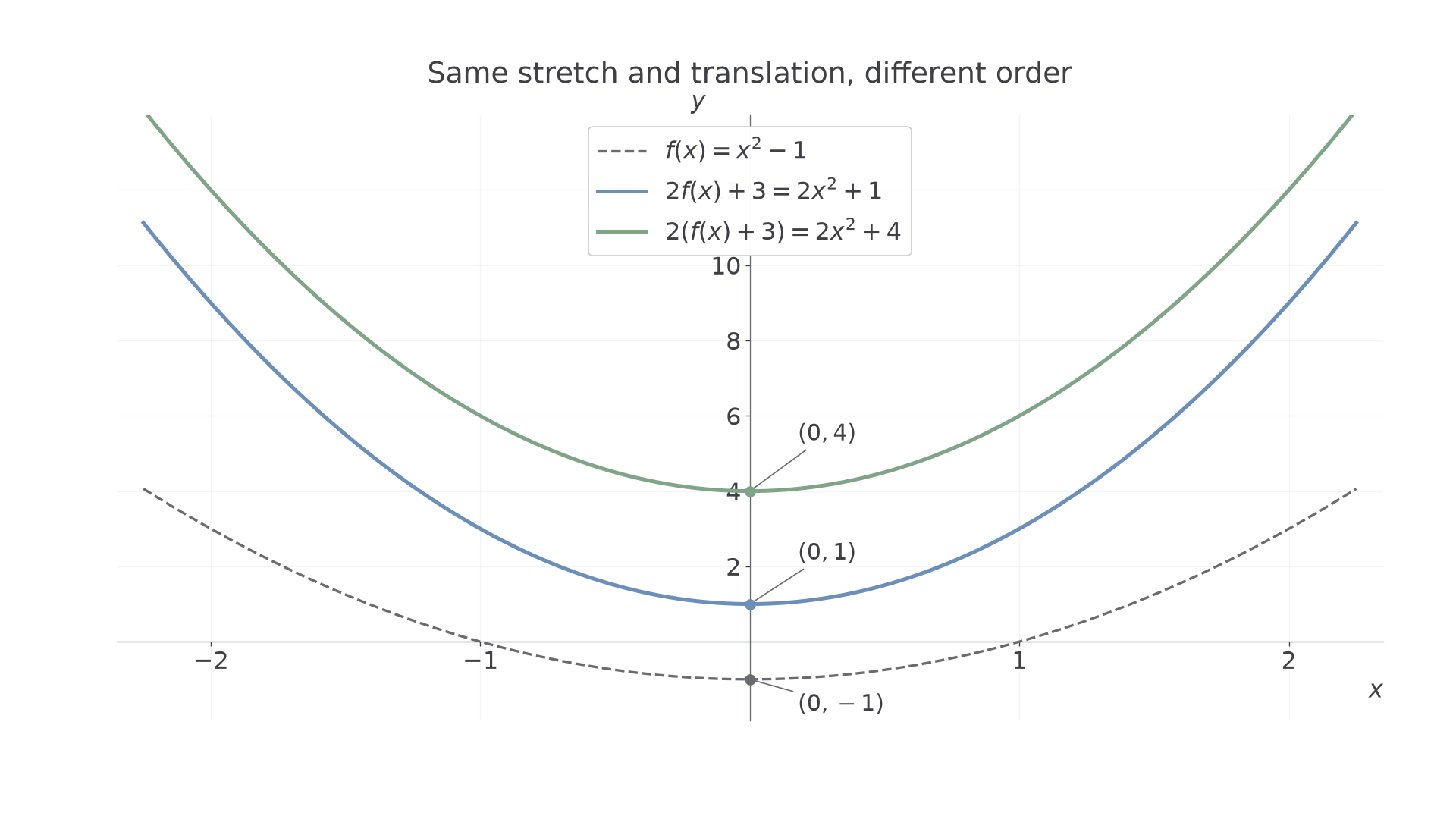
Answer. , vertex , and image point .
Check. Substituting in the final equation gives , agreeing with the point mapping. Its positive square term makes the vertex a minimum.
Change only the order of those same two transformations. The translation is now doubled.
Worked example 2: translating before stretching
Question. Starting with the same , translate up , then stretch vertically by scale factor . Find the final equation, vertex and image of .
Plan. Add inside the output bracket before multiplying by .
Answer. , vertex , and image point .
Check. The final graph is units above the result in Example 1: at every input.
The two final graphs have the same shape but different positions.
[DIAGRAM: asset_name: Why vertical transformation order matters; asset_slug: vertical-order; caption: Reversing a stretch and a translation changes the final vertex.; description: The original dashed parabola y equals x squared minus 1, and the parabolas y equals 2x squared plus 1 and y equals 2x squared plus 4. Vertices (0,negative 1), (0,1) and (0,4) are labelled, together with the equations.]
Watch out
. Expand the bracket or track one original point to test the order. Some transformations commute, but these two generally do not.
Write the equation from the sequence before mapping the point.
Combined horizontal and vertical scales
A multiplier outside a function changes heights directly, while a multiplier inside changes the input needed to reach each original point.
Suppose . For to use that same original input, solve , giving . An outside factor then makes the height . Thus maps to on .
Combining scale factors
For and , a point on maps under as
For positive , the vertical scale factor is and the horizontal scale factor is . A negative factor also supplies a reflection in the appropriate axis.
Not in the formula booklet: learn it.
These horizontal and vertical scalings act on different coordinates, so either order gives this same mapping. A vertical asymptote moves to ; a horizontal asymptote moves to , where those asymptotes exist.
Worked example 3: scaling both coordinates
Question. A graph contains and , and has asymptotes and . Find their images on .
Plan. Divide horizontal coordinates by and multiply vertical coordinates by .
Answer. , , with asymptotes , .
Check. At new input , , so the new output is . The asymptote is reached in the input when approaches , confirming .
Change only the outside factor from to . Horizontal positions are unchanged, while every transformed height is now one quarter of its previous value.
Worked example 4: a vertical contraction
Question. For the same original graph, find the images of and both asymptotes on .
Plan. Keep division of inputs by , but multiply outputs by .
Answer. , , with asymptotes , .
Check. At new input , the original input is , so , agreeing with .
On an unfamiliar sketch, map its labelled vertices, intercepts and other key points, then preserve the shape between them. Use any asymptotes to guide the ends.
Watch out
The factor in gives a horizontal scale factor of , not . Solve “new inside input equals old input” to avoid reversing that factor.
A negative outside factor changes the sign of the height as well as its size.
Translations and reflections
Reflections change the sign of a coordinate; translations then move the reflected or original coordinates by a stated amount.
The equation itself tells you which quantity has been negated. An outside minus sign reverses heights. A minus sign on the input reverses horizontal positions. For example, maps to : reflect in the -axis, then move up .
Continue this lesson.
You’re previewing NovaLearn without an account. Create a free account to read the rest.
Create free account