P2 4.4 - Infinite geometric sums
Understand how infinitely many terms can have a finite total, and recognise exactly when a geometric series has such a sum. Then combine finite and infinite sums to recover an unknown ratio and first term.
Convergence when absolute ratio is below one
Can have a total even though the additions never stop? Its first few partial sums are : they approach , with a smaller gap each time.
An infinite sum is defined by what happens to these partial sums, not by pretending that there is a final term. A negative ratio can work too. For , the partial sums approach from alternate sides.
[DIAGRAM: asset_name: Partial sums approaching a limit; asset_slug: gp-partial-sum-limits; caption: Both positive and negative ratios can produce convergence; ratio minus one does not.; description: Three panels show partial sums for first term 8 and ratios one half, minus one half and minus one. The first approaches 16 from below, the second alternates towards 16 over 3, and the third alternates between 8 and 0 without a limit.]
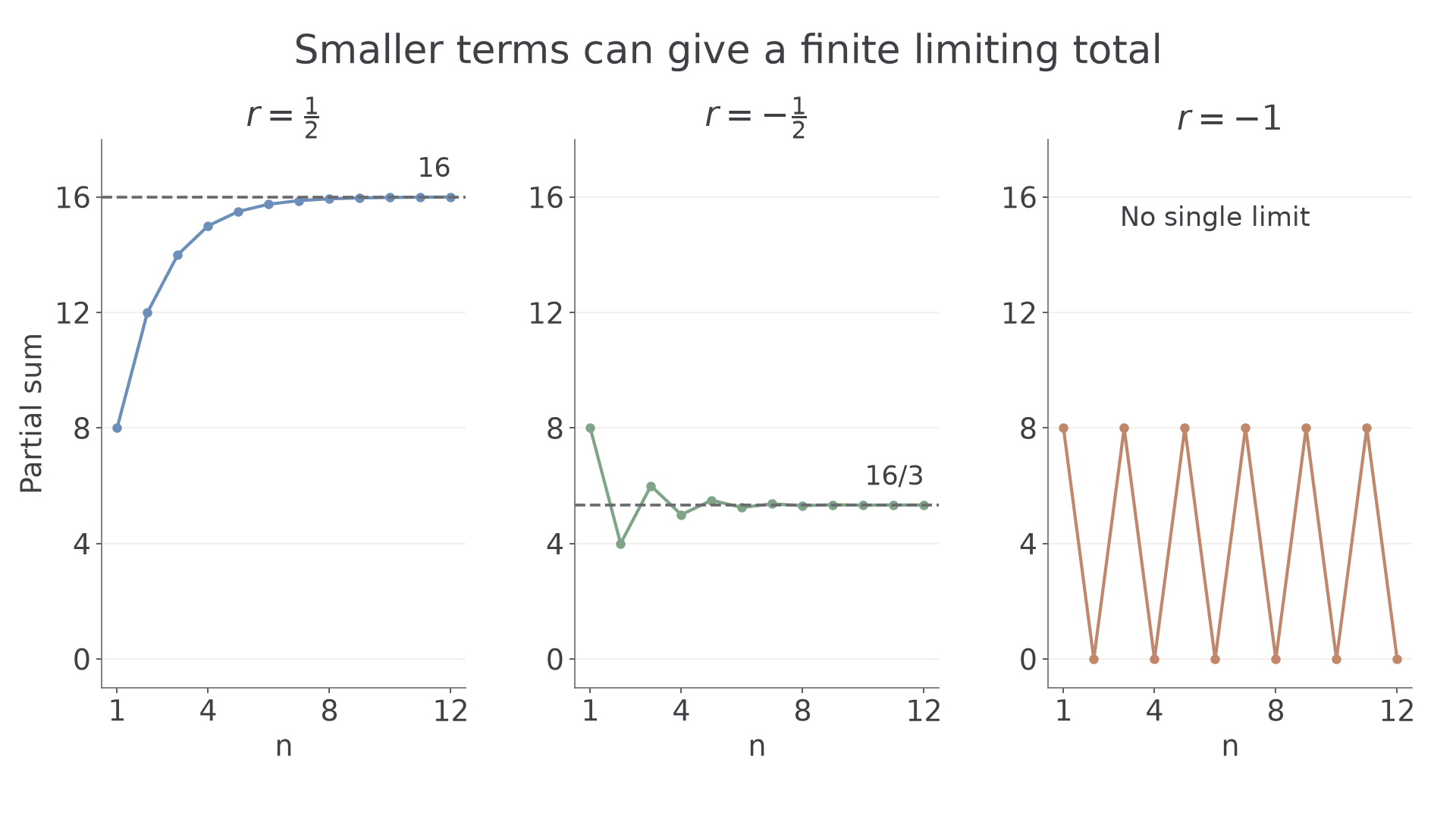
Convergent geometric series
An infinite series converges if its partial sums tend to one finite limit. That limit is its sum to infinity, written .
For a geometric series with nonzero first term, convergence occurs exactly when , or equivalently .
Here is why the magnitude matters. From the finite formula,
When , repeated multiplication makes tend to zero, even if its sign alternates. The partial sums therefore approach a fixed number. Merely having is insufficient: is less than , but its powers grow in magnitude.
The boundaries are excluded. If , then , which does not tend to a finite limit for . If , the sums alternate between and . When , the nonzero terms grow in magnitude, so the sums do not converge. The all-zero series is the harmless exception: its sum is zero.
For , the series is , so the sum is simply .
Key idea
For a nonzero geometric series, check before using a sum-to-infinity formula. Alternating signs alone neither guarantee nor prevent convergence.
Check both boundaries, not just whether the ratio is below .
Sum to infinity
Once convergence is established, the limit of the finite-sum formula gives the total directly. The term tends to zero; it is never necessary to find an “infinite last term”.
Infinite geometric sum
For ,
Here is the first term and is the common ratio.
In the formula booklet.
The opening series has and , so . Every finite partial sum is below ; the infinite sum names the limiting value.
Worked example 1: a positive ratio
Question. Find the sum to infinity of .
Plan. Find the ratio, check its magnitude, then substitute into the infinite-sum formula.
Answer. .
Check. The first three terms total . The remaining tail starts with and has sum ; together they give .
Change only the sign of the ratio. Convergence survives, but the total decreases because the second term is now subtracted.
Worked example 2: a negative ratio
Question. Find the sum to infinity of .
Plan. Use , retaining the minus sign in .
Answer. .
Check. The first sums are , , and . The proposed limit lies between each successive pair surrounding it.
Using the formula without checking convergence can produce a meaningless value: is a finite algebraic expression for many ratios whose infinite series do not converge.
Using finite and infinite sums together
The finite and infinite sums contain the same factor . Use that shared factor to eliminate the first term before solving for the ratio.
For a convergent geometric series,
Consequently, the remaining signed amount after terms is
This is the sum of the tail beginning with term . With negative , it can be negative: a partial sum may lie above the limit, with the remaining terms bringing it back down. These relations follow from the supplied formulas; they are not separately printed in the booklet.
Worked example 3: recovering a positive ratio
Question. A geometric series has sum to infinity and sum of its first three terms . Find its common ratio and first term.
Plan. Replace in by , solve for , then recover .
Answer. and .
Check. , and . Also , as required.
Change only the three-term total from to . A total above the limiting sum is possible when the terms alternate.
Worked example 4: recovering a negative ratio
Question. A geometric series has sum to infinity and sum of its first three terms . Find its common ratio and first term.
Plan. Use the same shared factor, allowing the cube root to be negative.
Answer. and .
Check. , while . The tail begins and sums to .
An even power can leave a sign choice. For example, allows and ; retain both unless other information rules one out. In every case, check the ratio against convergence and the original sums.
Quick Recap
- For a nonzero geometric series, convergence requires .
- The cases and do not give finite limiting sums.
- When it converges, and .
- A negative ratio can make partial sums alternate above and below their limit.
The opening infinite series has sum , although no finite partial sum reaches .