P3 4.1 - Differentiating standard functions
Extend differentiation beyond powers to exponential, logarithmic and trigonometric functions. Learn how their gradients change, handle linear expressions inside functions and combine the results to find tangents.
Exponential and logarithmic derivatives
Which curve has a gradient equal to its own height at every point? The curve has exactly this property: at , its height and gradient are both ; at , both are .
A derivative measures a small change in output per unit change in input. For example, near ,
Smaller input changes bring this secant gradient closer to . The corresponding limiting result at a general point is . The power rule is unsuitable because the variable is in the exponent, rather than in the base.
Exponential and logarithmic derivatives
These derivatives are not in the formula booklet: learn them.
The logarithm is increasing for every positive input, but its gradient gets smaller as the input increases. Near , a change of gives , consistent with a gradient of .
Worked example 1: add the gradients
For , , find and .
Plan. Differentiate the two terms separately, then substitute.
Answer. , and .
Check. Both terms of are increasing for , and the derivative is positive there.
Change only the sign joining the functions. The logarithmic contribution to the gradient now changes sign.
Worked example 2: subtract the gradients
For , , find and .
Plan. Preserve the minus sign when differentiating the logarithm.
Answer. , and .
Check. A central secant , close to .
Use the function's domain throughout the calculation.
Sine cosine and tangent derivatives
The gradients of sine and cosine repeat periodically, just as their values do.
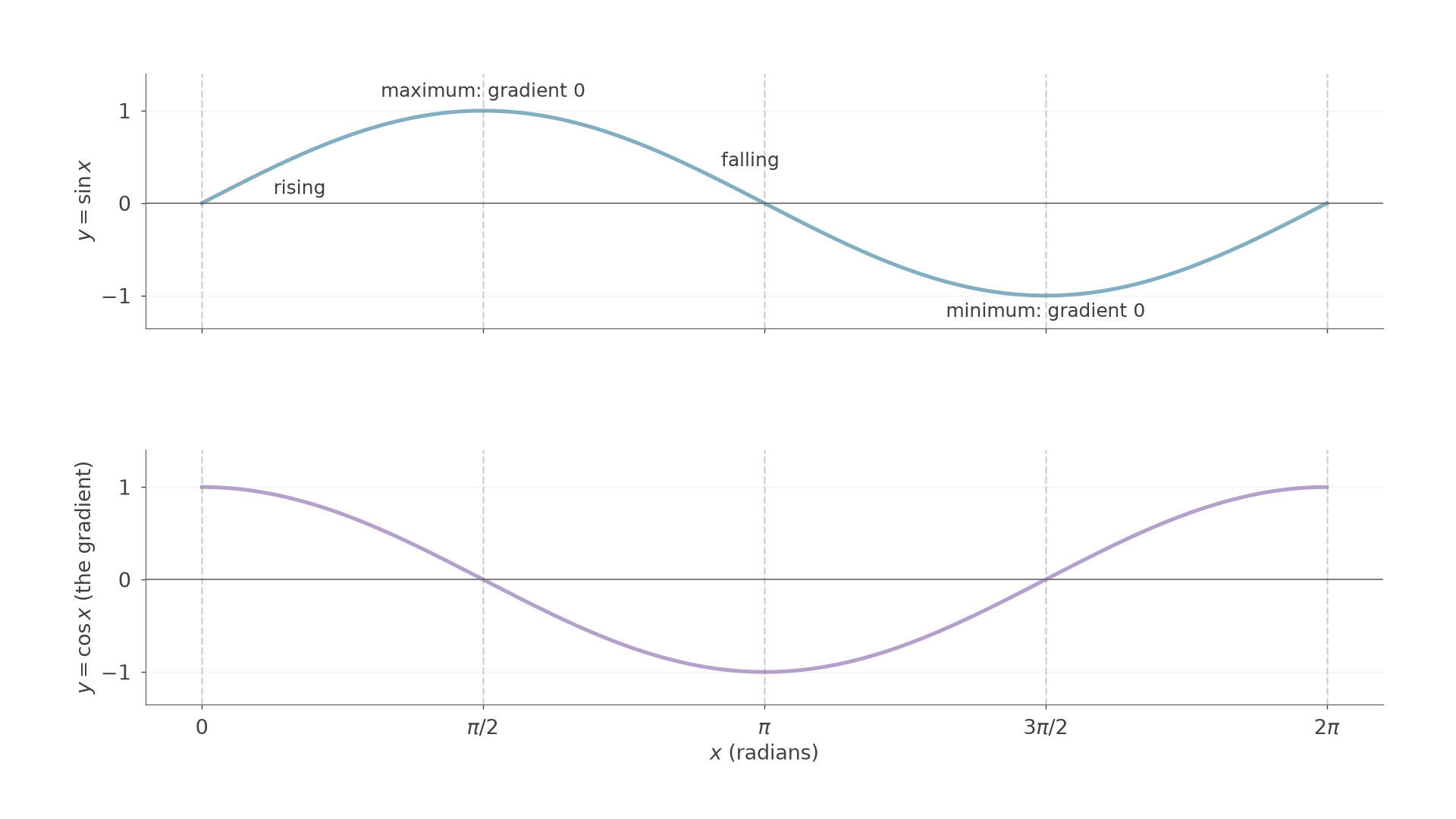
At , the sine curve rises through the origin with gradient ; at its maximum , its gradient is zero. Those gradients match the values of . The cosine curve has a horizontal tangent at zero and then falls, so its derivative has the negative sign in .
[DIAGRAM: asset_name: Sine values and sine gradients; asset_slug: sine-and-gradient; caption: At the sine curve's turning points the cosine curve is zero.; description: Aligned panels show sine x above cosine x for x from zero to two pi. Vertical guides at zero pi over two pi three pi over two and two pi connect the sine curve to its derivative values. Labels identify rising maximum falling minimum and the derivative cosine.]
Trigonometric derivatives
For angles measured in radians,
Here , so . The tangent derivative applies where . The tangent result is in the formula booklet; the sine and cosine results are not: learn them.
The positive derivative of tangent agrees with its rising shape on each interval between its asymptotes. Use radian mode for numerical checks of these formulae.
Worked example 3: three trigonometric terms
Differentiate .
Plan. Apply one standard derivative to each term, retaining the cosine derivative's minus sign.
Answer. , where .
Check. At zero, the three gradient contributions are , and , giving .
Change only the sign of the cosine term. Two negative signs now cancel.
Worked example 4: a subtracted cosine
Differentiate .
Plan. The derivative of is .
Answer. , where .
Check. At , the derivative is . A central secant using a step of radians gives approximately .
A sign outside a function remains a multiplier during differentiation.
Continue this lesson.
You’re previewing NovaLearn without an account. Create a free account to read the rest.
Create free account