D1 4.3 - Critical paths and event times
Find a project's minimum completion time using a forward pass, then work backwards to find how late each event may occur without delaying completion. You will identify all critical paths and calculate earliest and latest start and finish times for individual activities.
Forward pass for earliest events
If two branches take the same time, can the project have two critical paths? And if one branch becomes longer, what changes elsewhere? A small network will let us trace both effects exactly.
Use activities of duration , of duration , of duration , of duration , of duration , with dummy of duration zero. Durations are in days; project time starts at . Activities may run at the same time when dependencies allow, and sufficient workers and equipment are available.
[DIAGRAM: asset_name: A project with two branches; asset_slug: critical-path-network; caption: Event 4 must wait for both C and D; the dummy also makes D wait for A.; description: Directed activity-on-arc network A 1 to 2 duration4 B 1 to 3 duration6 C 2 to 4 duration5 D 3 to 4 duration3 E 4 to 5 duration2 and dashed dummy2 to3 duration0.]
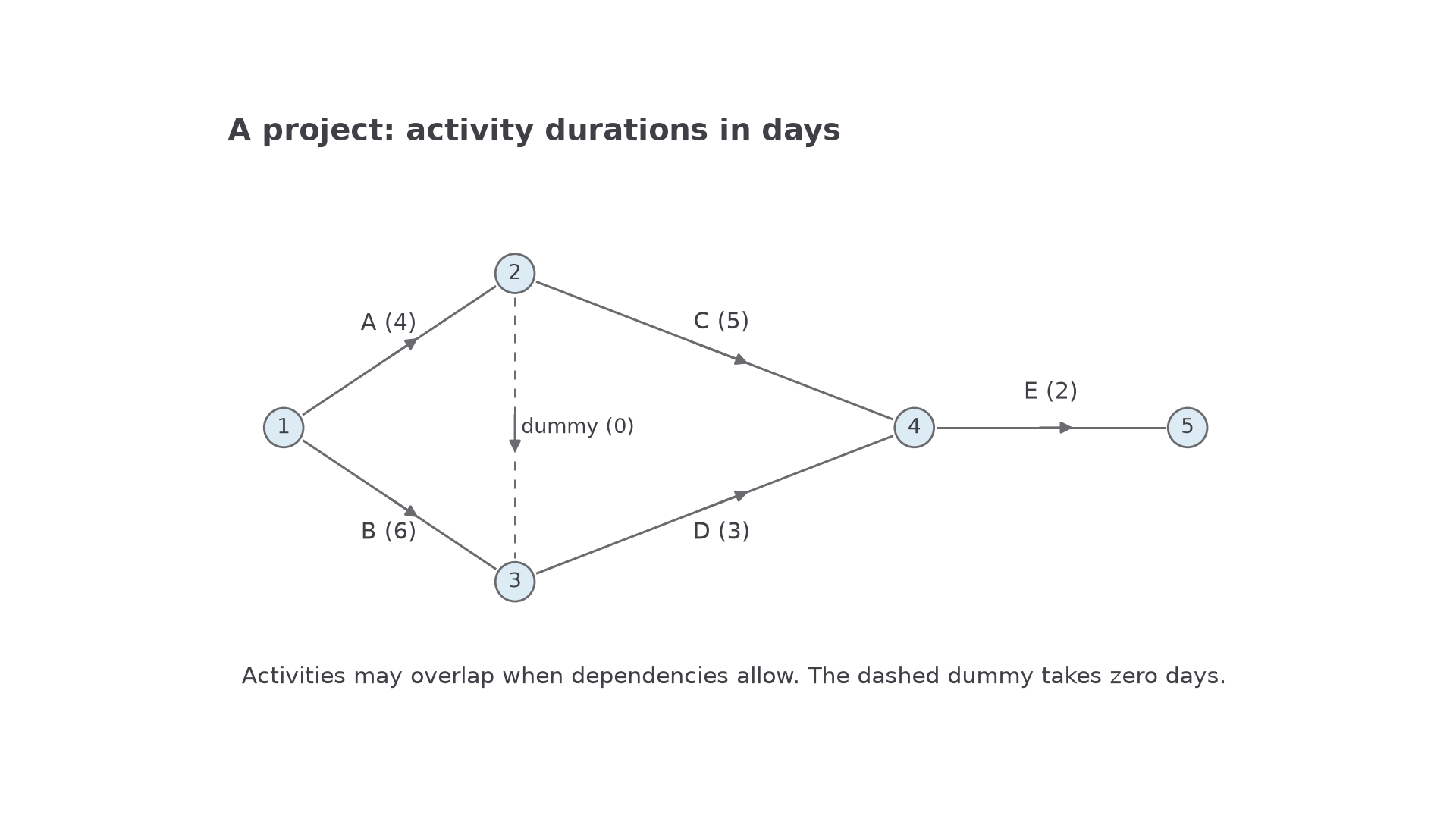
The earliest event time, , is the earliest that event can occur. It must wait for every incoming activity, so choose the maximum candidate arrival time. This differs from Dijkstra's shortest-path calculation: project completion cannot choose to ignore its slower required branch.
Forward pass
Set . For each later event ,
where is the duration of that activity, including zero for a dummy. The earliest finish event time is the minimum project duration under the stated resource assumptions. Not in the formula booklet: learn it.
Worked example 1: earliest event times
Find the earliest event times for the pictured project.
Plan. Move in arrow order, calculating every incoming candidate before taking a maximum.
Answer. Earliest times at events ; minimum project duration days.
Check. Both real branches and take days. Starting activities as early as possible attains the calculated finish, so is feasible as well as necessary.
Change only 's duration from to . The dummy still has duration zero, but its start event is not necessarily simultaneous with its finish event.
Worked example 2: a longer branch
Find the new earliest event times when .
Plan. Repeat the maximum comparisons wherever the changed duration can affect a successor.
Answer. Earliest times ; minimum duration days.
Check. The branch now takes , whereas takes . Event must wait for the longer one.
A zero-duration dummy enforces “not before”, not “must happen at the same time”. Event still waits for .
Backward pass for latest events
The latest event time tells you how late an event may occur while retaining the minimum project duration.
Write for this time. At an event with several outgoing activities, every successor's deadline must be respected. Subtract each outgoing duration from its successor's latest time and take the minimum: the tightest restriction controls.
Backward pass
For completion in the minimum duration, set . Working against the arrows,
Earliest times use maximum incoming values; latest times use minimum outgoing values. Not in the formula booklet: learn it.
Worked example 3: latest times for the original project
Use the original project, whose minimum duration is days.
Plan. Set the finish deadline to , then work backwards through all outgoing constraints.
Answer. Latest times , equal to the earliest times here.
Check. Each arc satisfies . At event , taking the larger candidate would make finish at , too late for event 's deadline .
Change only to the version, whose finish deadline is now .
Worked example 4: latest times with a longer branch
Find the revised latest event times.
Plan. Recalculate backwards from the revised minimum finish time, rather than retaining the old deadline.
Answer. Latest times . Event may occur between its earliest and latest .
Check. Event at time permits to finish at , exactly on time. At time , would finish at , delaying and the project.
[DIAGRAM: asset_name: Earliest and latest event times; asset_slug: critical-event-times; caption: With B taking 7 days, event 2 has earliest time 4 and latest time 5.; description: The same five-event project with B duration7, each event drawn with its earliest time above latest time: event1 0 and0 event2 4 and5 event3 7 and7 event4 10 and10 event5 12 and12.]
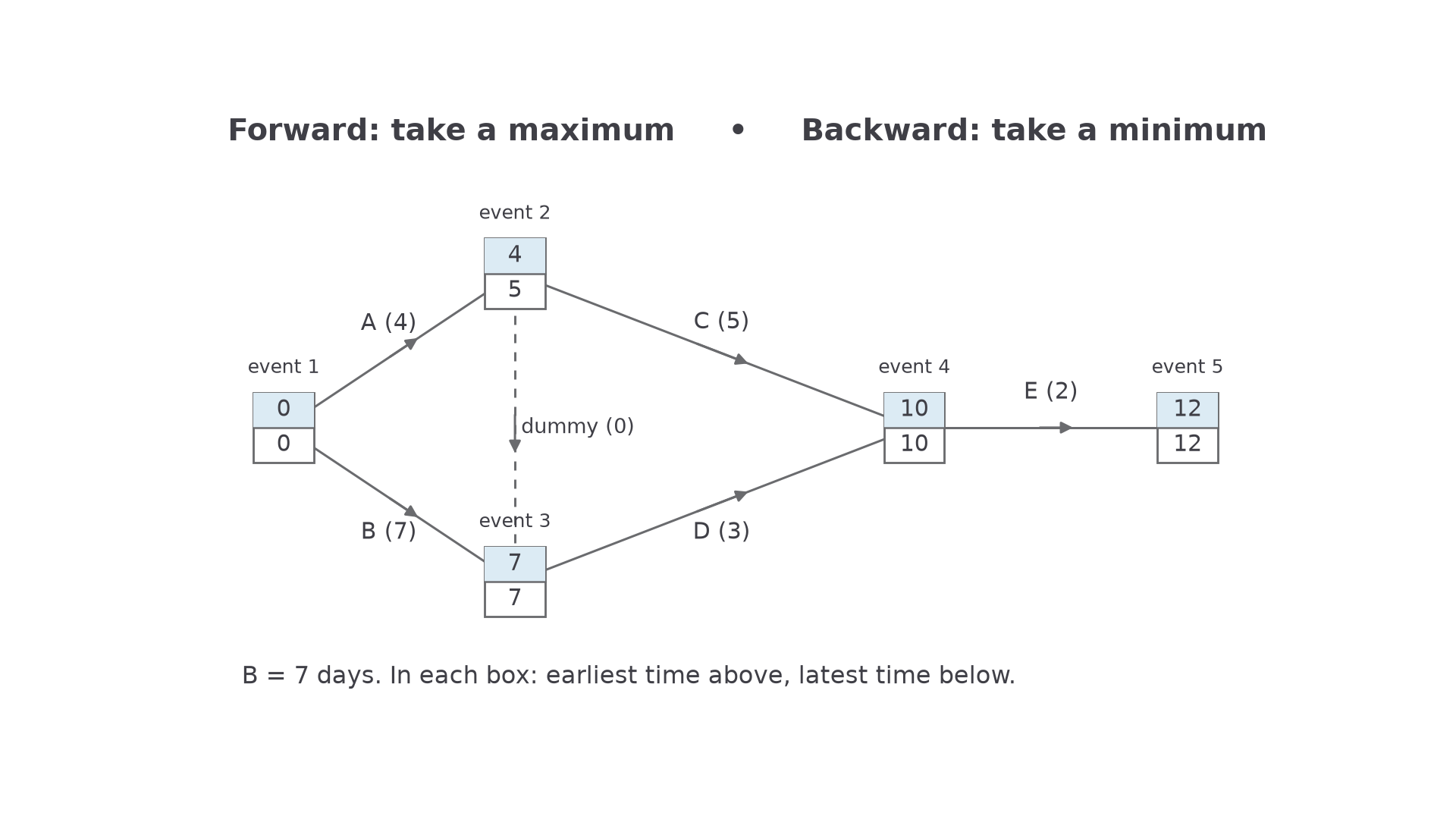
Check that at every event. A computed earliest time greater than a latest time means an error, or an impossible supplied deadline if the question fixes one shorter than the required duration.
Continue this lesson.
You’re previewing NovaLearn without an account. Create a free account to read the rest.
Create free account