P3 1.2 - Functions domain and range
Describe a function using its rule, its allowed inputs and its possible outputs. Use domains, graphs and algebra to distinguish one-one from many-one mappings and to find complete ranges.
One-one and many-one mappings
Can squaring be a function when and give the same answer? Yes: the essential condition concerns the output from each input, rather than the number of inputs sharing an output.
The rule “square the input” maps to . Each input has exactly one output. Writing names this rule; says that input produces output .
Function and mapping types
A function assigns exactly one output to each input in its domain, the allowed set of inputs. Its range is the set of outputs actually attained.
A one-one function gives different outputs for different inputs. A many-one function allows distinct inputs to have the same output. Both are functions.
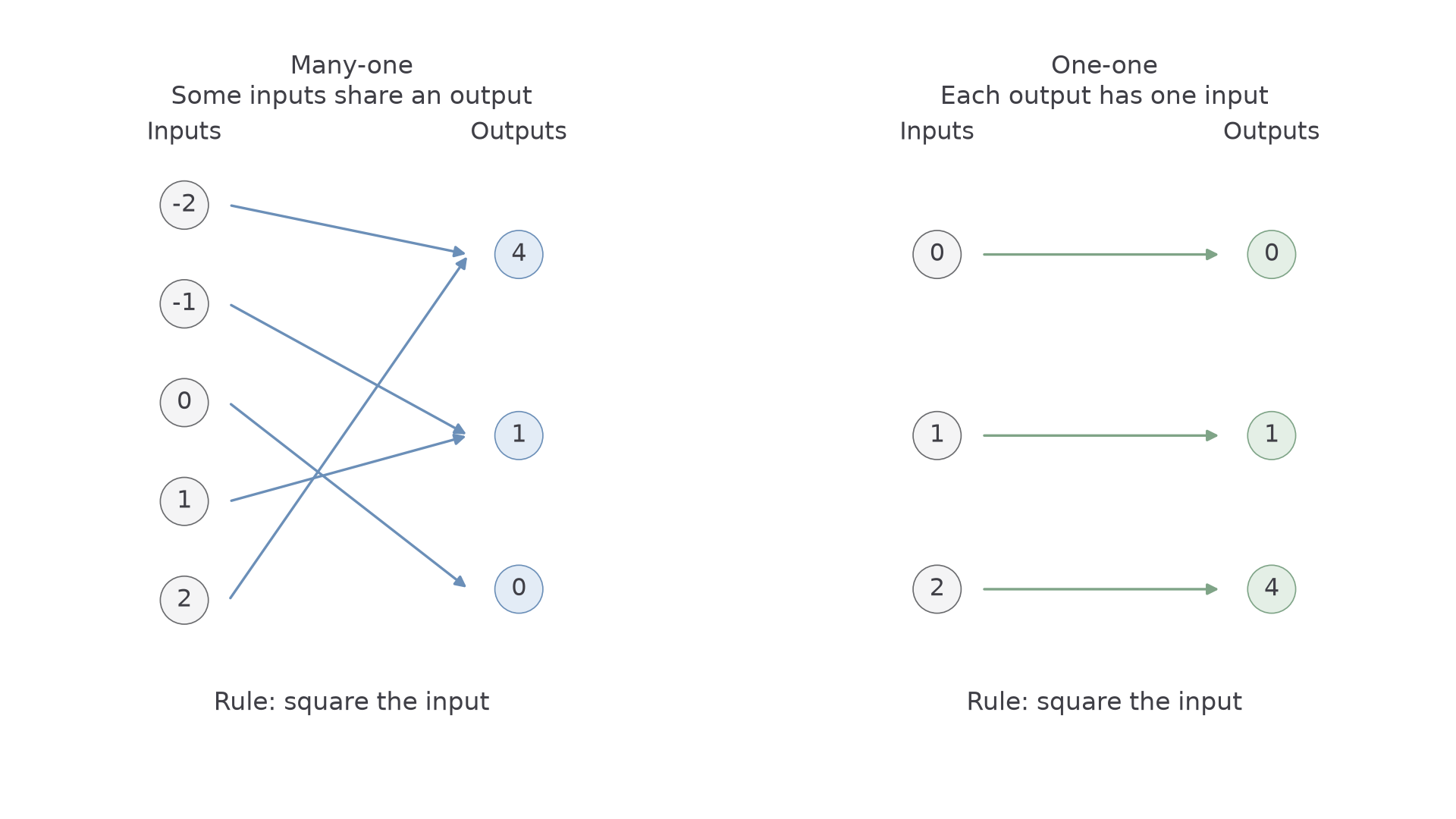
Squaring on all real inputs is many-one: . Restricting the inputs to makes it one-one, because nonnegative inputs with equal squares must be equal.
[DIAGRAM: asset_name: Squaring with two domains; asset_slug: squaring-mappings; caption: Removing negative inputs makes the squaring mapping one-one.; description: Two arrow diagrams. On the left inputs negative 2, negative 1, 0, 1 and 2 map to outputs 4, 1 and 0 under squaring, with pairs sharing 4 and 1. On the right inputs 0, 1 and 2 map to 0, 1 and 4 with no shared outputs.]
A rule “send to either or ” is not a function unless a single output is selected. The square-root function selects the nonnegative root, so , rather than .
For a graph, a vertical line must meet it at most once for it to represent as a function of . A horizontal line meeting it twice shows that the function is many-one. Thus a full parabola passes the vertical-line test but fails the one-one test.
Key idea
One output for each allowed input makes a function. Repeated outputs make it many-one, not invalid.
Distinguish repeated outputs from multiple outputs for one input.
Domain restrictions
A formula can restrict its own inputs, and a stated domain can restrict them further.
Over the real numbers, division by zero is undefined and a square root requires a nonnegative quantity inside it. If no domain is stated, find the largest real set on which the rule makes sense. If a domain is stated, use that set: do not silently enlarge it.
Domain restrictions
For a real function, a denominator must be nonzero and the expression under a square root must be at least zero. When the square root is itself in a denominator, its value must be positive.
For example, requires , while requires .
The symbols mean that belongs to the real numbers. An interval such as includes and excludes ; it means .
Worked example 1: a square-root endpoint
Question. Find the largest real domain of .
Plan. Require the expression under the root to be nonnegative.
Answer. , or .
Check. At the boundary, , which exists. An input such as would require the non-real value .
Change only the position of the same square root: put it in a denominator. The boundary is now forbidden.
Worked example 2: excluding a zero denominator
Question. Find the largest real domain of .
Plan. Require the root to exist and also be nonzero.
Answer. , or .
Check. exists, but does not. The strict inequality captures exactly this difference from Example 1.
When several restrictions occur, all must hold together. For , the domain is , with . Cancelling a factor in a rational rule does not remove an original exclusion.
Watch out
A square root permits zero; a denominator does not. Check where the root appears before deciding whether the boundary uses or .
Apply both conditions to the same expression.
Finding a range
The range records every output reached from the stated domain, including whether a limiting value is actually attained.
For on all real inputs, the square is at least zero, so . Every value at least occurs. On the restricted domain , the square runs from to , giving . A range therefore belongs to a rule and its domain.
Continue this lesson.
You’re previewing NovaLearn without an account. Create a free account to read the rest.
Create free account