M1 4.2 - Connected particles
Use the string model to connect two particles' motions, then write one force equation for each particle. You will find acceleration and tension, including what changes when one particle hits the ground. Take and round non-exact final numerical answers to three significant figures.
Common acceleration from inextensible strings
Two unequal masses hang from a string over a pulley. When the heavier one hits the floor, does the lighter one stop immediately? The answer depends on which constraints still apply.
A taut inextensible string has fixed length. In a simple arrangement with a fixed pulley, if one end moves towards the pulley, the other must move away. The particles therefore have equal speed and equal acceleration magnitude while the string stays taut. Their vector accelerations can point in different directions.
[DIAGRAM: asset_name: Shared acceleration separate forces; asset_slug: m1-pulley-separated-forces; caption: The string gives a common acceleration magnitude, but each mass needs its own equation.; description: Two hanging masses of two and three kilograms over a smooth fixed pulley, with separate particle free-body diagrams showing tension upward, weight downward and opposite acceleration directions.]
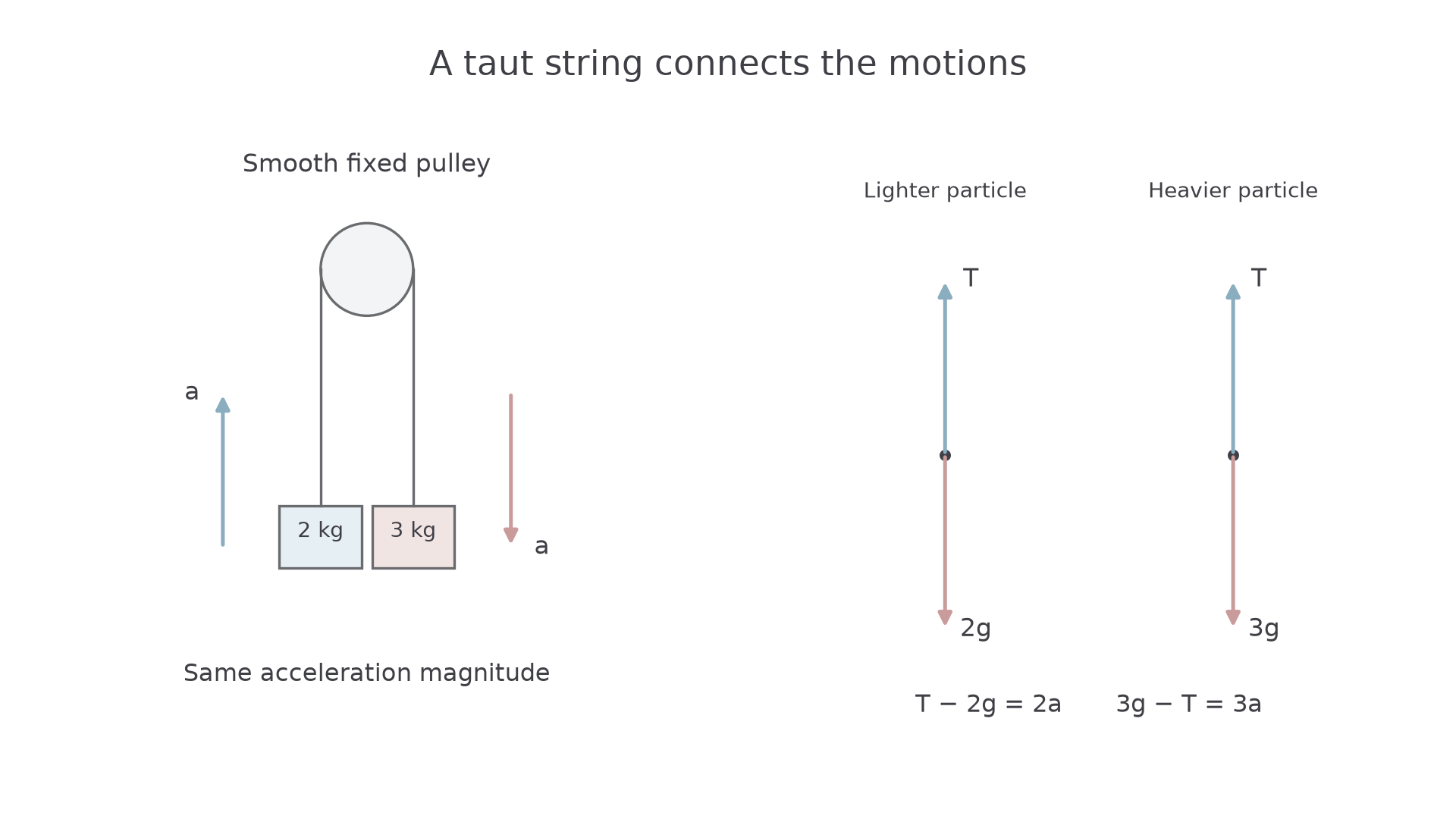
A light string has negligible mass. With a smooth pulley or peg, its tension has the same magnitude along a continuous taut string. A string pulls; it cannot push. A smooth peg can redirect the string just as a smooth fixed pulley does in this model.
Key idea
Equal tension does not mean equal weight. Equal acceleration magnitude does not mean zero acceleration. Draw a separate force diagram for each particle, then choose positive directions that follow the same motion around the string.
If the string becomes slack, it no longer fixes the particles' motions together and its tension is zero. If a string is cut, its tension is also zero immediately afterwards.
Two particles in a straight line
For two blocks joined on a smooth horizontal surface, the string pulls them towards each other. Tension is internal to the pair: it cancels when their equations are added. It remains essential when finding the force on either block separately.
Worked example 1: pulling the leading block
Blocks and , of masses and , are joined by a light taut inextensible string on a smooth horizontal surface, with to the right. A force pulls right. Find the acceleration and tension.
Plan. Take right positive for both. The tension pulls right and left.
Adding gives , so
Answer. Both accelerate rightwards at ; tension is .
Check. On , .
Change only the end at which the pair is pulled: pull left with the same force.
Worked example 2: pulling the other end
The same blocks are pulled left by a force on . Find acceleration and tension.
Plan. Take left positive. Tension now provides all of 's horizontal force.
Answer. leftwards and tension .
Check. The acceleration magnitude is unchanged because the external force and total mass are unchanged. Tension changes because it accelerates a different trailing mass.
On a rough surface, put each block's own friction into its own equation, opposing that block's sliding. Adding still cancels the internal tensions, but not external friction.
Smooth pulleys and pegs
A pulley changes the direction of a string's force. It does not remove gravity or make either hanging mass accelerate at . Use a common acceleration magnitude, but give each particle its own positive direction along its motion.
Continue this lesson.
You’re previewing NovaLearn without an account. Create a free account to read the rest.
Create free account