M1 2.1, M1 2.2 - Vectors in motion
Describe directions and resultants with two-dimensional vectors, then use them for displacement, velocity and acceleration. M1 2.1 supplies vector geometry; M1 2.2 connects that geometry to motion over a stated time interval.
Magnitude direction and components
Two boats both travel at , but one heads east and the other north. Do they have the same velocity? Their speeds match; their directions do not.
A scalar has magnitude only, such as time or mass. A vector has magnitude and direction, such as displacement, velocity, acceleration or force. Choose perpendicular axes first. Here is a unit vector east and a unit vector north. A unit vector has magnitude ; a negative component points opposite its axis.
The displacement metres means east and north. Its straight-line length is , by Pythagoras.
Magnitude and components
For perpendicular unit vectors ,
A vector of magnitude at angle anticlockwise from the positive horizontal axis has components
Check the quadrant before interpreting an inverse tangent. These vector results are not printed in the formula booklet: learn them.
[DIAGRAM: asset_name: Vector components and quadrant; asset_slug: m1-vector-components; caption: The component signs locate the vector before trigonometry finds its angle.; description: Two equal-scale coordinate diagrams show vectors three i plus four j and negative three i plus four j, both of magnitude five, with horizontal and vertical component legs and angles north of east and north of west.]
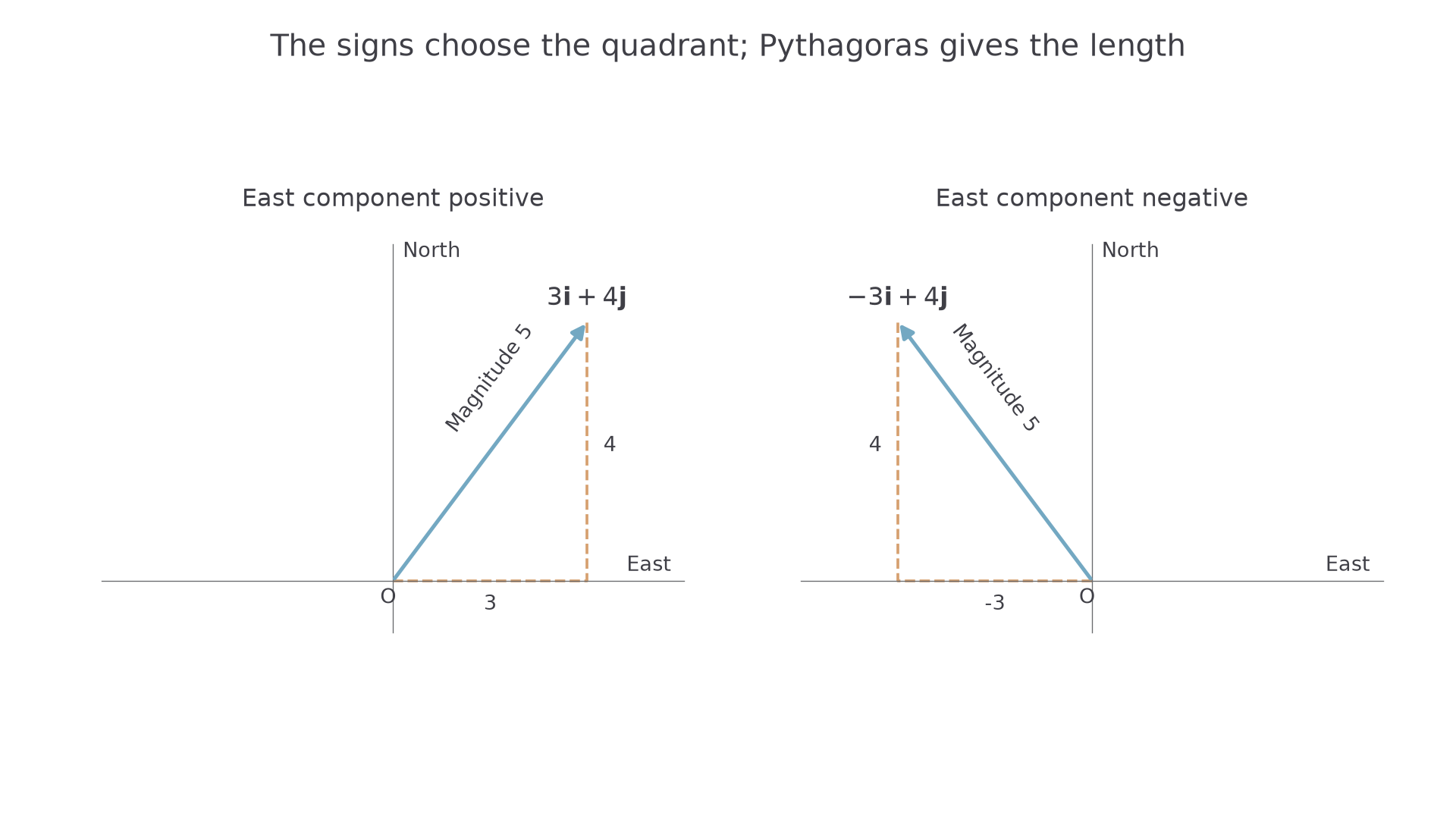
Worked example 1: north of east
Question. A displacement is . Find its magnitude and direction.
Plan. Use Pythagoras for magnitude and a right triangle for the angle north of east.
Answer. , at north of east.
Check. and , recovering both components.
Change only the horizontal component's sign. The magnitude stays the same, but the quadrant changes.
Worked example 2: north of west
Question. A displacement is . Find its magnitude, its angle north of west and its bearing to the nearest degree.
Plan. Locate the north-west quadrant, then use the same component triangle.
A bearing is measured clockwise from north, so here
Answer. , north of west; bearing .
Check. The bearing lies between and , as a north-west direction should.
An inverse-tangent result alone does not specify a vector direction.
Watch out
The magnitude is nonnegative. It does not retain the component signs, so it cannot tell you the quadrant.
Use the new component ratio in the same quadrant.
Resultants and vector diagrams
A resultant is the single vector equivalent to adding the vectors, so add components before finding a magnitude.
Walking east and then north gives a displacement of magnitude , not . The distance walked is . The displacement joins the original start to the final finish.
Vector addition
To add vectors in a diagram, place the tail of the second at the head of the first without changing its length or direction. The resultant joins the first tail to the final head.
Subtracting a vector means adding its opposite.
[DIAGRAM: asset_name: Adding force vectors head to tail; asset_slug: m1-vector-resultant; caption: The resultant joins the first tail to the final head.; description: An exact equal-scale vector diagram adds seven i plus two j to negative three i plus j, obtaining four i plus three j. The second vector is translated to begin at the head of the first.]
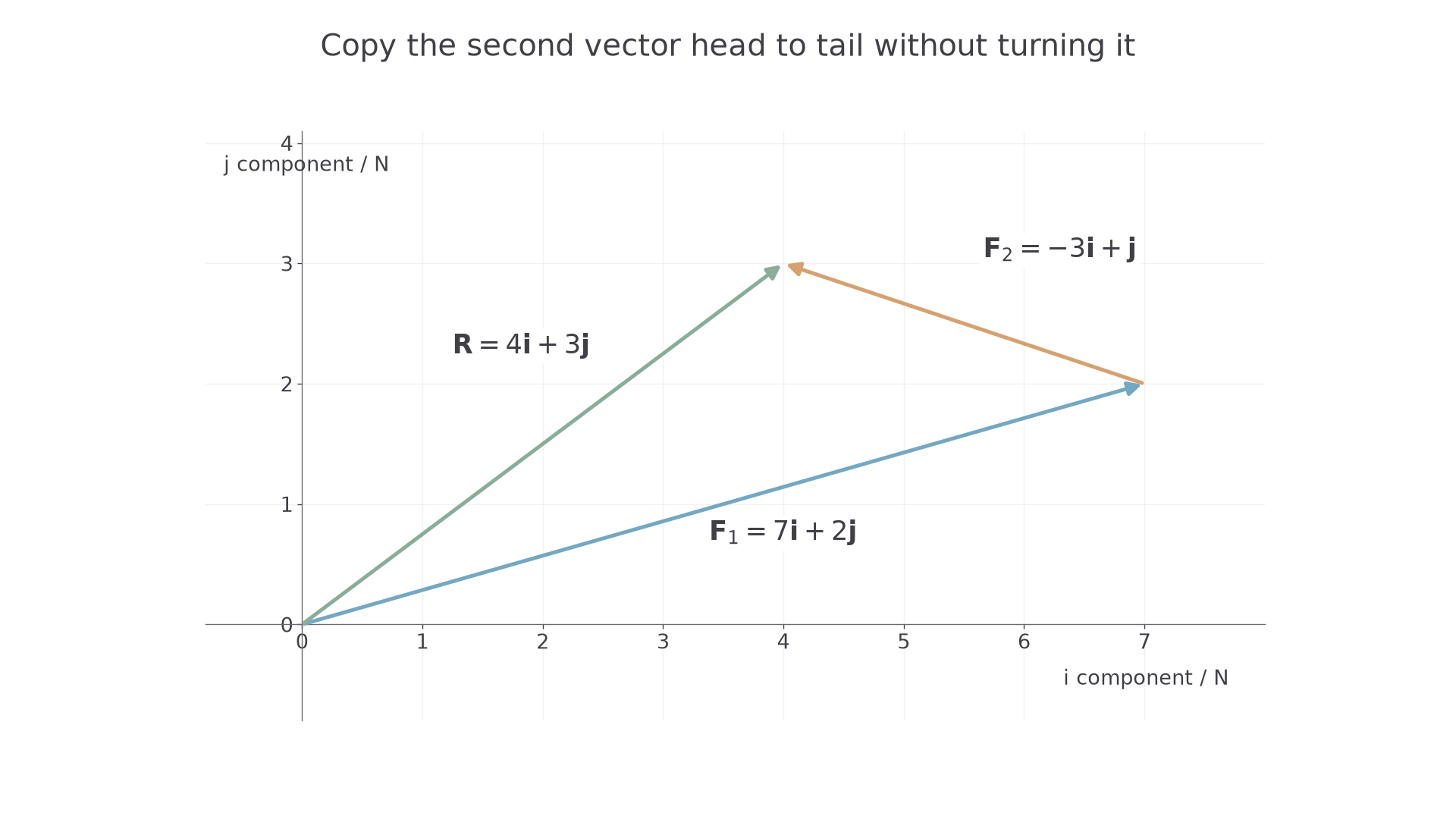
Two nonzero vectors are parallel if one is a nonzero scalar multiple of the other. A positive multiplier preserves direction; a negative multiplier reverses it. “Parallel to” therefore does not necessarily mean “in the same direction as”.
Worked example 3: two force vectors
Question. Forces and act on a particle. Find the resultant and its magnitude.
Plan. Combine horizontal and vertical components separately, then use Pythagoras.
Answer. Resultant , magnitude .
Check. Subtract from the resultant: , recovering .
Change only the sign of the second force: its arrow is reversed before adding.
Worked example 4: reversing one force
Question. Replace above by . Find the new resultant and its magnitude.
Plan. Add the reversed components, rather than subtracting magnitudes.
Answer. , magnitude .
Check. The new resultant minus the old is , exactly as required when replacing by its opposite.
Forces are vectors, even when the question eventually asks for a positive magnitude.
Watch out
In general . Add the vectors first. Equal magnitudes alone also do not establish equal directions.
Try the same reversed-vector structure with fresh values.
Continue this lesson.
You’re previewing NovaLearn without an account. Create a free account to read the rest.
Create free account