M2 4.1, M2 4.2 - Momentum and restitution
Use momentum and impulse as vectors, then combine conservation of momentum with Newton's law of restitution for direct impacts. Interpret the coefficient of restitution and calculate the kinetic energy lost in a collision.
Vector impulse and conservation
Can momentum be conserved in a collision while kinetic energy decreases? Momentum includes direction, whereas energy uses speed squared; the two conservation claims are different.
For a particle moving at , momentum is . Resolve an impulse into the same axes before comparing it with momentum.
Vector impulse-momentum principle
An impulse is a vector measured in newton seconds. Its magnitude is , not the sum of its signed components.
Not in the formula booklet: learn these relations.
Worked example 1: a change in two components
Question. A particle changes velocity from to under an impulse. Find the impulse and its magnitude.
Plan. Subtract initial momentum from final momentum component by component.
Answer. , magnitude .
Check. Initial momentum plus impulse gives final momentum , as required.
Change only the final vertical component so that its change reverses direction.
Worked example 2: the same magnitude, a different direction
Question. The same particle instead finishes with velocity , from the same initial velocity. Find its impulse and magnitude.
Plan. Recalculate the vertical momentum change rather than reusing its sign.
Answer. , magnitude .
Check. Adding the impulse to gives , which is twice the final velocity.
During a collision the impulse of on is equal and opposite to that of on . Adding their impulse equations cancels these internal impulses. If the total external impulse is negligible,
This is conservation of linear momentum. It holds in each component. A smooth horizontal surface supplies no horizontal impulse, making it a useful collision model.
Watch out
is a vector. Equating it directly to a scalar impulse magnitude discards direction; first find the vector, then take its magnitude.
Newton's law of restitution
Momentum alone supplies one equation for two final velocities in a direct collision; restitution supplies the second.
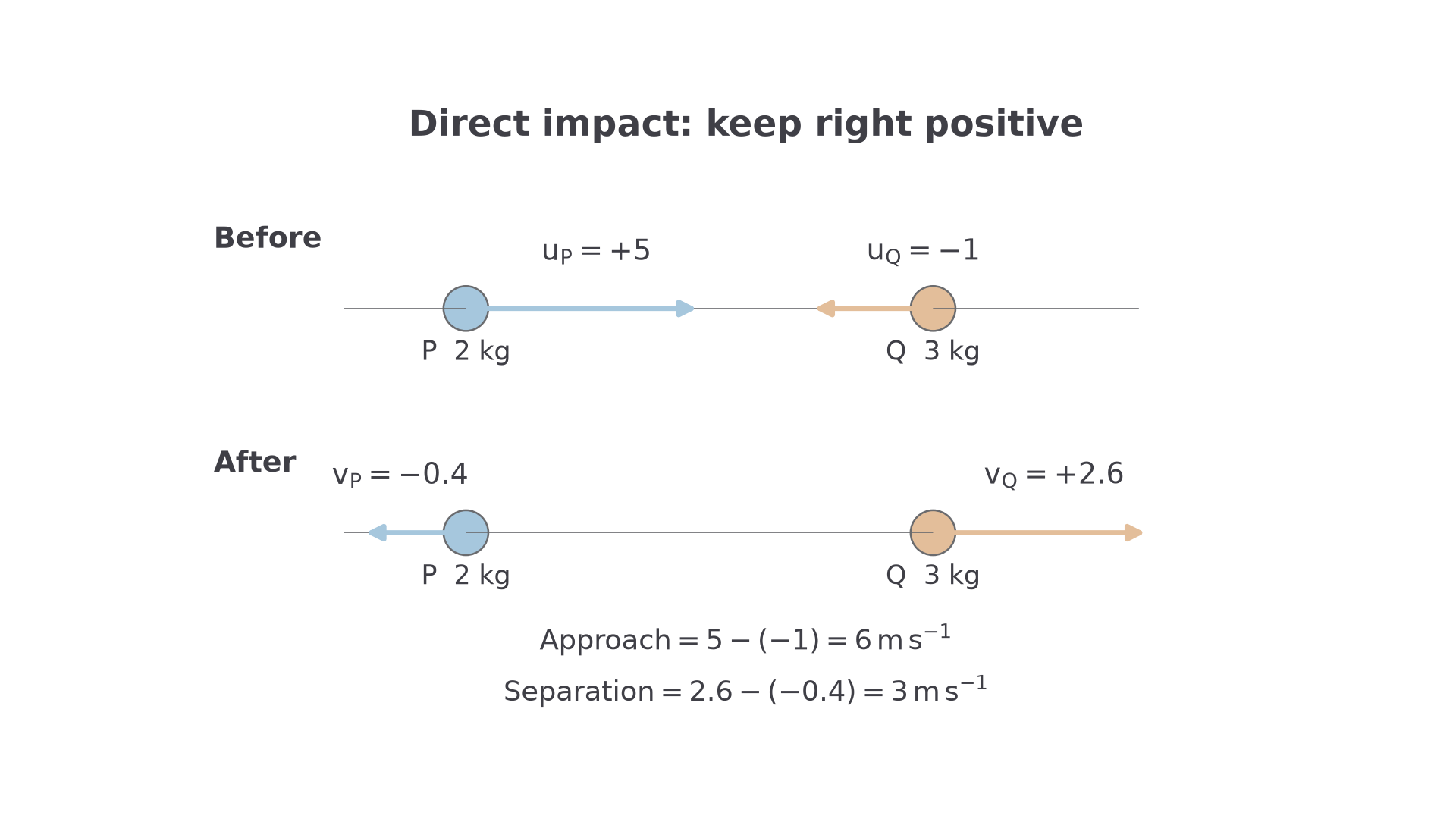
In a direct impact, the particles move along their line of centres. Put to the left of and choose right as positive. Before an approaching collision, , so the speed of approach is . Afterwards the speed of separation is .
Newton's law of restitution
The coefficient describes the pair of particles in the model. Use signed velocities within the differences, even if a particle reverses direction.
Not in the formula booklet: learn it.
[DIAGRAM: asset_name: Signed velocities in direct impact; asset_slug: m2-restitution-signed-velocities; caption: One right-positive direction is retained before and after the collision.; description: Before impact a two kilogram particle P on the left moves right at five metres per second and a three kilogram particle Q on the right moves left at one metre per second. After impact P moves left at zero point four and Q right at two point six metres per second. Speeds of approach six and separation three are shown separately.]
Worked example 3: a particle reverses
Question. On a smooth horizontal surface, has mass and velocity ; has mass and velocity . They collide directly with . Find their velocities afterwards.
Plan. Form momentum and restitution equations using right-positive velocities throughout.
Substitute into the first equation:
Answer. rebounds at left; moves at right.
Check. Final momentum is . Separation speed is half the approach speed .
Change only the restitution coefficient to . Keep the signed initial velocities.
Worked example 4: a perfectly elastic impact
Question. The same particles have the same initial velocities but . Find their final velocities.
Plan. The momentum equation stays the same; separation now equals approach.
Answer. and .
Check. , and .
Watch out
For opposite incoming directions, the approach speed is the sum of the incoming speeds. Here , not . A diagram with signed arrows prevents this slip.
Continue this lesson.
You’re previewing NovaLearn without an account. Create a free account to read the rest.
Create free account