M2 2.2 - Centres of mass of shapes
Locate centres of mass using symmetry, combine simple shapes, subtract removed regions, and use the standard centres supplied in the formula booklet. Distinguish area weighting for a lamina from length weighting for a wire.
Symmetry of uniform laminae
Can the centre of mass lie in a hole? Yes: a uniform ring balances about its geometric centre even though there is no material there. Symmetry locates the centre without adding the mass of every tiny piece.
A lamina is a thin, flat body whose thickness can be neglected in its plane geometry. A uniform lamina has constant mass per unit area. Reflecting it in an axis of symmetry pairs equal masses at equal opposite distances, so their moments cancel about that axis.
Mass symmetry
The centre of mass lies on every axis of symmetry of the mass distribution. Two intersecting symmetry axes locate it at their intersection. Symmetry of the outline alone is insufficient if density varies asymmetrically.
A uniform rectangle has two central symmetry axes, so its centre is halfway across and halfway up. A uniform circular disc or complete circular wire has its centre of mass at the circle's centre. A semicircle has only one symmetry axis; this locates a line containing its centre, not the distance along that line.
Worked example 1: a rectangular lamina
A uniform rectangular lamina has vertices , , and , in centimetres. Find its centre of mass.
Plan. Intersect the two central axes of symmetry.
Answer. .
Check. Each vertical strip to the left of has an equal strip at the same distance on the right. The same cancellation holds above and below .
Translate only the rectangle's position; the shape, uniformity and midpoint argument stay unchanged.
Worked example 2: translated coordinates
A uniform rectangular lamina now occupies , , with coordinates in centimetres. Find its centre of mass.
Plan. Average the coordinate limits in each direction.
Answer. .
Check. The translation from Worked example 1 is , which moves its centre from to too.
Removing material symmetrically preserves the corresponding mass symmetry. A hole centred on both axes of a rectangular lamina leaves its centre unchanged, provided the remaining material is uniform.
Watch out
One symmetry axis determines only one condition. For a semicircular lamina above a horizontal diameter, symmetry gives when the circle centre is the origin; it does not give .
Locate both symmetry axes of a new rectangle.
Composite figures
A composite shape can be treated as a collection of particles: replace each simple piece by its mass at its own centre of mass, then take moments.
For pieces of one uniform lamina, mass is proportional to area: , where is the common mass per unit area. The factor cancels from the weighted averages, so use areas as mass ratios. Choose non-overlapping pieces; counting an overlap twice changes the mass distribution.
Composite centres
For the same material and thickness, replace by area . For uniform wire of one material and thickness, replace it by length . If densities differ, use actual mass ratios. These weighted-position formulae are not printed in the formula booklet: learn them through moments.
A table separates the three decisions: how much material each piece contains, where its centre lies, and which coordinate is needed.
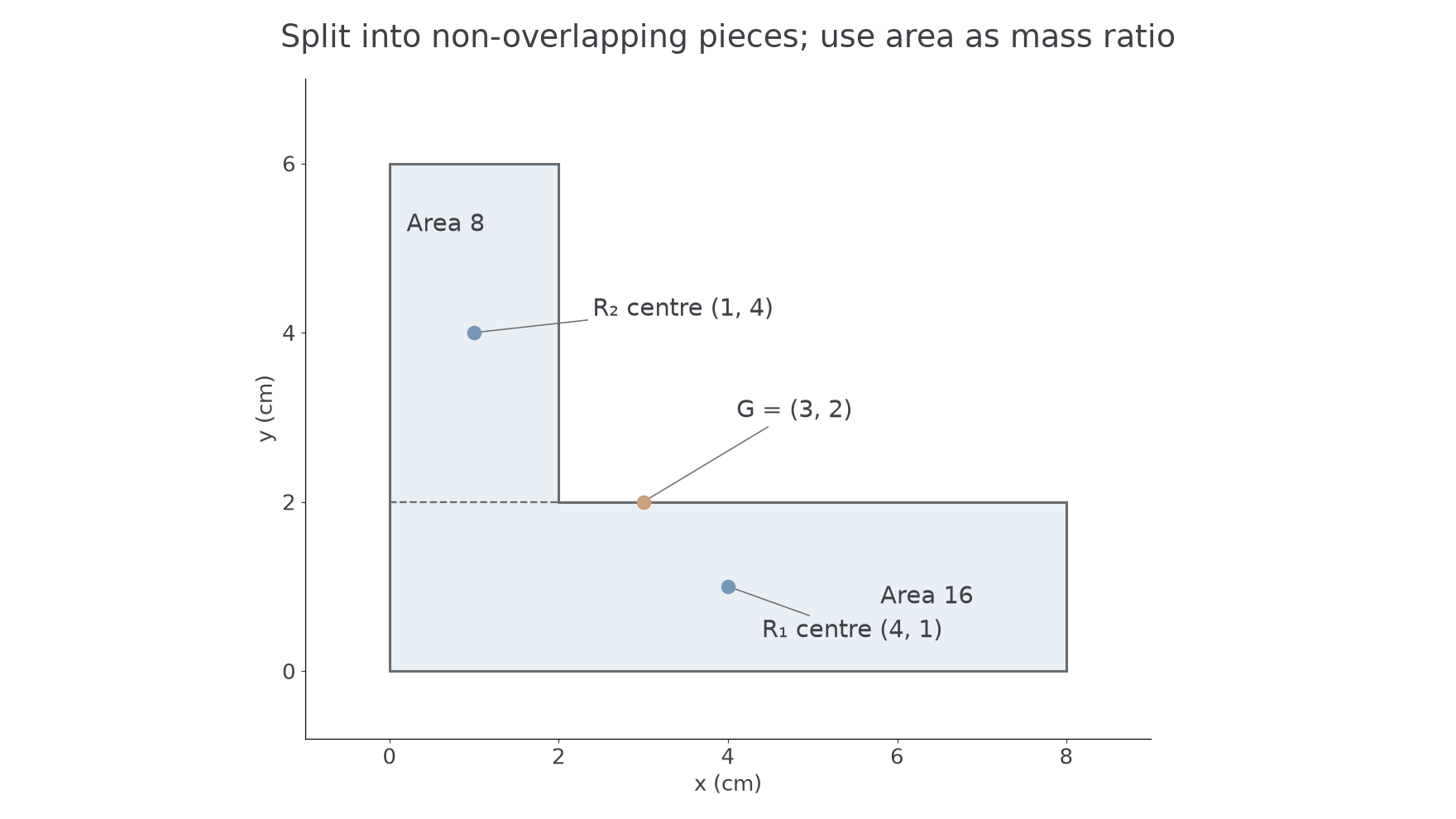
[DIAGRAM: asset_name: Splitting a composite lamina; asset_slug: m2-composite-lamina; caption: Two non-overlapping rectangles replace an L-shaped lamina by two mass contributions.; description: An L-shaped lamina is split into a lower rectangle 8 by 2 and an upper-left rectangle 2 by 4. Their centres (4,1) and (1,4) and the combined centre (3,2) are labelled on equal-scale axes.]
Worked example 3: one uniform material
An L-shaped uniform lamina consists of rectangle , , , and rectangle , , , all in centimetres. Find its centre of mass.
Plan. Use each rectangle's area and midpoint, then form two area-moment equations.
| Piece | Area | Centre |
|---|---|---|
Answer. .
Check. About this centre, the horizontal mass moments are proportional to ; the vertical ones to .
Change only the upper piece's density: its mass per unit area is now twice that of the lower piece.
Worked example 4: different densities
The two rectangles have the same dimensions as in Worked example 3, but has twice the mass per unit area of . Find the new centre of mass.
Plan. Multiply area by relative density before taking moments.
Answer. .
Check. The pieces now have equal masses, so their combined centre is the midpoint of and , namely .
The overall centre need not lie in the material: is in the missing corner of this L shape, yet it correctly represents the moments of the two pieces.
Watch out
Area ratios are mass ratios only when mass per unit area is the same. The second example needs , not . For a wire framework, use lengths, not the areas it encloses.
Choose non-overlapping rectangles and calculate both coordinates.
Removed regions with negative masses
When a region is cut out, subtract both its mass and its mass moment from those of the complete shape.
Imagine temporarily filling the hole with the original material. The complete shape's moment equals the remaining part's moment plus the removed part's moment. Rearranging gives the subtraction rule; no physical negative mass is being claimed.
A removed region
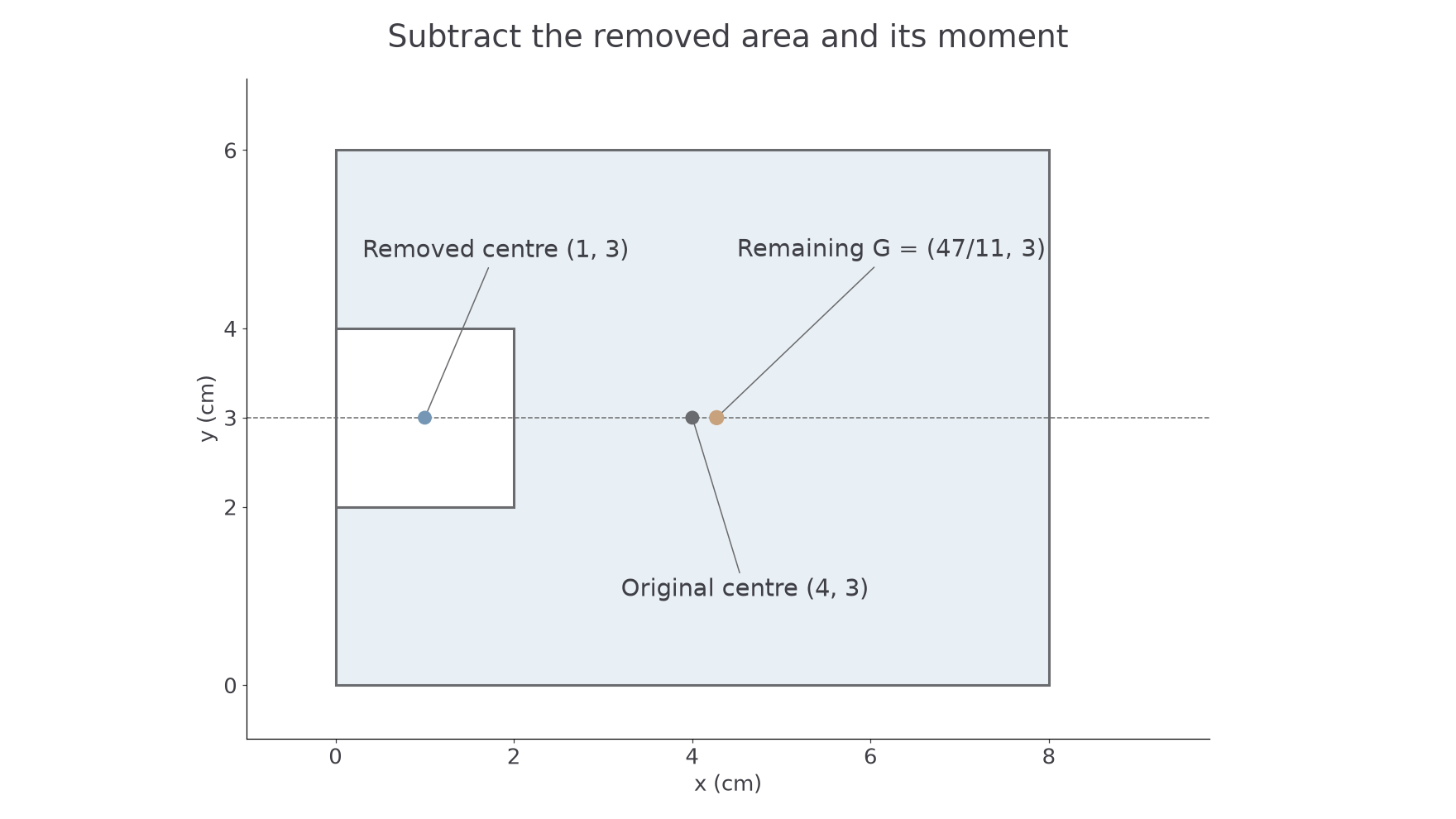
For an outer shape of mass centred at , with a removed region of mass centred at ,
For one uniform lamina, use areas in place of masses. This subtraction rule is not printed in the formula booklet: derive it from moments.
The hole's centre is measured from the same origin as the outer shape. Subtracting its coordinate from the outer coordinate first would not account for the amount removed.
[DIAGRAM: asset_name: A removed region shifts the centre; asset_slug: m2-removed-region; caption: Removing mass on the left moves the centre to the right.; description: A uniform 8 by 6 rectangle has a 2 by 2 rectangular hole at 0 to 2 horizontally and 2 to 4 vertically. The original centre (4,3), hole centre (1,3) and remaining centre (47/11,3) are marked; horizontal symmetry keeps the vertical coordinate at 3.]
Continue this lesson.
You’re previewing NovaLearn without an account. Create a free account to read the rest.
Create free account