P2 4.1, P2 4.3 - Describing sequences
Use a formula or a recurrence rule to generate a sequence, as in P2 4.1, then describe increasing, decreasing and periodic behaviour, as in P2 4.3. You will distinguish a term's position from its value and use the rule to justify behaviour beyond a few listed terms.
Explicit nth terms
Could a sequence have its millionth term equal to its second term? It could, but the first few numbers alone cannot tell you. A rule makes the question answerable; later we will build a sequence that alternates forever.
First consider the ordered list . Its terms are values, while are their positions. The rule produces exactly these four values, and also specifies every later one.
Sequence and explicit formula
A sequence is an ordered list of terms. The notation means the term in position . An explicit formula gives directly in terms of , so you can calculate a term without calculating all its predecessors.
Unless another starting index is stated, use .
A sequence is discrete: its positions are integers. The expression can be evaluated at , but that does not give a term of this sequence. Write negative substitutions in brackets: is different from .
Worked example 1: substituting term positions
Question. A sequence has . Find its first four terms and its tenth term.
Plan. Substitute the positions , then substitute directly.
Answer. The first four terms are , and the tenth term is .
Check. Rewrite the rule as . It gives and , confirming all five outputs by a different form.
Change only the sign before . The positions stay the same; the term values change.
Worked example 2: changing one sign
Question. A sequence has . Find its first four terms and its tenth term.
Plan. Substitute each requested position into the new rule.
Answer. , with .
Check. The new rule exceeds the old one by . At positions , adding to Example 1's values gives precisely the new values.
A term's subscript is its position, rather than a multiplier.
Watch out
means “the tenth term”, not . The first term of is , because the first input is , not zero.
Change the coefficient and calculate only the requested positions.
Recurrence rules and initial terms
A recurrence rule tells you how to get the next term from the current one, so an initial value is needed to start the process.
For example, “start at , then multiply the current term by and subtract ” gives . Starting at with that same rule gives . The transition rule is identical, but the sequences differ.
Recurrence relation
A recurrence relation of the form gives the next term from the current term. Together with an initial term, such as , it determines the sequence wherever the rule is defined.
Here is one term after ; it does not mean . To find , first find and then use that new value. Do not keep putting the initial term into the rule. If the starting index were , the first update would produce , rather than .
Worked example 3: using each new output
Question. A sequence is defined by and . Find its first four terms.
Plan. Begin with the supplied first term and update the current value three times.
Answer. .
Check. Reverse each update by adding one and dividing by three: , and .
Change only the initial term from to . Every update still uses the same recurrence.
Worked example 4: the importance of the initial term
Question. A sequence is defined by and . Find its first four terms.
Plan. Start from and feed each calculated term into the next update.
Answer. .
Check. From the second term onward, the sequence now follows the start of Example 3, because it has reached that example's initial value . Also, reversing gives , as required.
Iteration means repeating the whole update, with the latest value.
Watch out
Putting into does not mean calculating . The input is , the second term's value. Its subscript only identifies which term to use.
Change just the initial value once more.
Increasing decreasing and periodic behaviour
The relationship between successive terms lets you describe a whole sequence, beyond the short list visible on a page.
The terms increase; decrease. The alternating sequence does neither: it repeats after two positions.
Increasing decreasing and periodic sequences
A sequence is increasing when for every allowed , and decreasing when for every allowed . These are strict comparisons; equality gives a constant step rather than an increase or decrease.
A sequence is periodic when there is a positive integer such that for every allowed . Its period is the smallest such . A constant sequence has period .
To prove increase or decrease from a formula, examine : positive means increase, negative means decrease. A few computed terms can suggest behaviour but cannot establish it for every position. Similarly, seeing two equal terms is insufficient to prove that the entire sequence repeats.
[DIAGRAM: asset_name: Sequence positions and behaviour; asset_slug: sequence-behaviour; caption: Sequence graphs contain integer-position points; a periodic pattern returns to the same value after a fixed number of steps.; description: Three discrete point plots at n equals one to eight. Increasing u n equals n has values one to eight; decreasing u n equals one over n has values one, one half, one third through one eighth; periodic values two five alternate, with a bracket showing period two. No points are joined by continuous curves.]
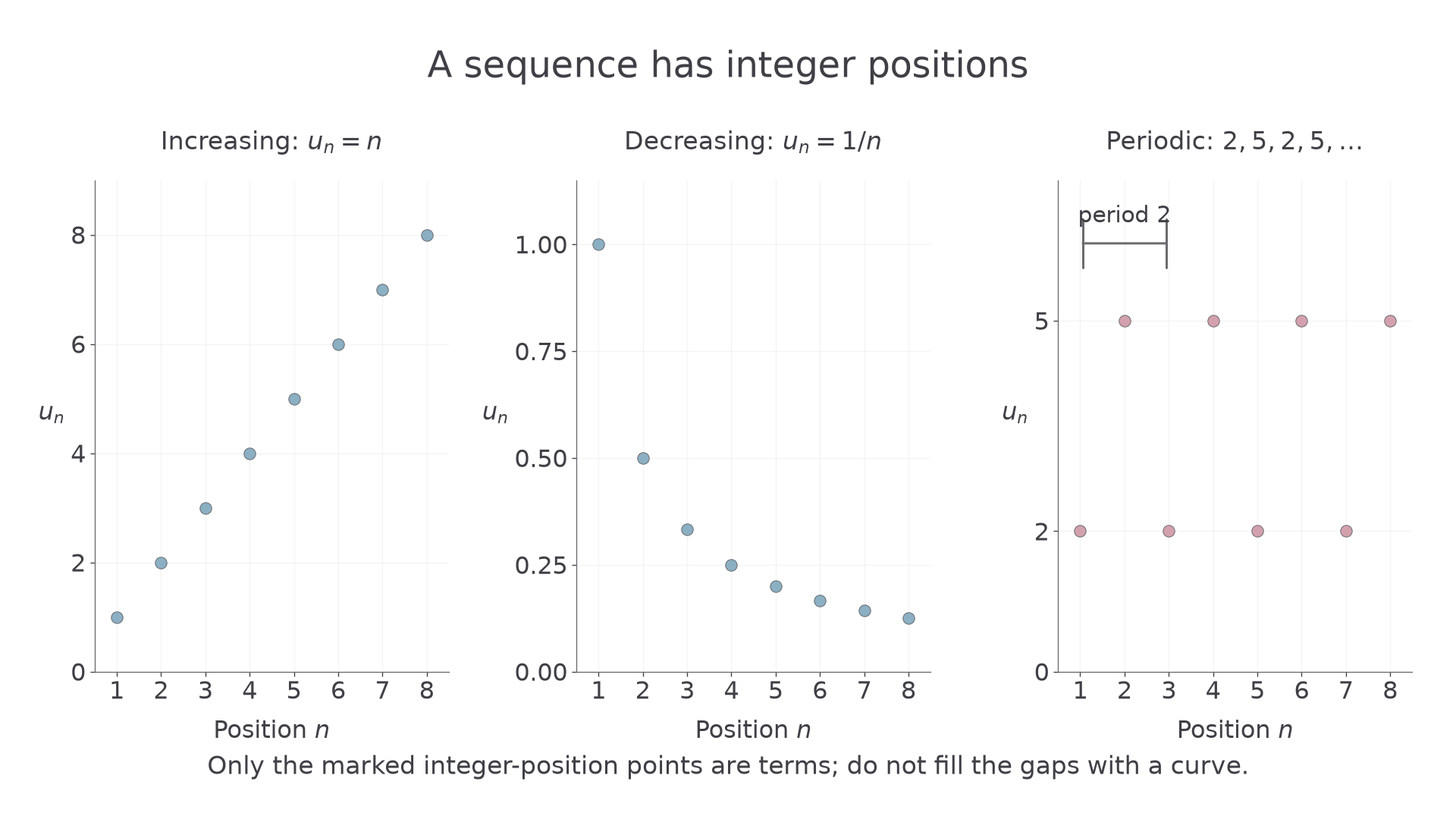
For increase and decrease, a difference calculation covers every position at once.
Worked example 5: proving increase
Question. Show that , for , is increasing.
Plan. Subtract the current term from the next and determine its sign for every positive integer .
Answer. Every next term is larger, so the sequence is increasing.
Check. The first four values are , with positive differences . These agree with at ; the algebra establishes all later cases.
Change only the sign of the explicit formula. Every term and every successive difference changes sign.
Worked example 6: proving decrease
Question. Show that , for , is decreasing.
Plan. Calculate the same next-minus-current difference, keeping the minus sign outside each square.
Answer. Every next term is smaller, so the sequence is decreasing.
Check. The values have differences , matching the negative of the previous example's differences.
A positive sequence can decrease too: for ,
Positivity describes the terms, while increase or decrease describes how they change. Periodicity needs a different comparison: compare a term with the one a fixed number of positions later.
Worked example 7: proving a period
Question. A sequence is defined by and . Find its first five terms and determine its period, justifying that it continues to repeat.
Plan. Generate the values, then apply the recurrence twice symbolically to check return to any current value.
For every ,
Answer. The first five terms are , and the period is . It is not period , since .
Check. Each update exchanges the two distinct values and . Returning after two updates applies indefinitely, not only for the first five terms.
Change only the initial term to . The same recurrence now starts exactly halfway between the two values it would exchange.
Worked example 8: when a repeating rule becomes constant
Question. A sequence is defined by and . Find its first five terms and determine its period.
Plan. Test the first update, then use its result to identify all later terms.
The next term is again , and the same reasoning continues.
Answer. The first five terms are . The period is : the sequence is constant, so it is neither strictly increasing nor strictly decreasing.
Check. A fixed value must satisfy . Solving gives , precisely the supplied initial term.
The opening puzzle now has a concrete answer: in Example 7, every even-positioned term is , so .
Watch out
A period must be the smallest positive repeat length. Example 7 also satisfies , but its period is , not . Example 8 has period , even though the two-update identity also holds.
Use the paired examples to analyse another initial value, rather than guessing from one repeated term.