P1 1.11 - Cubic and reciprocal graphs
Sketch simple cubic and reciprocal curves using roots, signs, intercepts and asymptotes. You will also interpret an equation as a search for shared points on two graphs, connecting an exact algebraic solution with its picture.
Cubic roots and end behaviour
Can two cubic graphs have the same general end directions but meet the horizontal axis a different number of times? Their leading terms control the distant ends; their factors tell us what happens at the roots.
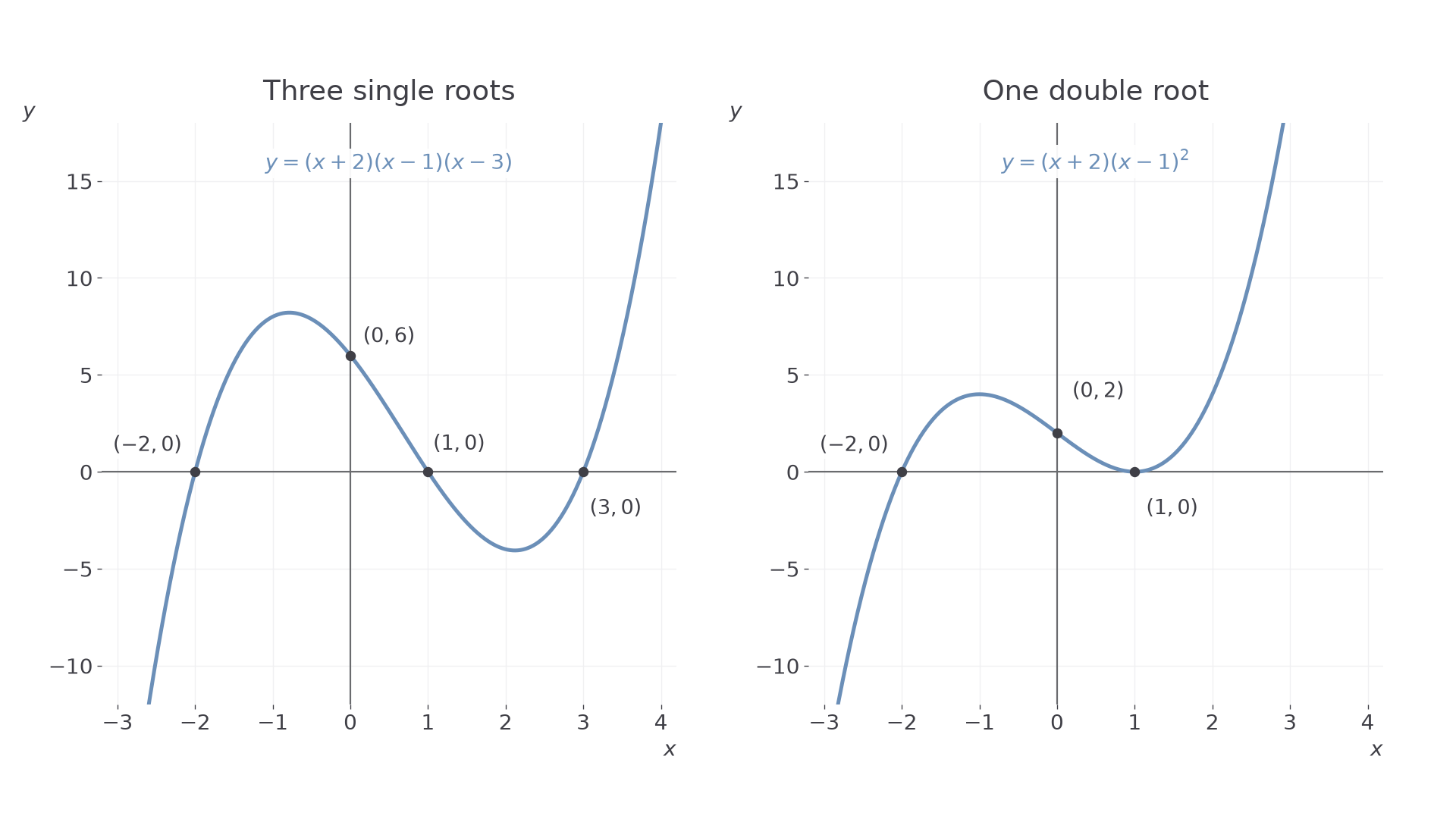
For , the height is zero at . Each single factor changes sign through its root, while the other two remain nonzero, so the curve crosses the axis at each root. At , , giving another exact point for a sketch.
Cubic graph features
A cubic polynomial has degree three, so its leading term is , where . Its end behaviour describes its direction for very large positive or negative . For , the left end is down and the right end is up; for , these directions reverse.
Why does the leading term decide? In , the cubic term eventually dominates the lower powers as the magnitude of increases. The exact roots and behaviour between them still depend on the other terms.
Worked example 1: three distinct roots
Question. Describe a sketch of , stating all axis intersections and both end directions.
Plan. Read the roots from the factors, substitute zero for the vertical intercept, and use signs between roots.
The signs in increasing -order are
The leading term is .
Answer. The curve crosses at , , , passes through , and runs from a downward left end to an upward right end, following the listed signs.
Check. Test values give , agreeing with the outer and middle signs.
Change only the final factor from to . Two roots now coincide, so the behaviour at changes.
Worked example 2: a repeated root
Question. Describe a sketch of , stating its axis intersections and end directions.
Plan. Distinguish the single root from the repeated root, then test the signs.
The squared factor is positive on either side of . Near , , so the curve stays above the axis on both sides and touches it at . At , the single factor changes sign.
Answer. Cross at , touch at , and pass through . The left end is down and the right end is up, since the leading term is still .
Check. At , ; at , . The sign does not change across the repeated root.
Compare the exact crossing and touching behaviour in these two pictures.
[DIAGRAM: asset_name: Distinct and repeated cubic roots; asset_slug: cubic-root-behaviour; caption: A single root crosses the axis; a double root touches without changing sign.; description: Two panels show y equals x plus two times x minus one times x minus three, then y equals x plus two times x minus one squared. Axis intersections and vertical intercepts are labelled, with the repeated root at one visibly touching the axis in the second panel.]
A root of multiplicity three, as in , still crosses the axis because an odd power changes sign. You do not need exact turning-point coordinates for these sketches unless the question asks for them; locating them by differentiation is a later method.
Watch out
A cubic need not have three distinct real roots. Count distinct axis intersections separately from repeated factors, and do not force a crossing at a double root.
Use the negative leading coefficient as well as the repeated factor.
Reciprocal graphs and asymptotes
A reciprocal curve behaves differently from a polynomial because its denominator excludes zero and splits the graph into separate branches.
For , the values at are . Increasing a positive denominator makes the height smaller, but never zero. As positive approaches zero, the denominator becomes tiny and the height grows without bound. Negative -values give negative heights.
Asymptote
An asymptote is a straight line that a curve approaches arbitrarily closely as a branch extends indefinitely. For and , with and , the axes and are asymptotes. These curves have no axis intersections.
Neither reciprocal form is defined at zero. Never join its two branches through the vertical axis. For these functions, the numerator is nonzero, so the output cannot equal zero either.
Worked example 3: a reciprocal first power
Question. Describe a sketch of , giving the asymptotes and useful exact points.
Plan. Calculate positive points, then use negative inputs to locate the other branch.
Positive inputs have positive heights; negative inputs have negative heights.
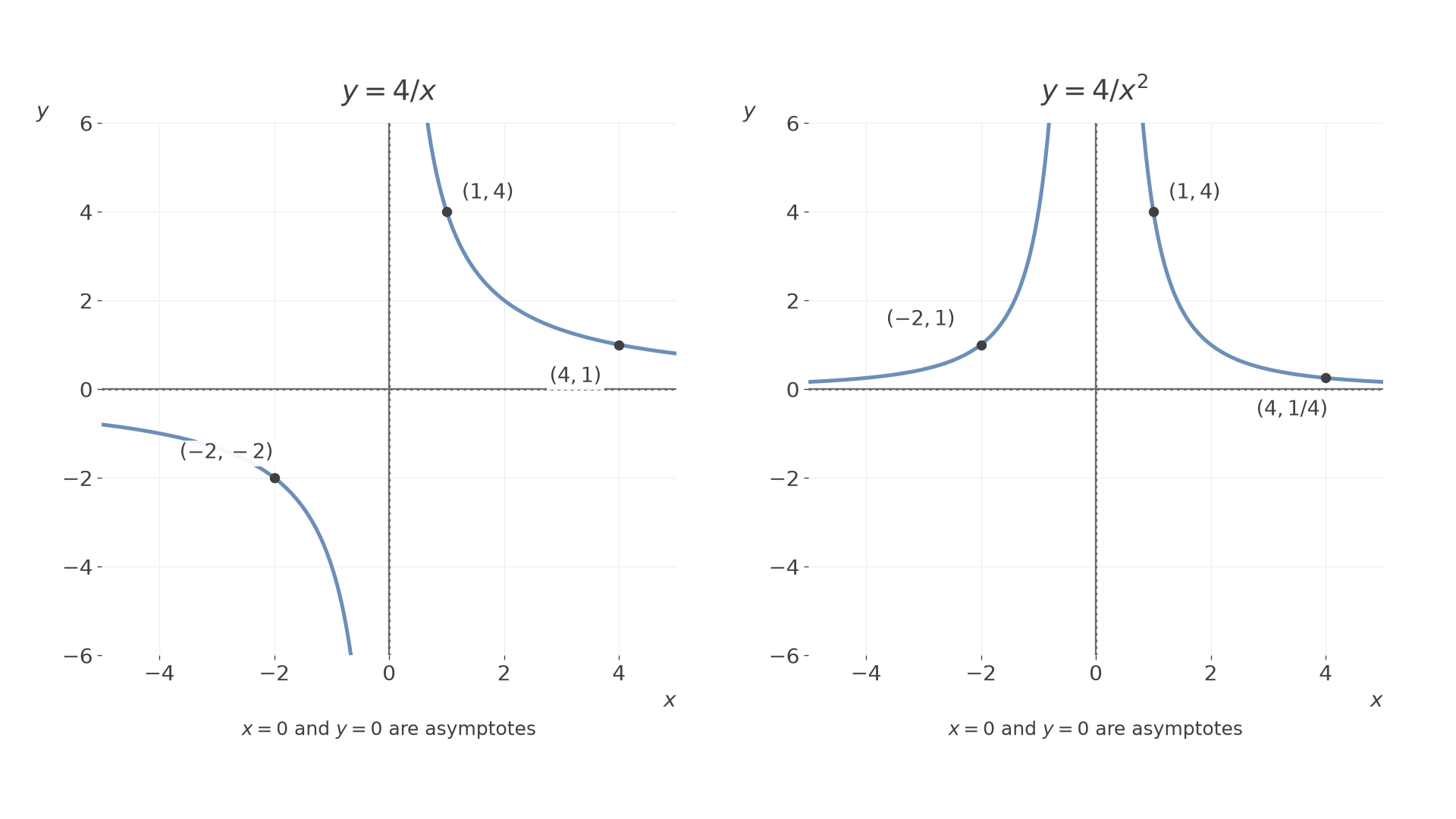
Answer. Draw branches in the first and third quadrants through the listed points, approaching but not meeting either axis. The asymptotes are and .
Check. Every listed point satisfies . Also, gives , continuing the approach towards the horizontal axis.
Change only the denominator's power from to . Negative inputs now produce the same heights as their positive partners.
Worked example 4: a reciprocal square
Question. Describe a sketch of , giving its asymptotes and useful exact points.
Plan. Square the inputs before dividing and use the resulting symmetry.
Answer. Both branches lie above the horizontal axis, are symmetric about the vertical axis, and approach and as asymptotes. Near zero, both branches rise without bound.
Check. Each listed point satisfies . At , the height is , confirming the rapid rise near the vertical asymptote.
The different denominator powers explain the different positions of the left branch.
[DIAGRAM: asset_name: Reciprocal and reciprocal-square branches; asset_slug: reciprocal-asymptotes; caption: Squaring the denominator makes both branches have the numerator's sign.; description: Two panels compare y equals four over x and y equals four over x squared, showing separate branches, labelled exact points, and dotted x equals zero and y equals zero asymptotes.]
For , all heights change sign. Thus has branches in the second and fourth quadrants, while has both branches below the horizontal axis. Changing the nonzero numerator changes heights, but does not move the asymptotes. For example, and .
Watch out
, whereas . Squaring the denominator changes its sign behaviour; it does not square the numerator.
Describe the branches using both the sign of the numerator and the squared denominator.
Intersections as equation solutions
An equation asks where two graphs have equal heights, so its real solutions are the horizontal coordinates of their intersections.
A graph can estimate how many intersections there are and where they lie. Algebra can then give exact coordinates. If you multiply an equation by a variable expression, preserve its exclusions: the original reciprocal curves still forbid .
Worked example 5: a line and a reciprocal
Question. Find the exact intersections of and .
Plan. Equate heights, multiply by nonzero , solve the quadratic and recover .
At , ; at , .
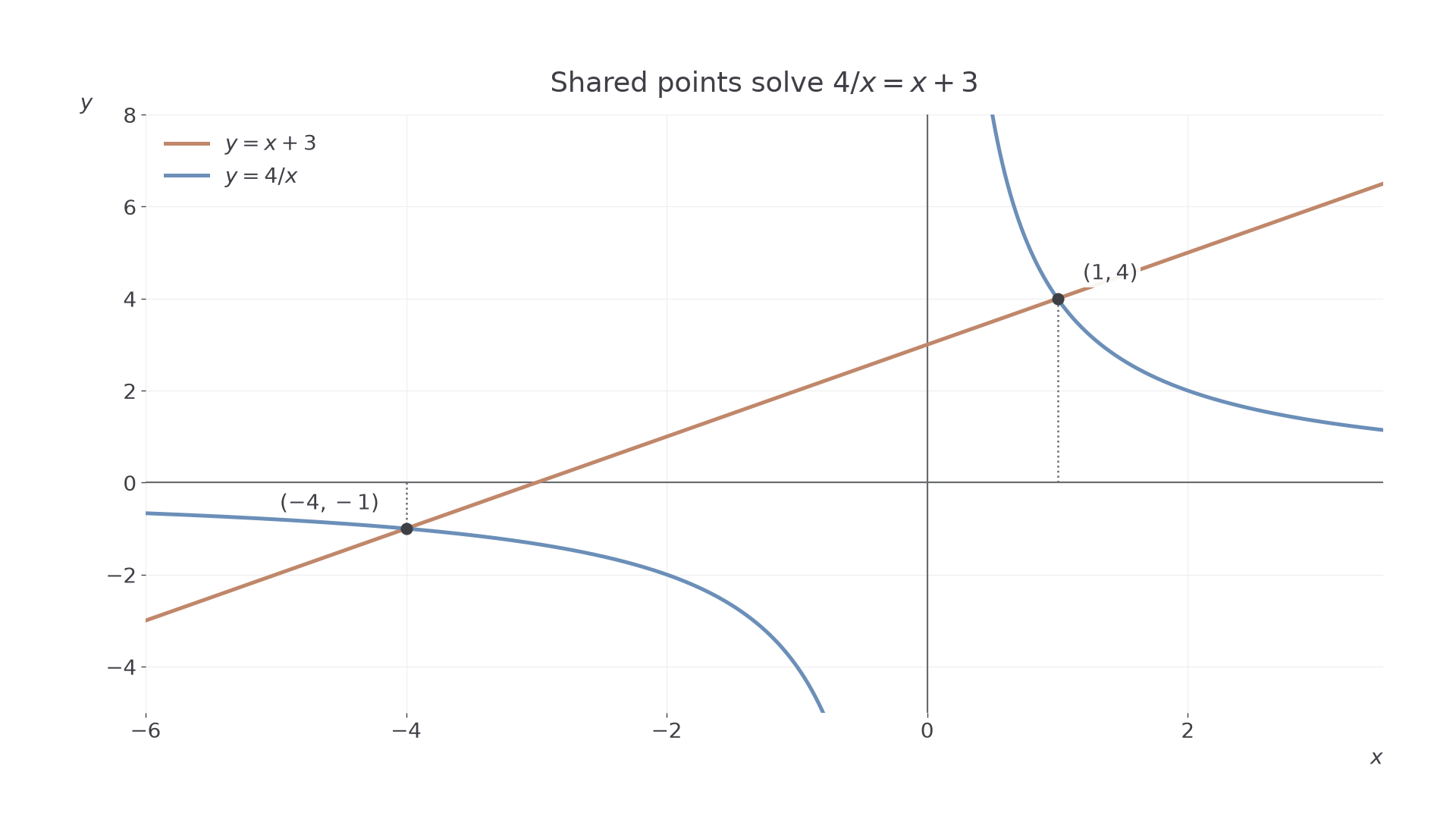
Answer. and .
Check. On the reciprocal, and ; both heights also equal .
The graph illustrates why the two algebraic solutions belong to different branches.
[DIAGRAM: asset_name: Solving an equation using graph intersections; asset_slug: reciprocal-line-intersections; caption: The x-coordinates of the two intersections solve four over x equals x plus three.; description: The line y equals x plus three intersects the two branches of y equals four over x at minus four comma minus one and one comma four, both labelled.]
Change only the reciprocal denominator from to , keeping the same line. The resulting equation is cubic, and a repeated root still represents only one point.
Worked example 6: a repeated intersection root
Question. Find the exact intersections of and .
Plan. Multiply the equal-height equation by , factorise the cubic and pair the distinct roots with their heights.
To find the factors using grouping, split into . This creates in both groups because :
Answer. and . The repeated root gives one intersection point, not two different points.
Check. and . Both inputs are allowed.
The equation may be cubic, but counting distinct real roots still tells us how many distinct intersection points occur. This also answers the opening question: the number of crossings depends on the roots, while the distant directions depend on the leading coefficient.
Watch out
An intersection's -coordinate solves the equation; its -coordinate is not an additional solution of that equation. If the question requests coordinates, back-substitute for the matching height.
Use the graph interpretation to organise the exact calculation.
Quick Recap
- Cubic roots locate axis intersections; single and double roots give crossing and touching behaviour.
- The sign of the cubic's leading coefficient controls its two end directions.
- For nonzero , and exclude zero and have the coordinate axes as asymptotes.
- Intersections give equation solutions through their horizontal coordinates; calculate heights when full coordinates are required.