P3 4.2 - Product and chain rules
Differentiate functions built by putting one function inside another or multiplying two functions together. Use their structure to choose the chain rule, the product rule or both, and check that no changing factor has been overlooked.
The chain rule
Can you differentiate without expanding it? The expression has an inside, , and an outside, raising to the twentieth power. Keeping that structure saves a great deal of algebra.
Let and . Near a particular point, a small change in produces approximately times that change in . A small change in then produces approximately times that change in . Multiply those two local rates:
Chain rule
If and are differentiable at the relevant points, then
Differentiate the outer function, keep its input unchanged, then multiply by the inner derivative. Not in the formula booklet: learn it.
The notation resembles cancelling , but the reason for the rule is composition of rates. There can be several layers. With , useful forms include
Use each formula only where the original function is defined and differentiable; in particular requires .
Worked example 1: a positive outer power
Differentiate .
Plan. Differentiate the cube first, then the quadratic inside.
Answer. .
Check. Expanding first gives , whose derivative factors to the same result.
Change only the outer exponent from to . The chain rule still applies without expansion.
Worked example 2: a negative outer power
Differentiate .
Plan. Apply the power rule to the whole bracket, then multiply by .
Answer. .
Check. At , the result is . A central secant with step gives approximately ; the function is decreasing for positive , agreeing with the sign.
The inner factor is essential. alone is a derivative with respect to , not with respect to .
The product rule
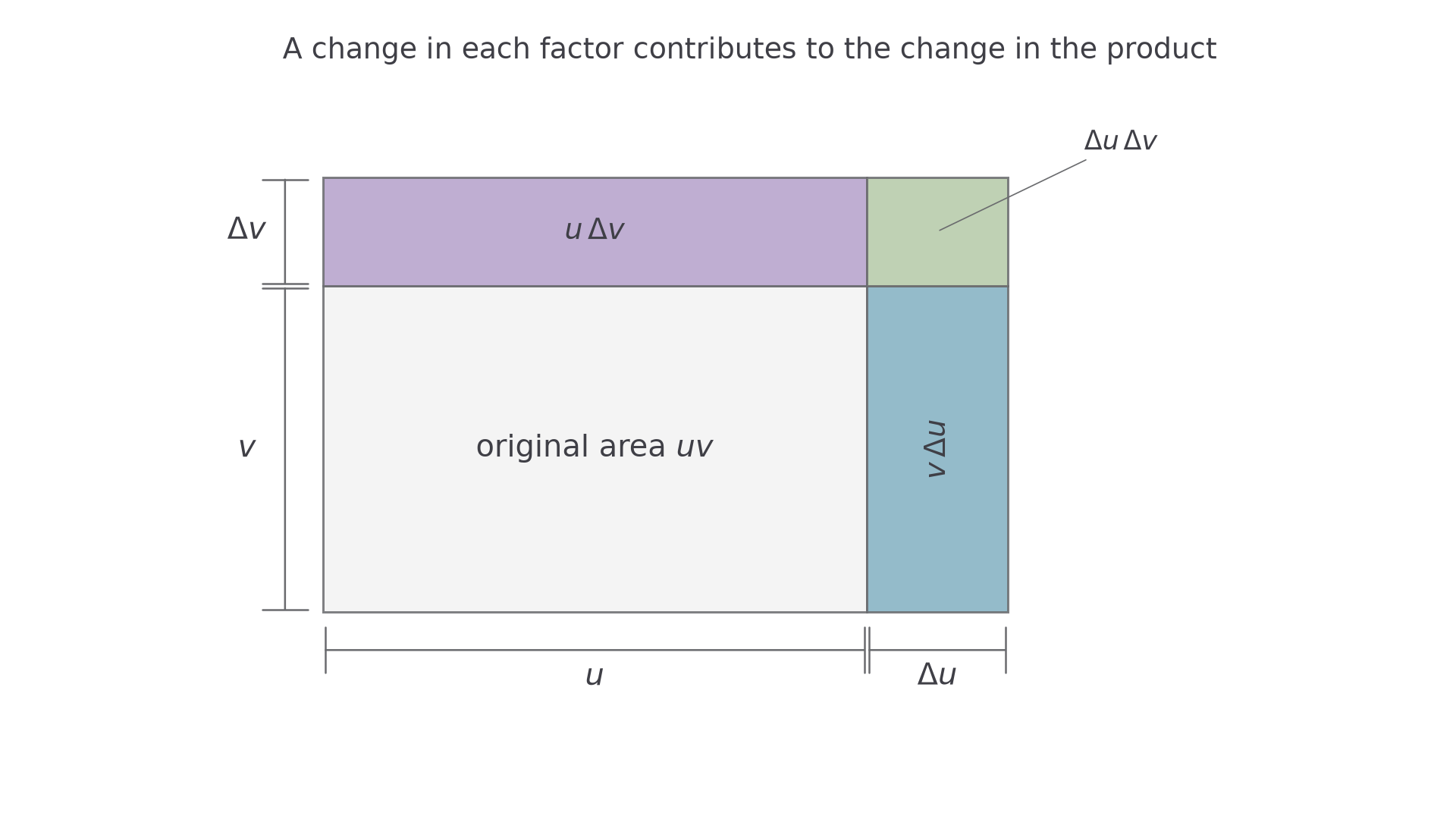
When two factors both change, each contributes to the change in their product.
Imagine a rectangle with side lengths and . Changing them by small amounts and changes its area by
After dividing by the input change and taking the derivative limit, the final tiny product term disappears. The two main contributions remain.
[DIAGRAM: asset_name: Two contributions to a changing product; asset_slug: product-area; caption: Each changing side adds a strip; both strips contribute to the product rule.; description: A rectangle of width u and height v is extended by positive increments delta u and delta v. The right strip is labelled v delta u, the top strip u delta v and the small corner delta u delta v. Brackets label the original and added side lengths.]
Product rule
For differentiable functions and ,
Differentiate one factor at a time and leave the other unchanged. Not in the formula booklet: learn it.
A numerical coefficient is constant, so it can stay outside the calculation. A sum of functions uses separate derivatives; a product requires this two-term rule.
Worked example 3: a polynomial times a sine
Differentiate .
Plan. Take , , then add their two contributions.
Answer. .
Check. At , the first contribution is zero and the second is . Near , the positive factor multiplies a sine changing from positive to negative, so a negative gradient makes sense.
Change only the polynomial exponent from to . Both contributions must be updated.
Worked example 4: a different power factor
Differentiate .
Plan. Keep the sine unchanged in the first term and the whole cubic unchanged in the second.
Answer. .
Check. At , the derivative is . A central secant with step gives approximately .
Continue this lesson.
You’re previewing NovaLearn without an account. Create a free account to read the rest.
Create free account