M2 2.3 - Equilibrium of a lamina
Use a lamina's centre of mass to determine its hanging orientation, balance moments about a horizontal axis, and find the onset of toppling on a slope. Relate the weight's vertical line of action to the pivot and the support.
Suspension from a point
Why does an unevenly shaped sign hang at a particular angle? Its weight acts through its centre of mass, and the support cannot balance a turning moment about the point from which it hangs.
Treat the lamina as rigid, with its weight acting vertically downwards at its centre of mass . When it hangs freely from a point , the support force acts at , so has zero moment about . Equilibrium requires the weight's line of action to pass through too.
Freely suspended equilibrium
A freely suspended lamina in stable equilibrium has its centre of mass vertically below the suspension point. A position with the centre directly above the pivot is also a zero-moment configuration, but is unstable: a small displacement turns it farther away.
Use the geometry of the original lamina to find the angle between and a marked edge. The entire lamina rotates without changing this angle; in its hanging position, is the downward vertical. If the centre coincides with the suspension point, weight produces no turning moment in any orientation and this rule does not select a unique angle.
[DIAGRAM: asset_name: A suspended lamina aligns its centre below the pivot; asset_slug: m2-suspended-lamina; caption: The angle between an edge direction and SG becomes the angle with the downward vertical.; description: A 6 by 4 rectangular lamina is shown before and after suspension from its top-left corner S. Its centre G is three units right and two below S in body coordinates. After rotation, SG is vertical downward; the left side makes angle arctan(3/2), or 56.3 degrees, with that vertical.]
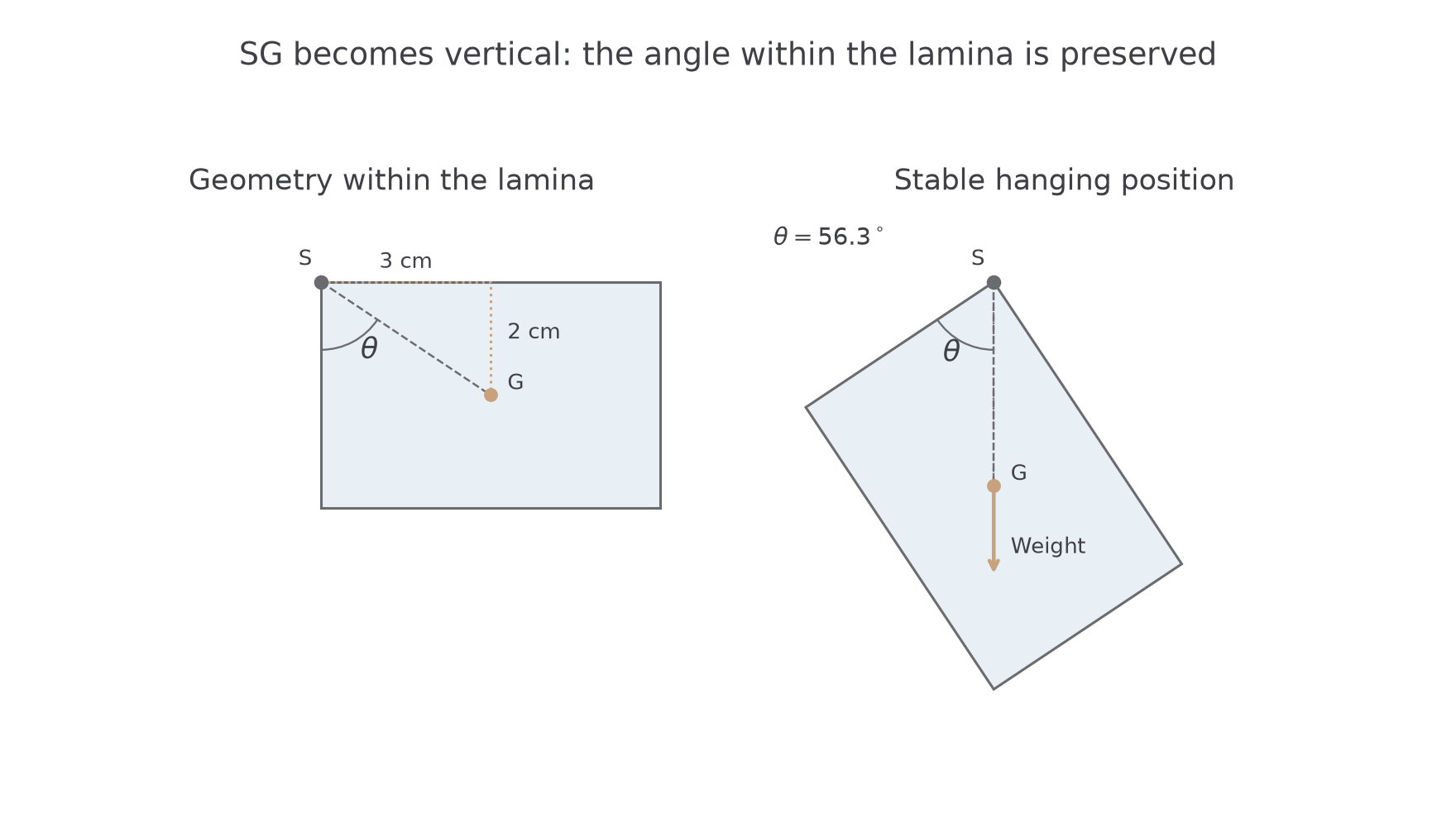
Worked example 1: suspension from a corner
A uniform rectangular lamina occupies , , in centimetres. It is freely suspended from . Find the acute angle between its left side and the downward vertical in stable equilibrium.
Plan. Locate , then calculate the angle between and the left side directed downwards from .
Answer. , to three significant figures.
Check. ; its components perpendicular and parallel to the left side have lengths and . Thus , giving the same acute angle.
Change only the suspension point, moving it one centimetre along the top edge. The centre of mass remains fixed within the lamina.
Worked example 2: suspension away from a corner
The same uniform rectangle is freely suspended from . Find the acute angle between a line parallel to its left side and the downward vertical in stable equilibrium.
Plan. Recalculate the displacement from the new pivot to .
Answer. .
Check. The horizontal and vertical separations in the lamina are equal, so the triangle determining the angle is right-angled and isosceles.
In a composite lamina, first find by mass moments, then do this same geometry. Distance along a side and distance from a different axis must not be mixed.
Watch out
The requested angle may be with a particular edge, rather than with a coordinate axis. Mark that edge and on the original shape before choosing the tangent ratio; the reciprocal gives the complementary angle.
Translate the geometry from the given centre and suspension point.
Rotation about a horizontal axis
A fixed horizontal axis can support a lamina while allowing it to turn; taking moments about that axis removes the unknown support force from the moment equation.
Consider a lamina standing in a vertical plane, with a smooth horizontal axle through a point , perpendicular to its plane. In this model the axle allows free rotation and supplies no resisting couple. Its force acts at . Other forces, including weight at , must have zero resultant moment about the axle for equilibrium.
Moment balance about the axis
Here is the perpendicular distance from the axis to the force's line of action. Equivalently use times the distance from the pivot, where is the angle between that distance and the force. These results are not printed in the formula booklet: learn them.
For vertical weight, its lever arm is the horizontal distance from to , not necessarily the sloping length . Force balance still determines the support force if it is requested; moment balance alone does not remove that physical force.
[DIAGRAM: asset_name: Holding a lamina about a horizontal axle; asset_slug: m2-lamina-axle; caption: Only the component perpendicular to AB creates a moment for the force applied at B.; description: A rectangular lamina in a vertical plane has lower-left pivot A, lower-right point B six centimetres to its right, and centre G at (3,2). Weight 40 newtons acts downward at G. A force at B acts either vertically upwards or at 30 degrees above horizontal; the latter has turning component F sin 30.]
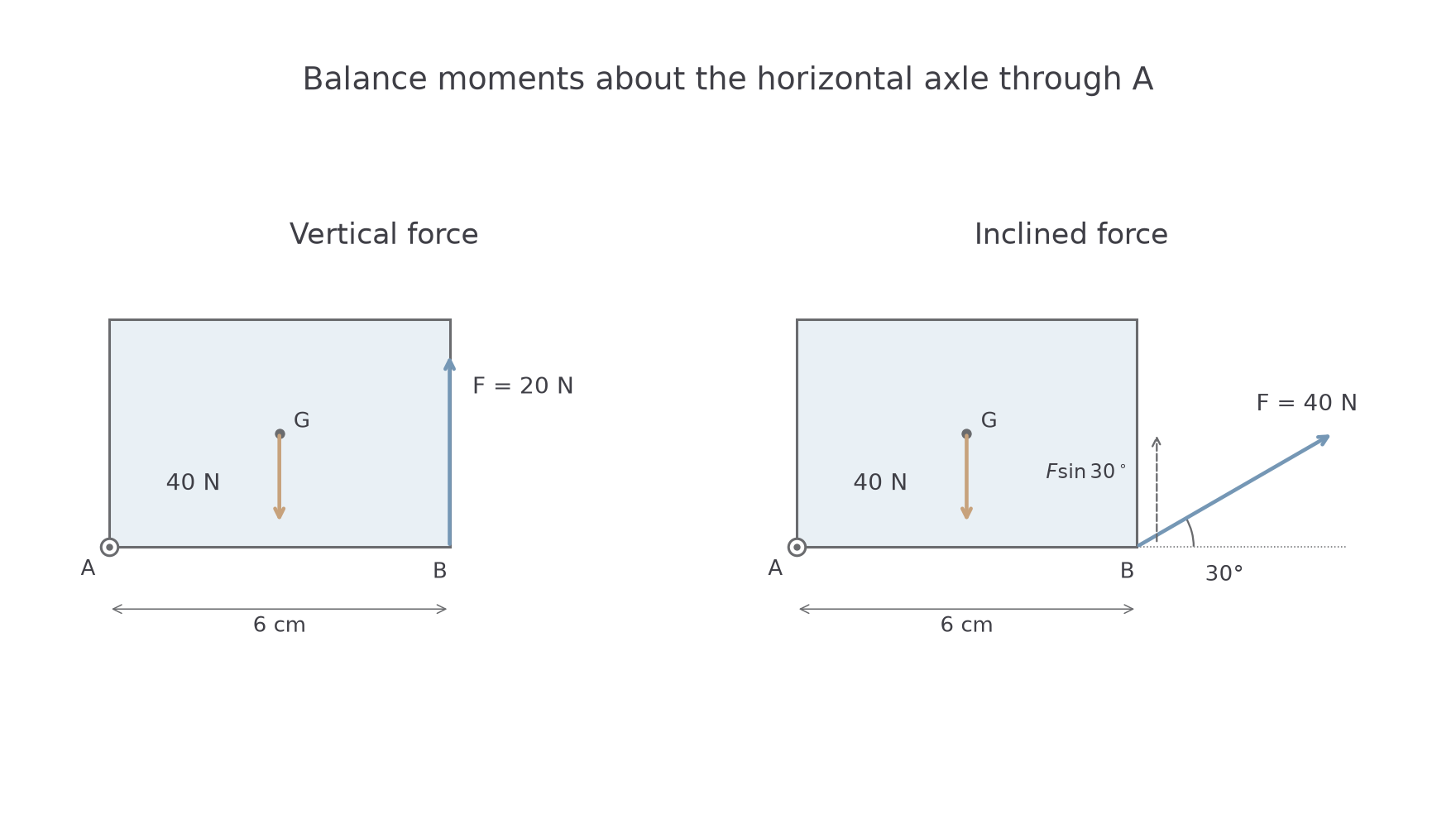
Worked example 3: a vertical holding force
A uniform rectangular lamina, wide and high, has weight . It turns freely about a horizontal axle through its lower-left corner , perpendicular to the lamina. A vertical upward force at the lower-right corner holds its lower edge horizontal. Find this force.
Plan. Take moments about , using the horizontal distances to and to the centre.
Using centimetres consistently in both moments is valid; both sides then have units .
Answer. upwards.
Check. The force is half the weight and acts at twice its lever arm, so their moments are equal and opposite.
Continue this lesson.
You’re previewing NovaLearn without an account. Create a free account to read the rest.
Create free account