P2 3.1 - Tangents and chords
Use perpendicular radii, chord midpoints and the angle in a semicircle to solve circle problems. Connect these geometric properties to line equations and simultaneous equations, including lines that cut, touch or miss a circle.
Radius perpendicular to tangent
Can parallel lines cut a circle twice, touch it once, or miss it altogether? Their direction alone cannot decide this: their position matters too. We will begin with the line that just touches the circle.
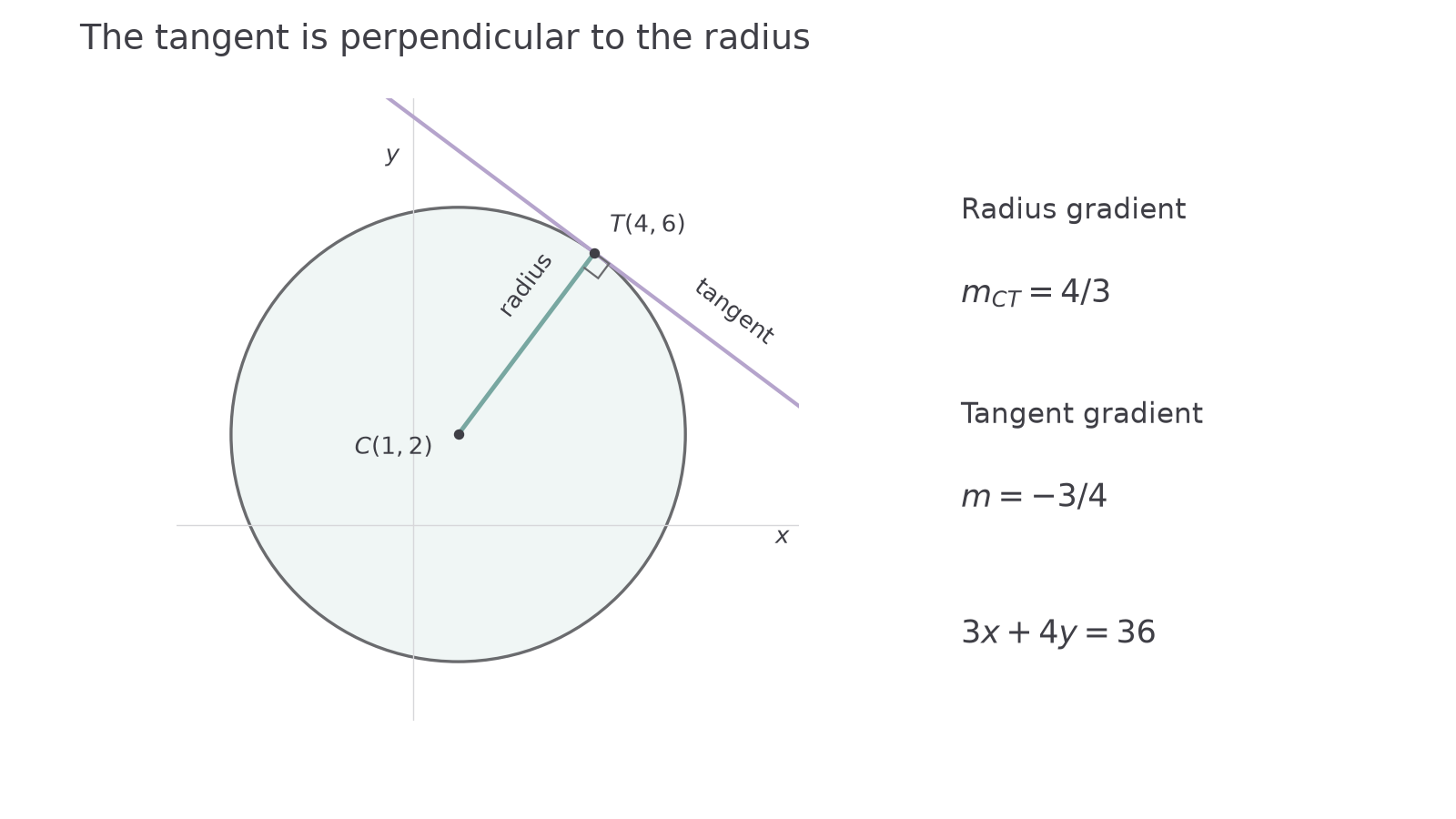
For a circle with centre , the point has squared distance , so it lies on the circle of radius . The radius fixes the tangent's direction because they meet at a right angle.
[DIAGRAM: asset_name: Tangent and radius; asset_slug: tangent-perpendicular-radius; caption: The tangent at T is perpendicular to CT and passes through T.; description: Equal-scale coordinate diagram of the circle with centre (1,2) and radius 5, its point T(4,6), the radius CT and tangent 3x+4y=36. A right-angle marker is drawn at T, away from the coordinate labels.]
Tangent
A tangent to a circle is a straight line meeting the circle at exactly one point. The radius to that point is perpendicular to the tangent. For two nonvertical lines with nonzero gradients , perpendicularity means ; horizontal and vertical lines form the exceptional pair.
To find a tangent, first check that the stated point lies on the circle. Then use its radius, rather than a line from the origin, to find the perpendicular direction.
Worked example 1: a sloping tangent
Question. Find the tangent at to .
Plan. Find the radius gradient from , take its negative reciprocal, then use the point .
Multiplying out gives .
Answer. .
Check. satisfies the line, since . The product of gradients is , so the line is perpendicular to the radius at a point on the circle.
Change only the point of contact to , on the same circle. The radius is now horizontal, so the tangent needs a vertical equation.
Worked example 2: a vertical tangent
Question. Find the tangent at to .
Plan. Recognise the horizontal radius from to , then draw its perpendicular through .
The radius has constant . Its perpendicular has constant , and must pass through .
Answer. The tangent is .
Check. Substitution into the circle gives , so is the only intersection. Thus the line touches at exactly .
The negative-reciprocal calculation is useful only when the gradients exist and are nonzero.
Watch out
A vertical line has undefined gradient, not gradient zero. Do not try to calculate : use the fact that a horizontal radius has a vertical tangent, and a vertical radius has a horizontal tangent.
Locate the radius direction before writing the tangent.
Centre perpendicular bisects a chord
The perpendicular from a circle's centre to a chord meets the chord at its midpoint, splitting a chord-length problem into two equal right triangles.
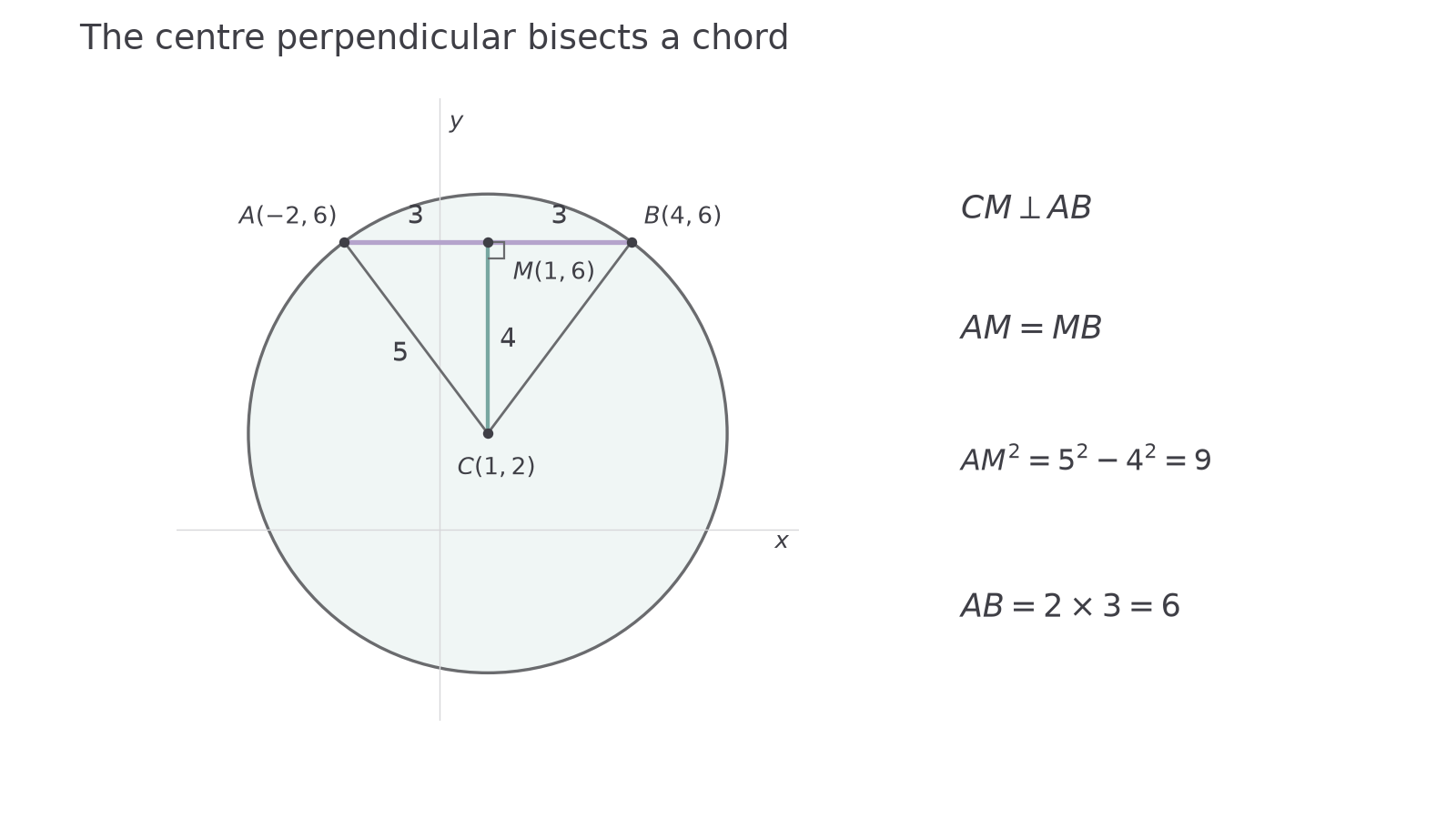
A chord joins two points on a circle. If its midpoint is , each half-chord is a leg of a right triangle with hypotenuse and other leg . Equal radii give the two right triangles equal hypotenuses and a shared side; their half-chords are therefore equal.
[DIAGRAM: asset_name: A perpendicular bisects a chord; asset_slug: chord-midpoint-triangle; caption: CM is perpendicular to AB, so AM equals MB and each can be found by Pythagoras.; description: Equal-scale circle with centre C(1,2), radius 5, horizontal chord y=6, endpoints A(-2,6) and B(4,6), midpoint M(1,6), perpendicular CM of length 4 and half-chords of length 3. The right-angle marker at M and labels are separated.]
Half-chord length
If a chord is a perpendicular distance from the centre of a circle of radius ,
The perpendicular meets the chord at its midpoint. A chord through the centre is a diameter and has length .
Not in the formula booklet: learn it.
For a sloping chord, find that midpoint by intersecting the chord with its perpendicular through the centre. This avoids assuming a right angle that is not given.
Worked example 3: a sloping chord with a known centre
Question. A circle has centre and radius . Its chord endpoints are and . Find the chord length using the perpendicular from the centre.
Plan. Find the chord's midpoint, calculate its distance from the centre, then double the half-chord.
The centre perpendicular meets the chord at , so
Answer. The chord length is .
Check. The direct endpoint distance is , agreeing with the half-chord method.
Keep the chord endpoints and change only the information supplied about the centre: its vertical coordinate is now unknown. The perpendicular bisector lets us recover it.
Worked example 4: locating an unknown centre
Question. and lie on a circle with centre . Find and an equation for the circle.
Plan. Find the perpendicular bisector of , put to locate the centre, then calculate the squared radius.
The midpoint remains , and
The perpendicular bisector therefore has equation
The centre lies on this line. At , , so . Using ,
Answer. , and the circle is .
Check. 's squared distance from is , so the second given point lies on this circle too.
If the chord line is supplied instead of its endpoints, locate its midpoint by intersecting that line with the perpendicular through the known centre. The same right triangle then gives the length.
Watch out
A chord is not automatically a diameter. Use the centre-to-chord perpendicular to justify the right triangle; the triangle formed by the centre and the two chord endpoints is generally not right-angled.
Find the midpoint before the length for this new parallel chord.
Angle in a semicircle
Joining the endpoints of a diameter to another point on the circle always forms a right angle at that third point.
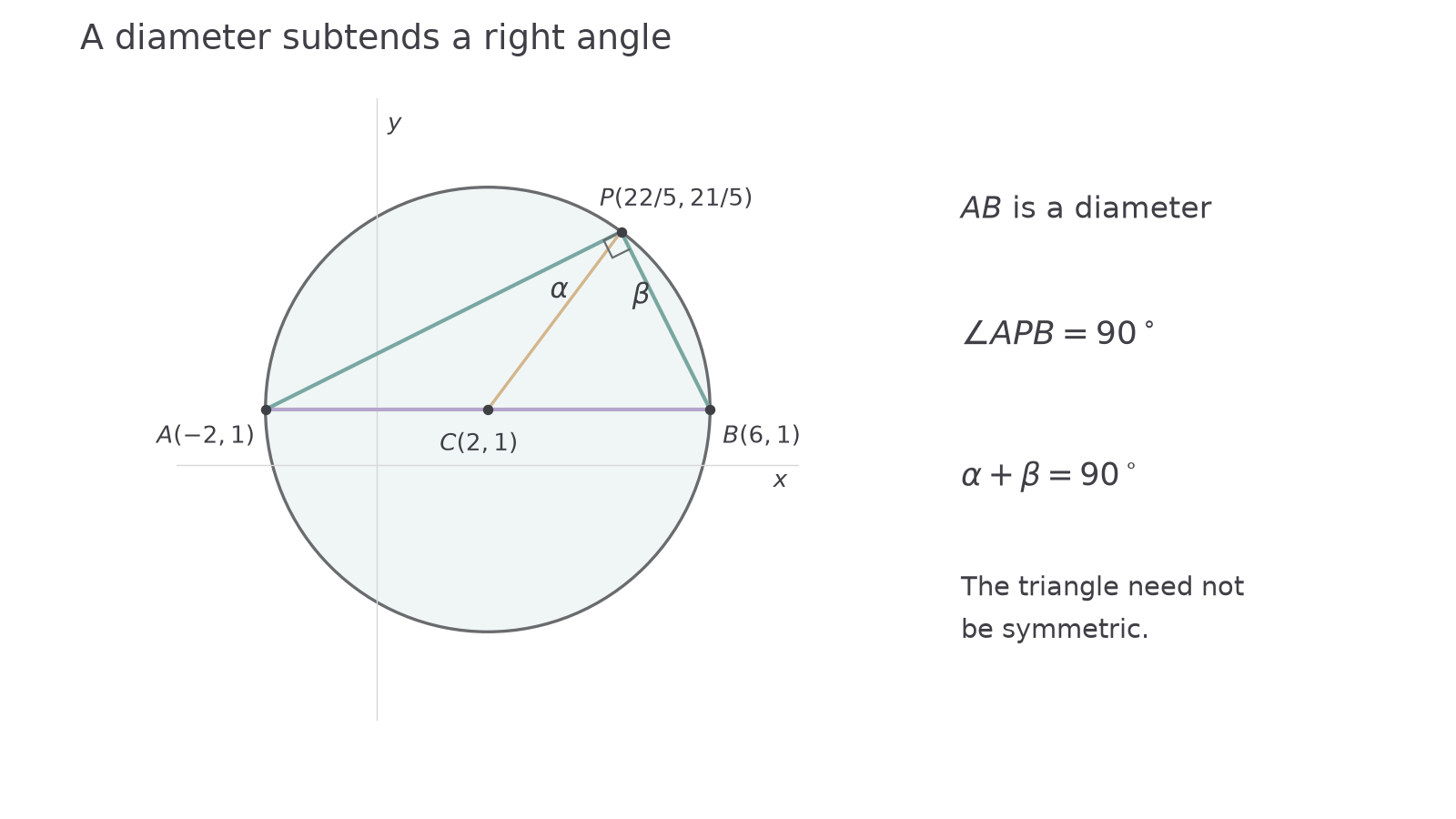
Let be a diameter, its centre and a different point on the circle. The triangles and are isosceles because their sides from are radii. If their base angles at are , the angles of triangle are . Their sum is , so and the angle at is .
[DIAGRAM: asset_name: The angle in a semicircle; asset_slug: semicircle-right-angle; caption: AB is a diameter, so the angle APB is a right angle even when P is away from the top of the circle.; description: Equal-scale diagram of circle centre (2,1), radius 4, diameter endpoints A(-2,1), B(6,1), and an asymmetric point P(22/5,21/5). Segments AP, BP and CP are drawn, with the right angle at P and distinct base-angle alpha and beta labels inside the triangle.]
Angle in a semicircle
If are the endpoints of a diameter and is another point on the circle, then
The right angle is at the circumference, opposite the diameter.
Not in the formula booklet: learn it.
Coordinates provide a useful independent way to verify the perpendicular lines.
Worked example 5: checking the right angle
Question. A circle has diameter endpoints and . Verify that is on the circle and that .
Plan. Use the midpoint and radius to check membership, then compare the gradients.
The centre is and , so the circle is . At , . Also
Answer. is on the circle and , since the gradients multiply to .
Check. The squared side lengths are . Pythagoras independently confirms a right angle at .
Move only along the same circle. The two shorter sides are no longer equal, but the right angle remains.
Worked example 6: an asymmetric triangle
Question. For the same diameter endpoints, verify that is on the circle and .
Plan. Check the circle equation and calculate each gradient exactly.
The gradients are
Answer. is on the circle and the lines are perpendicular because .
Check. The squared lengths are and . Their sum is , agreeing with the right angle.
The diameter condition is essential: an arbitrary chord does not guarantee a right angle at a third point on the circle.
Watch out
The centre lies on the diameter, but the theorem's right angle is at , not at the centre. A sketch that happens to look symmetric is not the reason the angle is right.
Check the theorem with a fresh circle.
Combining circle geometry with line equations
Substituting a line equation into a circle equation tells you whether the line cuts, touches or misses the circle.
The resulting quadratic has two distinct real roots for two intersections, one repeated real root for a tangent, and no real roots when the line misses. Geometry then checks the algebra: two intersections give a chord; one intersection has a perpendicular radius.
You already know
For a quadratic , the discriminant is positive for two distinct real roots, zero for a repeated real root, and negative for no real roots. Use this after substitution; a sketch alone cannot decide exact tangency.
Keep the coordinates exact until the geometric conclusion is settled.
Worked example 7: two intersections and a chord
Question. Find the intersections of with , and hence find the chord length.
Plan. Substitute , solve the quadratic, then use the distance between the intersection points.
Thus or ; the corresponding points are and .
Answer. The chord joins those two points and has length
Check. Both points satisfy the line and circle. Their midpoint is , distance from the origin; the half-chord is therefore , confirming total length .
Change only the line's constant from to . Its gradient stays the same, but the two intersection points merge.
Worked example 8: recognising a tangent algebraically
Question. Show that is tangent to , and find the point of contact.
Plan. Substitute the line into the circle and look for a repeated root.
The only solution is , giving .
Answer. The line is tangent at , since there is exactly one intersection.
Check. The radius from the origin has gradient , while the line has gradient . They are perpendicular, and satisfies both equations.
This answers the opening question: shifting a parallel line can produce two intersections, then tangency, then no intersection.
Watch out
A root of the substituted quadratic is an -coordinate, not a complete point. Substitute it into the line to obtain the corresponding , keeping the coordinates paired.
Move the line farther from the centre and use algebra to decide what happens.
Quick Recap
- A radius to a point of tangency is perpendicular to the tangent.
- A perpendicular from the centre bisects a chord.
- The angle opposite a diameter at the circumference is a right angle.
- Line-circle substitution turns intersections into a quadratic problem.
Parallel lines can cut, touch or miss the same circle: changing position changes the number of real intersections.