P1 1.3, P1 1.5 - Quadratic graphs and completed squares
Read the key features of a quadratic graph and rewrite its equation to reveal its turning point. P1 1.3 connects the algebra to the graph; P1 1.5 supplies completing the square, which can reveal a minimum or maximum without plotting a table of values.
Roots and intercepts
What is the smallest possible value of ? Its expanded form hides the answer. Before uncovering it, connect the forms you already know to points on a graph.
Quadratic function
A quadratic function has the form , where are real and . Its graph is a parabola, opening upwards if and downwards if .
The -intercept occurs at , so its coordinates are . A root is a value of for which ; a real root gives an -intercept . In factorised form, a product is zero exactly when at least one factor is zero. Thus gives or .
Worked example 1: intercepts of an upward parabola
Find the axis intercepts and direction of opening of .
Plan. Set each factor to zero for the -intercepts, then substitute .
Expanding would give leading term , with positive coefficient.
Answer. , and ; the parabola opens upwards.
Check. Substituting or makes one factor zero. At , , so the curve does lie below the axis between its two crossings.
Change only the overall sign of the function. Multiplying by changes nonzero heights, but zero remains zero.
Worked example 2: changing the leading sign
Find the axis intercepts and direction of opening of .
Plan. Keep the same zero factors, then include the minus sign in the -intercept.
The leading term is now .
Answer. , and ; the parabola opens downwards.
Check. At , , the opposite height from Example 1. Both original root substitutions still give zero.
The graphs show what changed and what stayed fixed.
[DIAGRAM: asset_name: Quadratic intercepts and leading sign; asset_slug: quadratic-intercepts; caption: Opposite leading signs reverse the heights but preserve the two roots.; description: The graphs y equals (x minus 1)(x minus 5) and y equals negative (x minus 1)(x minus 5) on the same labelled axes. Both cross at (1,0) and (5,0). Their y-intercepts are (0,5) and (0,negative 5).]
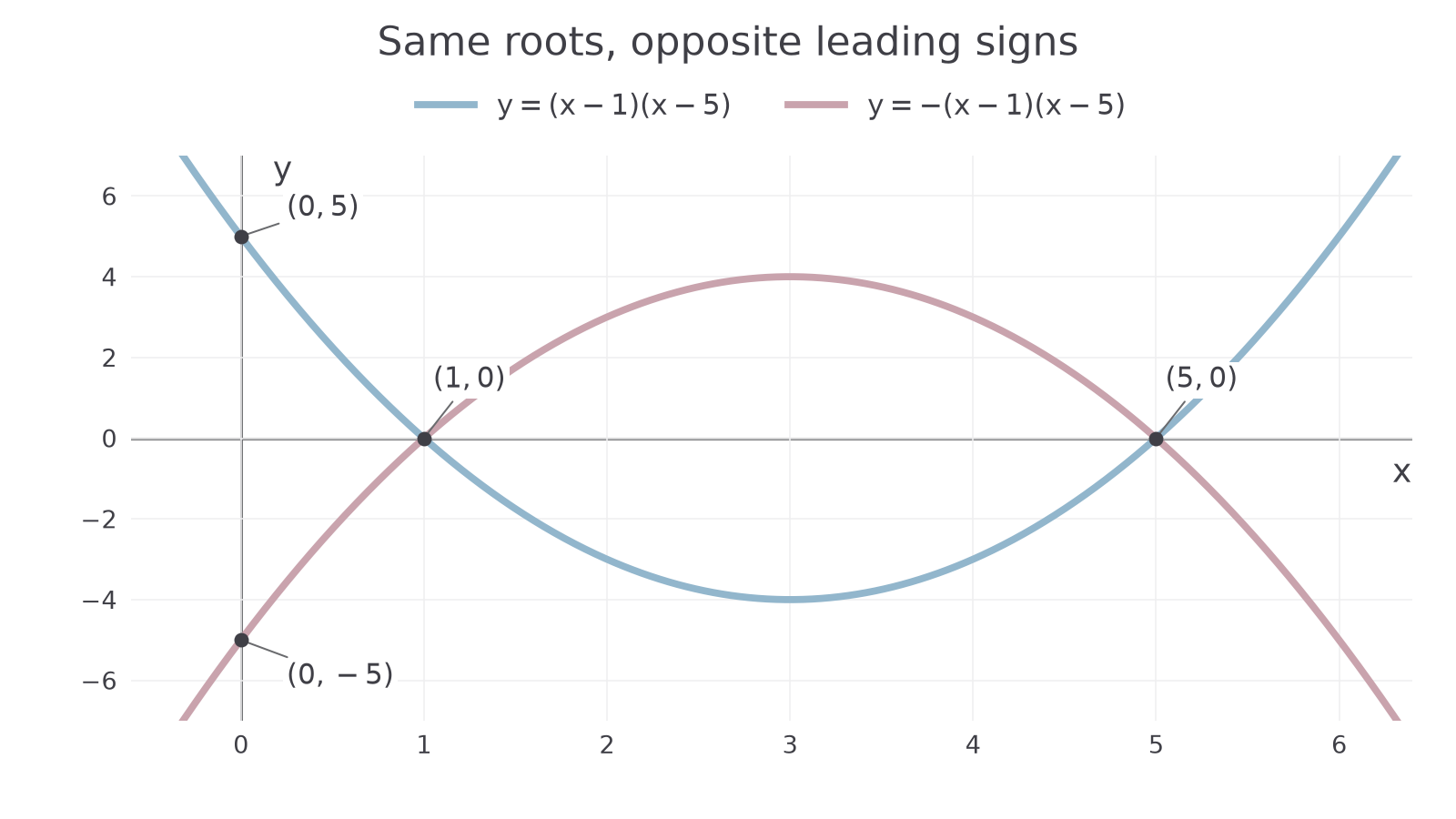
A root is one coordinate value; an intercept is a point.
Watch out
The root from is , not . Report an intercept as when coordinates are requested.
Use the factorised form directly.
Completing a monic square
Completing the square rewrites a quadratic as a squared bracket plus a constant; it does not change the function.
Expanding gives . To match , choose . The bracket then contains an extra , which must be subtracted outside:
The coefficient on makes this a monic quadratic.
Completing a monic square
For real ,
Halve the linear coefficient for the bracket; subtract the square you have added.
Not in the formula booklet: learn it.
The correction outside the bracket keeps the equality true for every .
Worked example 3: a positive linear coefficient
Complete the square for .
Plan. Use , then adjust its constant from to .
Answer. .
Check. Expanding gives .
Change only the sign of the linear term. The bracket sign changes; the square of its constant does not.
Worked example 4: a negative linear coefficient
Complete the square for .
Plan. Halve to get , then subtract the extra .
Answer. .
Check. At , both forms give . Expanding the square gives the required middle term .
The bracket constant is half the linear coefficient, not half the constant term.
Watch out
. The right side has constant . Subtracting the added repairs the equality.
Keep the correction outside the square.
Completing a non-monic square
When the coefficient of is not , take it outside the quadratic and linear terms before completing the square.
For , start with . Completing the square inside gives . The outside multiplies the correction as well as the square.
Completing a general quadratic
For real , with ,
Factoring out first explains each term; the formula also works when .
Not in the formula booklet: learn it.
Keep the outside coefficient visible until the final constant is simplified.
Worked example 5: an outside factor of two
Complete the square for .
Plan. Factor from the first two terms, then complete the square inside.
Answer. .
Check. Re-expanding gives . At , both forms give .
Change only the leading coefficient in the original expression from to . The inside linear coefficient changes when that factor is removed.
Worked example 6: a negative outside factor
Complete the square for .
Plan. Factor from the first two terms, so the inside square starts with .
The correction becomes positive because .
Answer. .
Check. At , the original is , matching the completed form. Expanding also restores all three coefficients.
The correction belongs inside the bracket until multiplied out.
Watch out
becomes , not . The outside factor multiplies both terms.
Use the same method with a different coefficient.
Vertex and symmetry from completed form
In , the squared term is zero at , and equal positive distances on either side of give equal heights.
Vertex and axis of symmetry
The vertex, or turning point, of is . The axis of symmetry is the vertical line . If , the vertex is a minimum; if , it is a maximum.
The reason is that for real . Multiplying by positive keeps it nonnegative, so . Multiplying by negative makes it nonpositive, so . There is no real value of that can push the graph past that bound.
Worked example 7: finding a minimum
Find the vertex, axis of symmetry and minimum value of .
Plan. Use Example 5's completed form and the nonnegative square.
with equality exactly when .
Answer. Vertex , axis , minimum value at . This answers the opening question.
Check. At and , the original function gives in each case, consistent with symmetry and both above the minimum.
Change only the coefficient of the squared term from to , keeping the same vertex.
Worked example 8: finding a maximum
Find the vertex, axis of symmetry and maximum value of .
Plan. A negative multiple of a nonnegative square cannot exceed zero.
with equality at .
Answer. Vertex , axis , maximum value at .
Check. At and , , equal heights below . At the vertex, substitution gives .
Both curves have the same turning point, while the sign determines which way they open.
[DIAGRAM: asset_name: A square reveals a turning point; asset_slug: completed-square-vertices; caption: The same squared bracket gives the same symmetry line; its coefficient decides minimum or maximum.; description: Two side-by-side graphs, y equals 2(x minus 2) squared minus 3 and y equals negative 2(x minus 2) squared minus 3. Each has vertex (2,negative 3) and dashed symmetry line x equals 2; the first has a minimum and the second a maximum.]
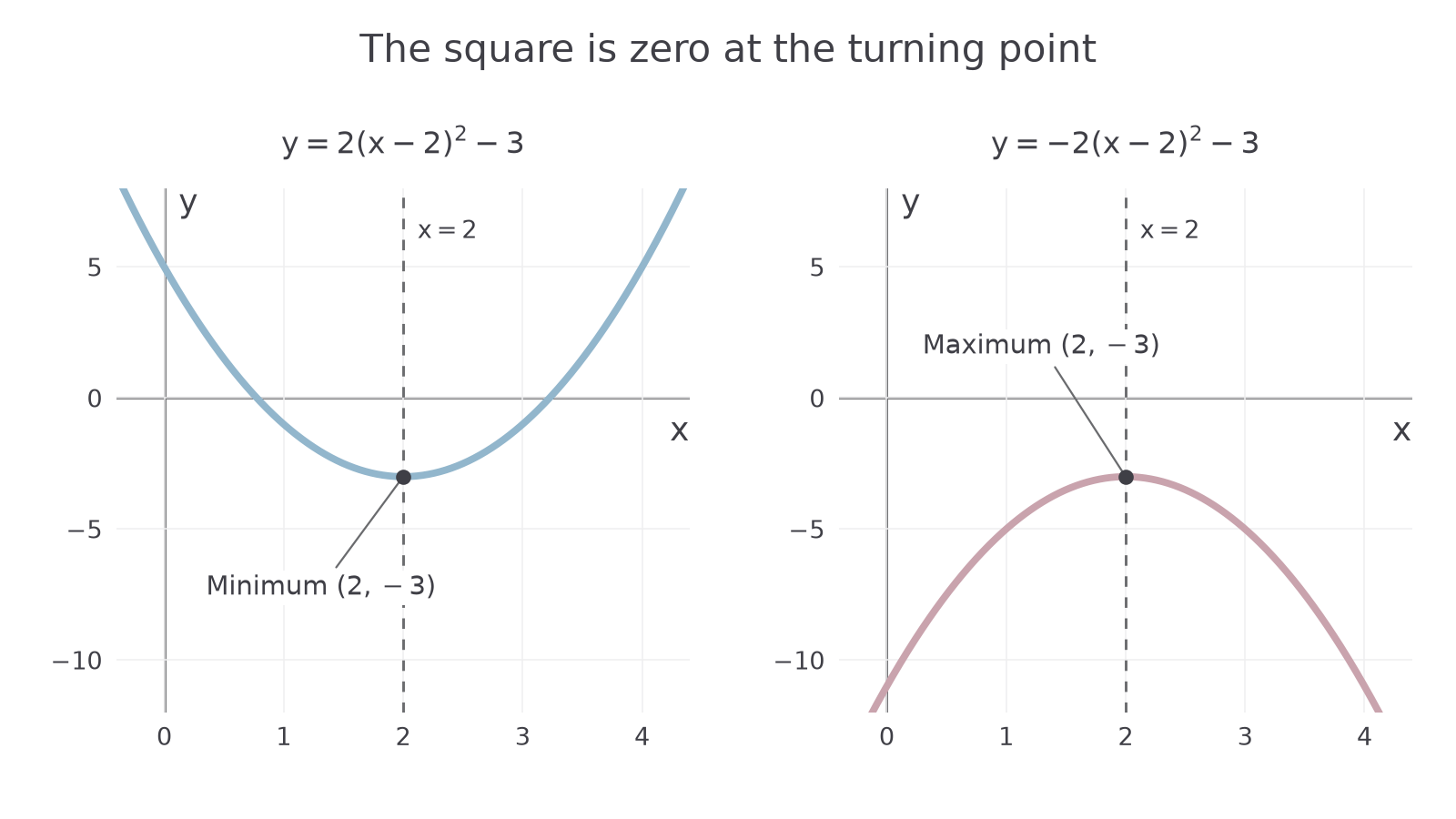
Read the value that makes the whole bracket zero.
Watch out
, so has vertex , not . A minimum value is a height; its location is an -value.
Combine completing the square with a turning-point statement.
Quick Recap
- Factorised form exposes real roots; gives the -intercept.
- Complete a monic square by halving the linear coefficient and correcting the constant.
- With a non-monic quadratic, apply the outside coefficient to the correction too.
- has vertex , symmetry line , and minimum or maximum height .
The smallest value of is , reached at .