M1 6.1 - Moments and parallel forces
Measure a force's turning effect using perpendicular distance, then balance both forces and moments on a body. You will calculate support forces and use a non-uniform rod's given centre of mass, including the instant a support loses contact.
Perpendicular distance and moment
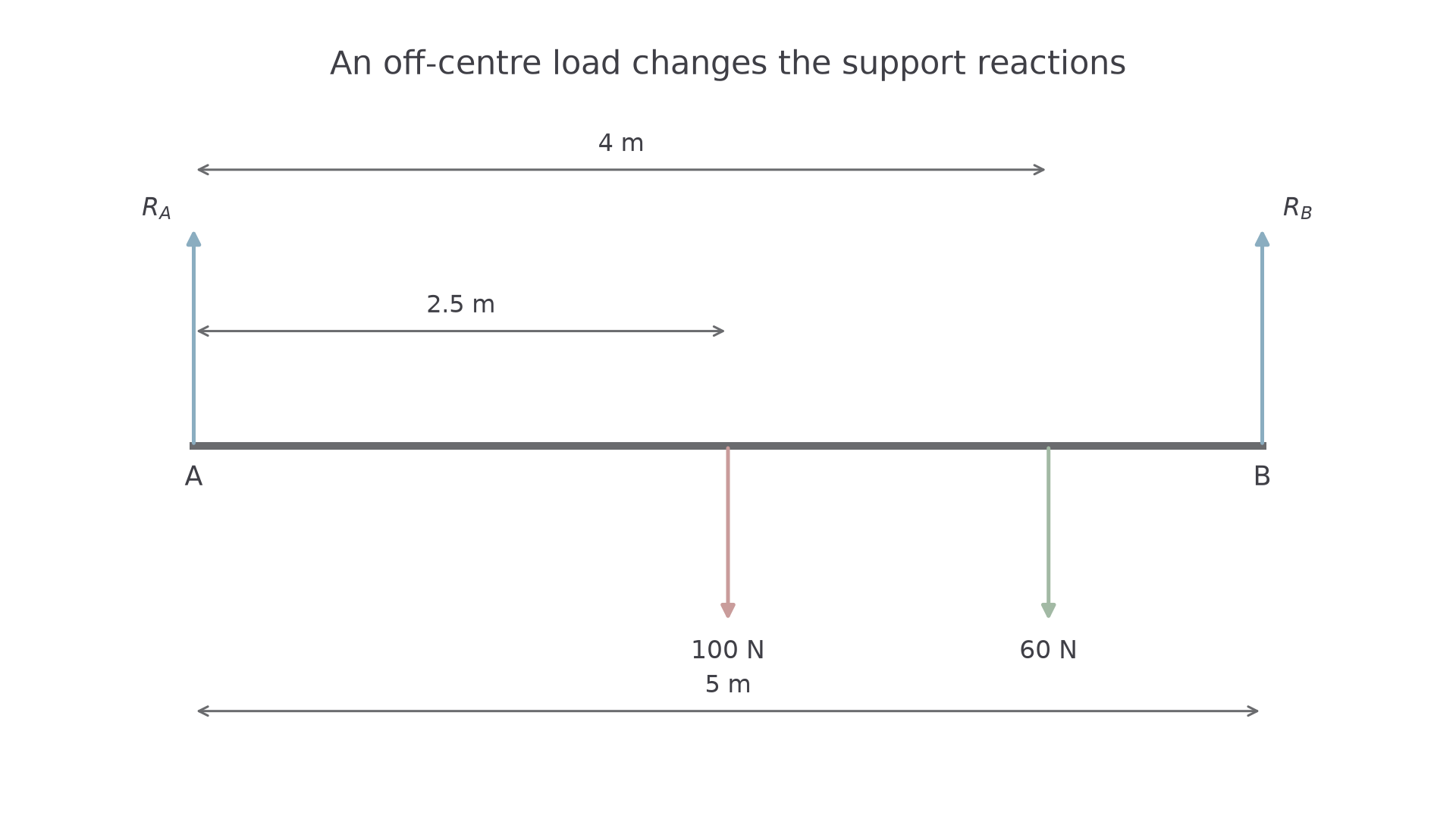
A beam can have zero resultant vertical force and still turn. Why does moving a load towards an end change the support forces, even though its weight stays the same? The missing information is where each force acts.
Moment of a force
The moment of a force about a point is its turning effect about that point. Its magnitude is
where is the perpendicular distance from the point to the force's line of action. State clockwise or anticlockwise. Units are . Not in the formula booklet: learn it.
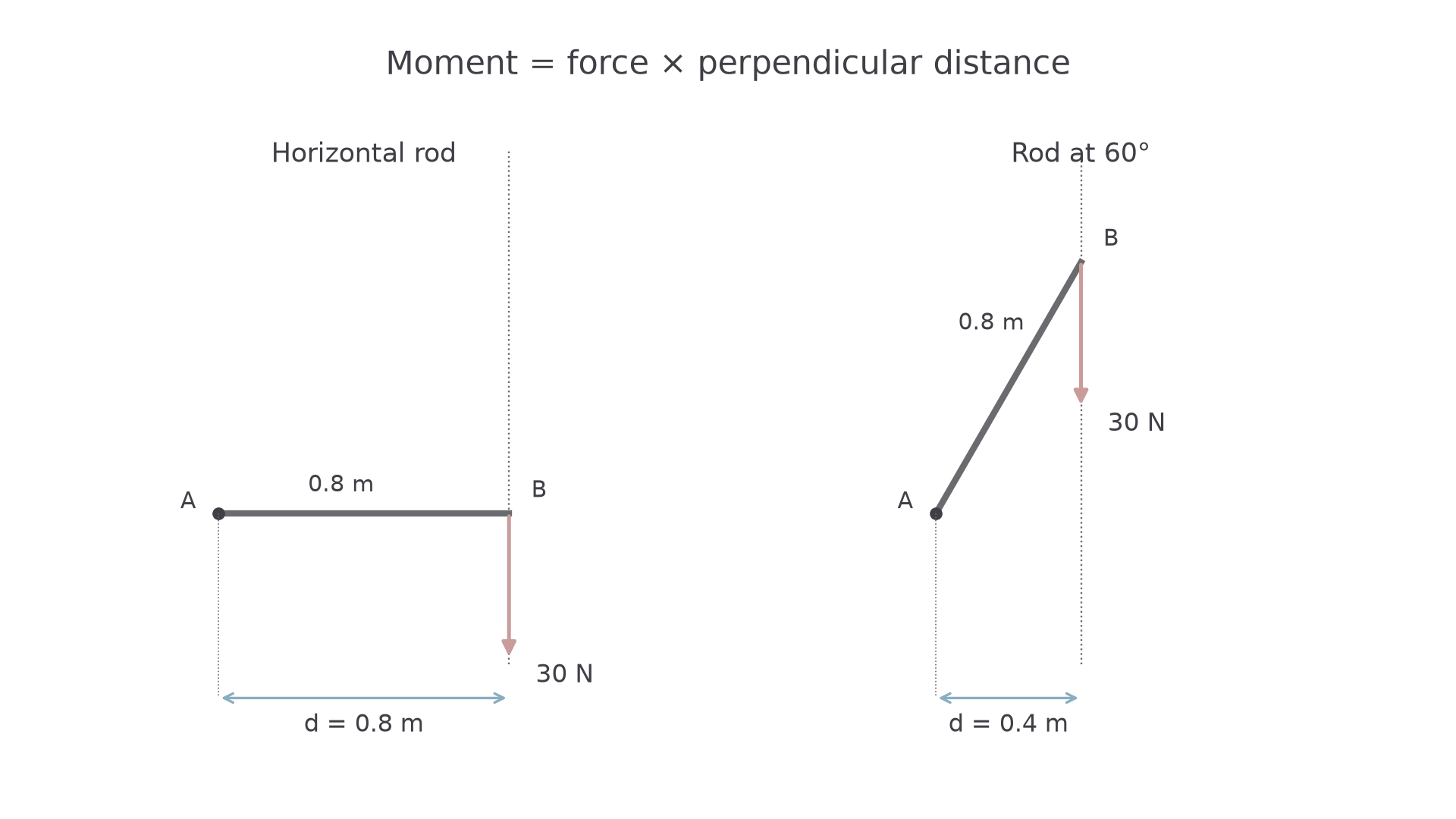
The line of action extends indefinitely in the direction of the force. Measure the shortest distance to this line, not necessarily the length along the rod. A force whose line of action passes through the chosen point has zero moment about it.
[DIAGRAM: asset_name: The perpendicular moment arm; asset_slug: m1-moment-perpendicular-distance; caption: For a vertical force, the moment arm is horizontal, even when the rod is tilted.; description: Horizontal and sixty-degree rods of length zero point eight metres with a downward end force, showing perpendicular distances zero point eight and zero point four metres to the vertical line of action.]
Worked example 1: a horizontal rod
A force acts vertically downwards at the right-hand end of a horizontal rod of length . Find its moment about .
Plan. The rod is perpendicular to the vertical force, so its full length is the moment arm.
Answer. clockwise.
Check. A downward force to the right of turns the rod clockwise; force times length has units .
Change only the rod's inclination; keep the force vertical.
Worked example 2: a tilted rod
The same rod rises at above horizontal from to . The same force acts down at . Find its moment about .
Plan. Use the horizontal distance to the force's vertical line of action.
Answer. clockwise.
Check. At a vertical inclination the force's line would pass through , giving zero moment. The decreasing horizontal distance has the correct effect.
Do not multiply by if the force is already given in newtons. Multiply a mass by only to obtain its weight.
Clockwise and anticlockwise moments
For several forces, choose one point and add the moments with a consistent sense. You can take anticlockwise as positive, or equate the total clockwise and anticlockwise moments when the body is in equilibrium.
The turning sense depends on both the force direction and which side of the point its line passes. A downward force left of a pivot is anticlockwise; the same downward force right of it is clockwise.
Worked example 3: balanced turning effects
A horizontal beam is pivoted at . A force acts down left of , and a force acts down right of . Find their resultant moment about .
Plan. Take anticlockwise positive and attach signs to the turning effects.
Answer. Zero resultant moment about .
Check. The smaller force acts at the larger distance; each turning effect has magnitude .
Change only the left-hand force to .
Worked example 4: an unbalanced moment
Find the resultant moment about with this changed force.
Plan. Keep the same perpendicular distances and sign convention.
Answer. anticlockwise.
Check. Equal downward forces at unequal distances do not balance; the left force has the larger moment arm.
A pivot reaction through contributes no moment about , even if its magnitude is unknown. This makes a support point a useful choice when forming an equilibrium equation.
Parallel-force equilibrium
A rigid body in equilibrium must have no resultant force and no resultant moment. For vertical parallel forces on a horizontal beam, resolve vertically and take moments about a convenient point. Balancing moments alone does not establish force balance.
A uniform rod has its centre of mass at its midpoint, so its weight acts there. A light rod has negligible weight. A support underneath pushes up: its reaction cannot be negative while it remains an ordinary supporting contact.
[DIAGRAM: asset_name: Loads and support reactions on a beam; asset_slug: m1-beam-load-reactions; caption: Moving a load changes its moment, so each support's share can change.; description: A five-metre horizontal uniform beam with endpoint reactions, weight one hundred newtons at the midpoint and an extra sixty-newton downward load four metres from the left end.]
Continue this lesson.
You’re previewing NovaLearn without an account. Create a free account to read the rest.
Create free account