P2 8.1, P2 8.2 - Definite integrals and area
Evaluate a definite integral by substituting its limits into an antiderivative. Distinguish signed integrals from positive area, then calculate regions bounded by curves and straight lines, including areas between two curves that cross.
Evaluating a definite integral
Can an integral be zero when the region between a curve and the axis has positive area? Yes: contributions below and above the axis can cancel. First learn how to evaluate the integral; then decide what it represents.
You know that differentiates to . A definite integral uses two fixed input values, called its limits, and produces a number. Instead of choosing a particular , subtract the antiderivative's value at the lower limit from its value at the upper limit.
Evaluating a definite integral
If and is continuous from to , then
The arbitrary constant cancels: . The final answer is a number, with no .
Not in the formula booklet: learn it.
Use the power integration you already know, including rewriting products or denominators first. For example, an antiderivative of is ; the power rule still excludes the integrand . Do not integrate across an input where the original integrand is undefined using the formula above.
Worked example 1: substitute both limits
Question. Evaluate .
Plan. Find an antiderivative, then subtract its lower-limit value from its upper-limit value.
Answer. .
Check. Differentiating gives . Also, this straight-line function has endpoint heights and : its signed trapezium calculation gives .
Change only the lower limit from to . The antiderivative is unchanged, but its lower-limit value must be recalculated.
Worked example 2: a negative integral
Question. Evaluate .
Plan. Use the same antiderivative with the new pair of limits.
Answer. . A definite integral can be negative.
Check. The line's endpoint heights are and , so , independently confirming the signed result.
Brackets matter: subtracts the whole lower-limit expression. Reversing the limits reverses the sign, because ; equal limits give zero.
Watch out
, not . Show the substituted brackets before simplifying.
Try a new polynomial and keep both lower-limit signs.
Signed integrals and positive area
A definite integral counts regions below the horizontal axis negatively, whereas a geometric area is nonnegative.
For , a thin vertical strip has signed contribution approximately . Below the axis, , so this contribution is negative. To find total area between curve and axis, locate every axis crossing in the interval, split there and add the positive sizes of the pieces.
Integral and total area
If on , area is . If , area is .
When the sign changes, split at the zeros and add the absolute values of the separate integrals. Taking the absolute value of just the final combined integral can lose area through cancellation.
Not in the formula booklet: learn it.
Here is a region with one piece on each side of the axis.
Worked example 3: separate signed contributions
Question. For , between and , find the definite integral and the total area between the line and the axis.
Plan. Split at the zero , then keep signs for the integral and positive sizes for area.
Answer. Integral ; total area square units.
Check. The two triangles have areas and , matching the separate integrations.
[DIAGRAM: asset_name: Signed contributions and positive area; asset_slug: signed-area-pieces; caption: The integral subtracts the lower triangle, while total area adds both triangles.; description: The line y equals x minus one is plotted from x equals zero to three. A purple triangle below the axis from zero to one has geometric area one half and signed contribution negative one half. A blue triangle above the axis from one to three has area two and signed contribution positive two. The zero at one is marked.]
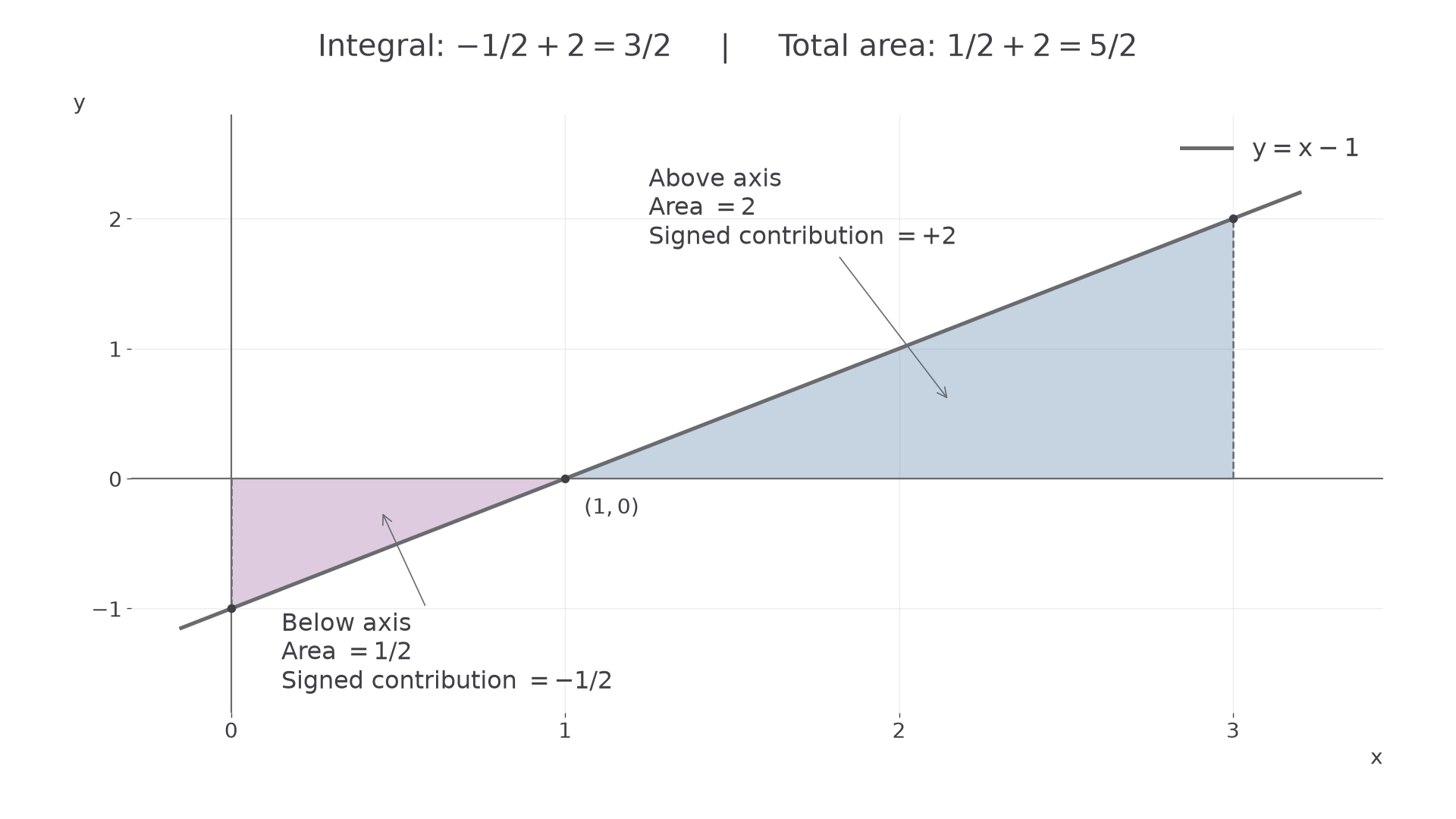
Change only the upper limit from to . The two triangle sizes now agree, so the integral cancels completely.
Worked example 4: zero integral and nonzero area
Question. Find the integral and total area for the same line , now from to .
Plan. Retain the split at , then add signed contributions or positive sizes as required.
Answer. The integral is ; the total area is square unit.
Check. The second triangle has base and height , just like the first. Their areas add to , while their signs cancel. Direct evaluation gives .
This answers the opening question: zero signed balance does not mean there is no region.
Watch out
For Worked example 4, , so taking one absolute value at the end still gives the wrong total area. Split before changing signs.
Find the crossing before evaluating these two quantities.
Area bounded by a curve and lines
The height of a vertical strip is the upper boundary's height minus the lower boundary's height.
If the lower boundary is the axis, this is simply . If it is a horizontal or sloping line , use . Vertical lines and supply the integration limits. Check which boundary is above throughout the interval before integrating.
Area between upper and lower boundaries
For and throughout ,
This adds strips of nonnegative height. If the order changes, split the interval at the crossings.
Not in the formula booklet: learn it.
First use the axis as the lower boundary.
Worked example 5: curve, axis and vertical lines
Question. Find the area bounded by , , and .
Plan. Check the curve is above the axis, then integrate its height over the given interval.
For , . Hence
Answer. square units.
Check. The strip heights lie between and , across width . The area lies between and , as it must.
Change only the lower horizontal boundary, from to . Each strip is now one unit shorter.
Worked example 6: a raised lower boundary
Question. Find the area bounded by , , and .
Plan. Subtract the lower line's height before integrating.
Answer. square units.
Check. Raising the lower boundary removes a rectangle of width and height . Thus , agreeing with integration.
Continue this lesson.
You’re previewing NovaLearn without an account. Create a free account to read the rest.
Create free account