P1 1.8 - Shading inequalities
Represent linear and quadratic inequalities as regions of the coordinate plane. You will choose the correct boundary style, test which side satisfies a condition, and locate the overlap when several inequalities must hold together.
Boundary equations
Which points lie above and below at the same time? A region can contain infinitely many points, but its edges come from equations you can draw and solve.
Start with . At , it allows every height . Repeating this for every horizontal position fills a region above the line. Equality gives the dividing edge, .
Boundary equation
The boundary equation of an inequality is obtained by replacing its inequality symbol with an equals sign. It separates the points that satisfy the condition from those that do not. Whether the edge itself belongs to the solution depends on whether equality is allowed.
A boundary can be straight, curved, horizontal or vertical. For example, has the vertical boundary ; it selects points to the right. The condition has horizontal boundary .
Worked example 1: a straight boundary
Question. Find and locate the boundary for .
Plan. Replace with equality and find two points on the resulting line.
A straight line is determined by two distinct points.
Answer. The boundary is the line , through and .
Check. Both coordinates satisfy the original inequality with equality: and .
Change only to . Equality still supplies the edge, but two points are no longer enough to describe its curved shape.
Worked example 2: a curved boundary
Question. Find and locate the boundary for .
Plan. Use the parabola's minimum and symmetric points.
Since , the minimum height is , at .
Answer. The boundary is the upward-opening parabola , with vertex , through and .
Check. Opposite -values give equal squares, so the listed points have the expected symmetry about the vertical axis.
The boundary equation gives the shape; the inequality then chooses the allowed side.
Watch out
The boundary of is , even though the boundary points themselves are excluded. Do not omit the edge when describing the region.
Separate the boundary from the side to be shaded.
Solid and dotted boundaries
A boundary's line style tells you whether points with equality are included in the solution.
The point lies on . It satisfies , because , but fails , because is false. Points strictly above the line satisfy both inequalities; only the edge changes.
Boundary conventions
Use a solid boundary for or : equality is included. Use a dotted boundary for or : equality is excluded. These conventions apply to curves as well as straight lines.
Shade the solution side unless the question asks you to shade the unwanted region. Label the intended region clearly; dark shading by itself does not say which convention you have used.
[DIAGRAM: asset_name: Including or excluding a boundary; asset_slug: solid-dotted-boundaries; caption: The shaded side stays the same when equality is removed; the edge changes from solid to dotted.; description: Two coordinate panels show the region above y equals x plus one. The left has a solid boundary and y greater than or equal to x plus one; the right has a dotted boundary and y strictly greater than x plus one.]
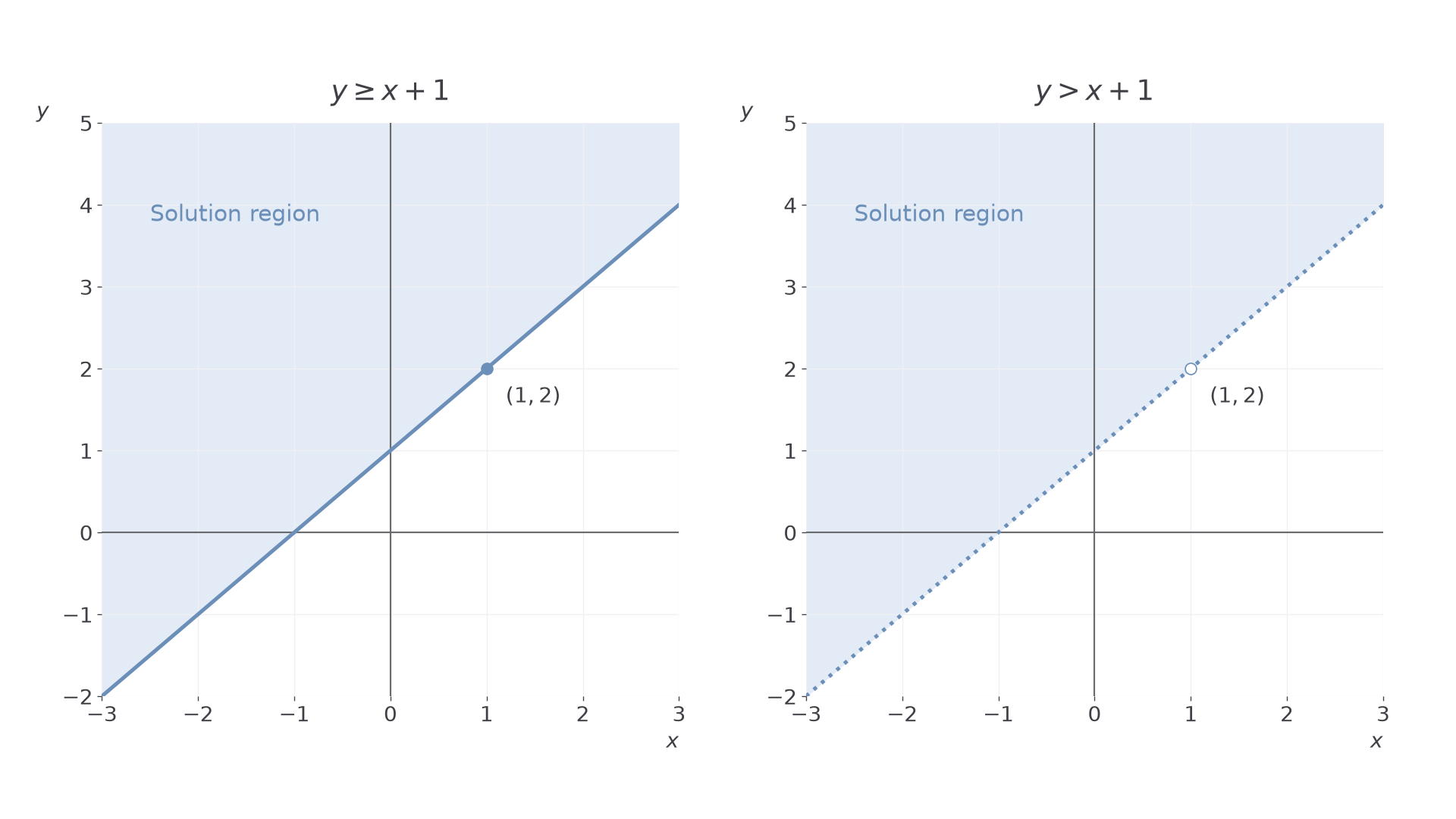
To choose a side, use a test point away from the boundary. For , gives , false, so reject its side. The point gives , true, so shade the side containing it. On , “below” means a smaller -coordinate at the same ; a downward-opening parabola does not reverse that meaning.
Watch out
A point on the boundary cannot choose the side: it gives equality. If the origin lies on the boundary, choose another easy point such as or .
Choose both the line style and the region.
Linear regions
Several simultaneous inequalities select the overlap of their individual regions.
The word and matters: a point must satisfy every condition. Draw all boundaries first, decide their styles, then test the side of each. A point in the final region survives every test.
Worked example 3: a bounded linear region
Question. Describe the region satisfying , and , giving its vertices.
Plan. Work in the first quadrant and keep the side of containing the origin.
The line meets the axes where
At , , so keep the side below this line. The axis conditions remove negative coordinates.
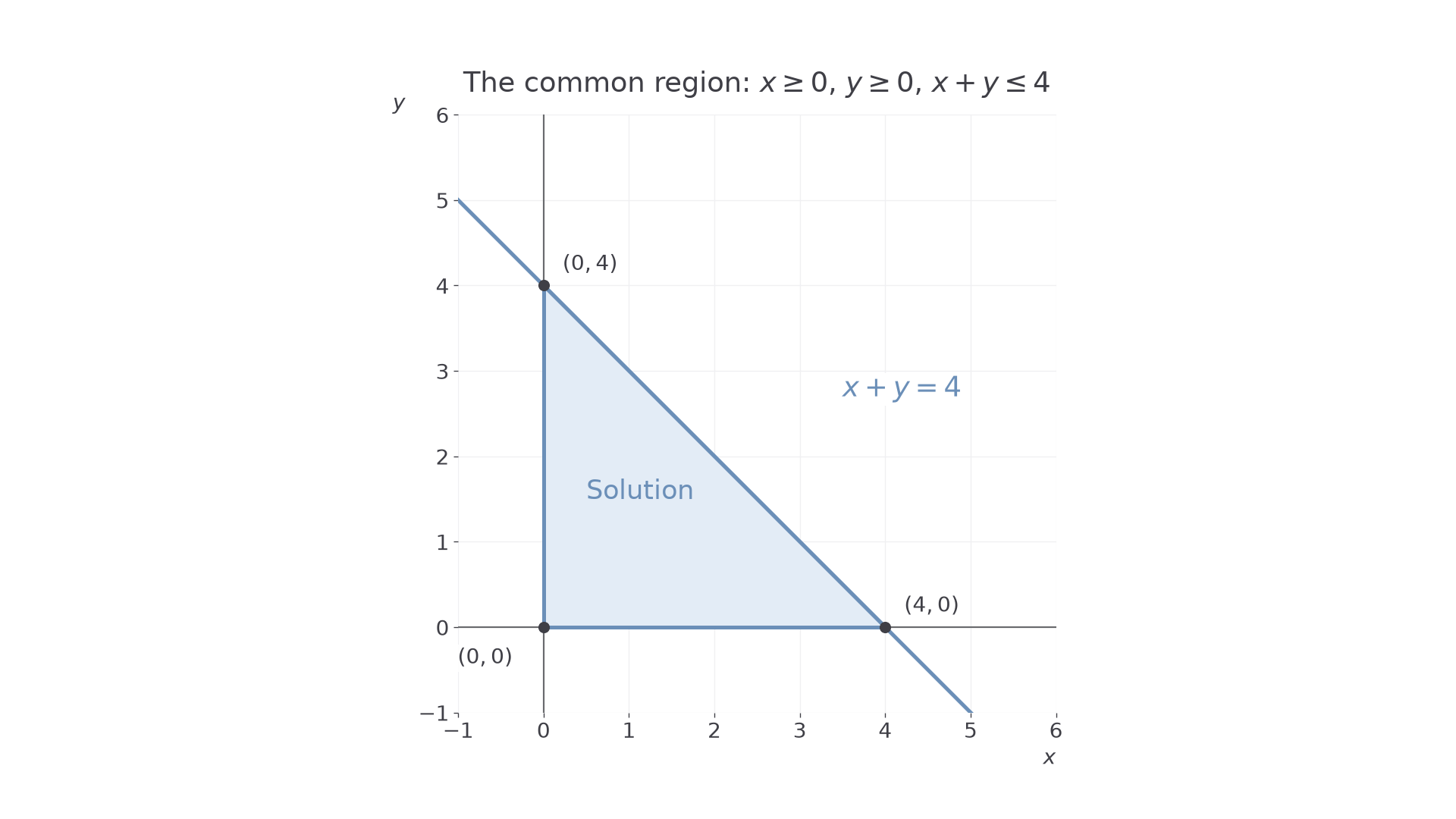
Answer. The filled triangle with vertices , and . All three edges are solid and included.
Check. The interior point satisfies , and . The point fails only the final condition, so it is outside.
Here the shaded solution is the common part of three half-planes.
[DIAGRAM: asset_name: Overlap of three linear inequalities; asset_slug: linear-overlap; caption: Every shaded point satisfies all three inequalities.; description: First-quadrant triangle under x plus y equals four, with all three solid edges and vertices zero comma zero, four comma zero and zero comma four labelled.]
Change only the last inequality's direction. The axes stay fixed, but the region is no longer bounded.
Worked example 4: an unbounded linear region
Question. Describe , and .
Plan. Keep the first quadrant, then select the other side of the same line.
The boundary is still , through and . The origin fails , whereas satisfies .
Answer. The first-quadrant region on or above , extending without bound. Its boundary includes the line segment from to , the vertical ray , and the horizontal ray ; all are solid.
Check. is allowed and is not. The region therefore cannot be the small triangle from the previous example.
In a sketch, extend unbounded regions towards the edge of your axes rather than inventing a closing boundary.
Watch out
Satisfying one inequality is insufficient. The point satisfies but fails , so it cannot belong to the triangle.
Locate vertices by intersecting actual boundary equations.
Quadratic regions and intersections
A curved boundary is handled in the same way: compare heights, then find where all the conditions can hold together.
For a region above a parabola and below a line, the parabola must itself be no higher than the line. Their intersection coordinates locate the ends of the region, rather than new vertical boundary lines.
Worked example 5: a region between a curve and a line
Question. Describe and , including its boundary intersections.
Plan. Solve for the crossings, then keep the points between the two graphs.
Substituting into gives and . Between these horizontal coordinates, .
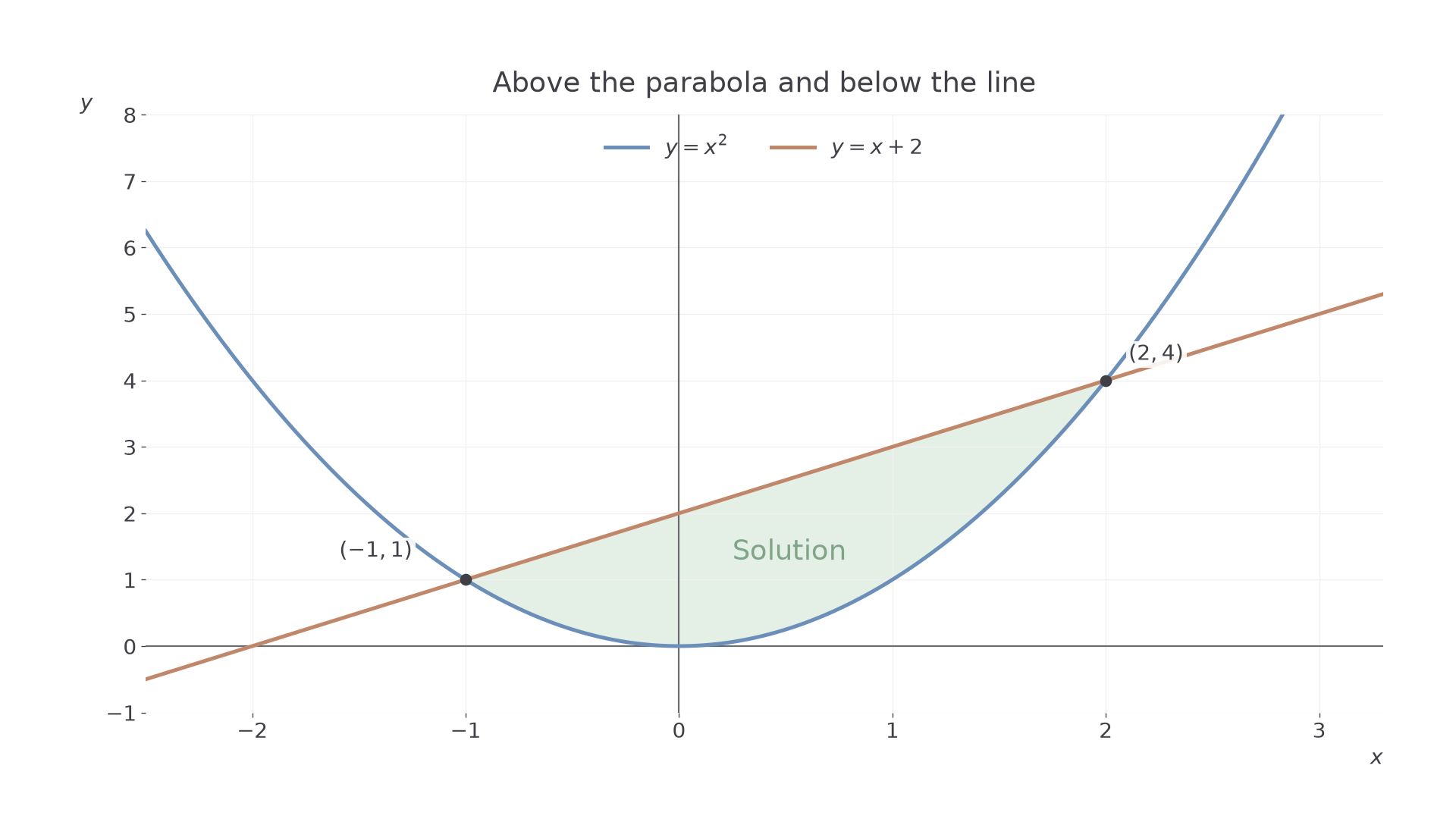
Answer. The region , with . Its lower edge is the parabola, its upper edge is the line, and both solid edges and intersection points are included.
Check. At , the allowed heights are . At , the conditions demand and , which cannot both hold.
This is the region posed in our opening question.
[DIAGRAM: asset_name: Region between a parabola and a line; asset_slug: quadratic-overlap; caption: The line is above the parabola only between their intersections.; description: The region above y equals x squared and below y equals x plus two is shaded between minus one and two, with both solid boundaries and the intersections minus one comma one and two comma four labelled.]
Change only the lower condition from to . Most of the region stays, but the curved edge disappears from the solution.
Worked example 6: a mixed strict boundary
Question. Describe and , including its boundary intersections.
Plan. Use the same crossing coordinates, then inspect which equalities are allowed.
For an allowed height to exist, we need
At either crossing, the only height between the graphs would equal , which is forbidden.
Answer. The region , with . Draw the parabola dotted and the line solid. The crossing points and are excluded, even though the line itself allows equality.
Check. satisfies both conditions; fails the strict lower condition. At , is false.
A boundary point must satisfy every inequality just like an interior point. A solid boundary from one condition cannot override a strict condition from another.
Key idea
Use equations to locate boundaries and intersections; use the original inequalities to decide what is included.
Apply the same comparison with a different line.
Quick Recap
- Replace the inequality by equality to locate its boundary.
- Solid includes equality; dotted excludes it.
- Test a point off the boundary to choose the side, then intersect the allowed regions.
- Solve boundary equations for crossings and check inclusion against every condition.
The opening region is , with .