P3 1.3 - Modulus graphs and equations
Interpret modulus as distance, sketch graphs involving absolute values and solve equations and inequalities from their intersections. Distinguish changing a function's output from changing its input.
The absolute value function
How far is from zero? Its position is negative, but its distance is . Modulus records that nonnegative distance and produces a graph with a corner.
Modulus or absolute value
For a real number , its modulus is
Thus , and . Modulus is never negative.
For , ask when the whole inside expression changes sign. It is zero at , not at . To the left, replace it by its negative; to the right, keep it.
Worked example 1: locating the corner
Question. Give a piecewise rule and the axis intercepts of , and describe its shape.
Plan. Solve for the corner, then use the sign on each side.
The gradients are on the left and on the right. At , .
Answer. A V-shaped graph with vertex and -intercept , and -intercept .
Check. At , both and the left rule give . At , both the modulus and right rule give .
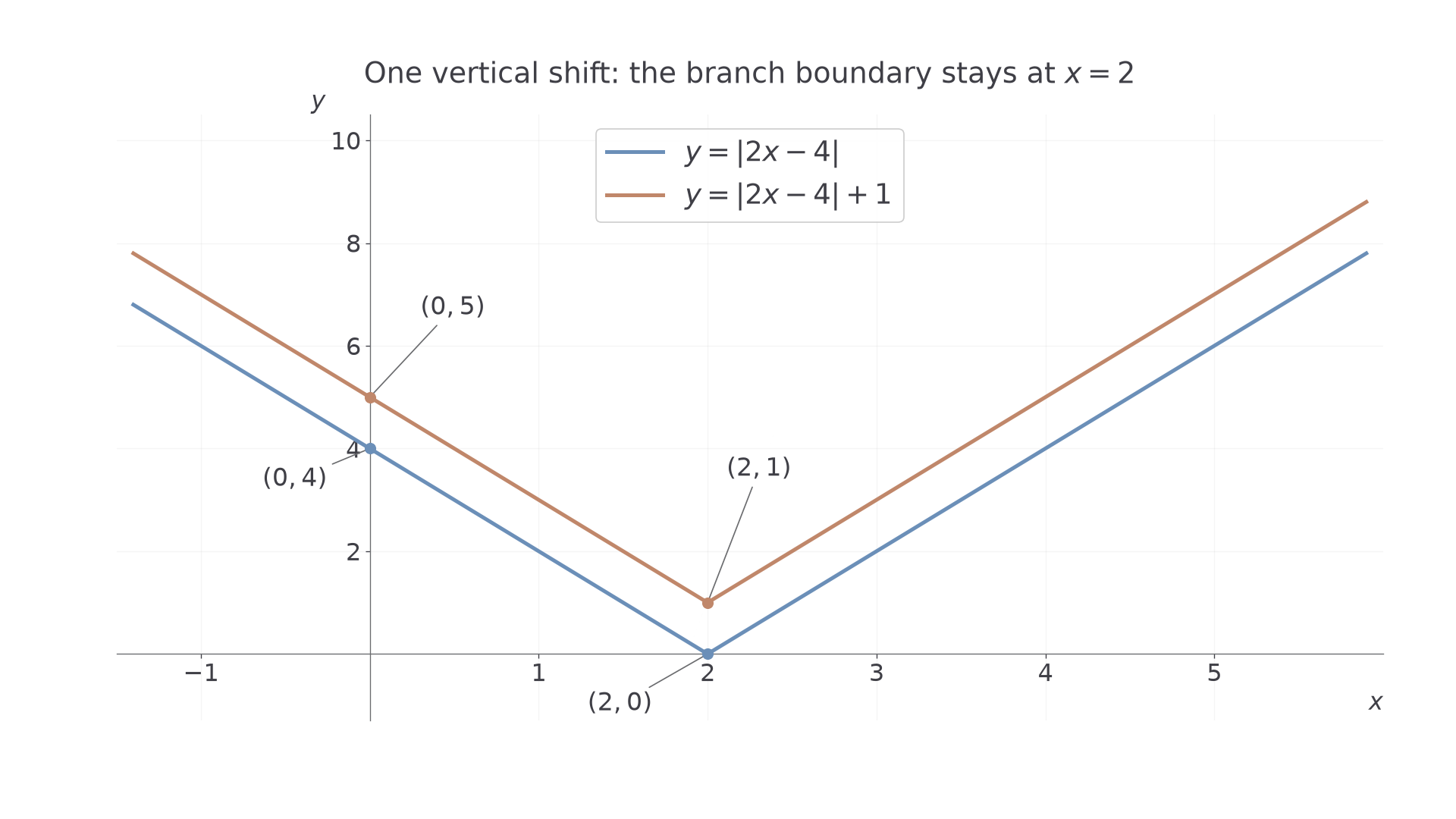
Change only the addition outside the modulus, raising the graph by . The sign change inside still occurs at the same input.
Worked example 2: moving the vertex above the axis
Question. Give a piecewise rule and the axis intercepts of , and describe its shape.
Plan. Add to both branches from Example 1.
Answer. A V-shaped graph with vertex , -intercept , and no -intercept because .
Check. At , both branch rules give . At , the original expression gives .
Both branches meet; the change of rule does not create a gap.
[DIAGRAM: asset_name: A modulus vertex and a vertical shift; asset_slug: modulus-vertices; caption: Adding one outside the modulus raises every point, including the vertex.; description: On labelled axes the V-shaped graphs y equals absolute value of 2x minus 4 and y equals that absolute value plus 1. Vertices (2,0) and (2,1) and y-intercepts (0,4) and (0,5) are labelled.]
Watch out
is not for every . At , the first is , while the second is . Negate the entire inside expression only where it is negative.
Find the zero inside the modulus before choosing the branches.
Graphs of modulus of f and f of modulus
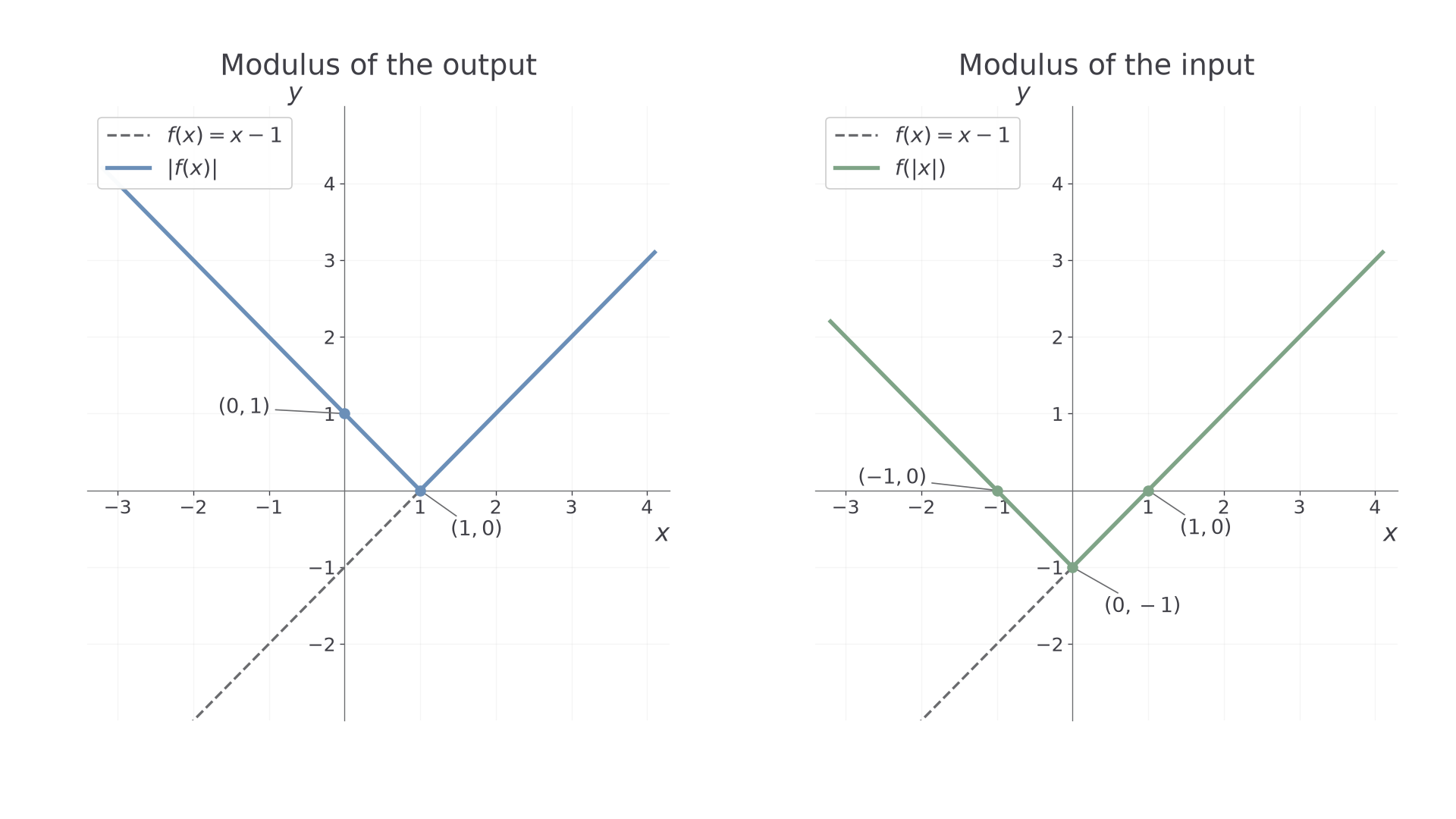
Putting modulus around the output changes heights; putting it around the input changes which side of the original graph is used.
In , each input stays fixed, and negative outputs become positive. Keep the graph on or above the -axis; reflect every part below that axis upwards. In , the function receives only nonnegative inputs. Keep the original right-hand half, including , and reflect that half in the -axis to fill the left. Discard the original left-hand half.
Two different modulus graphs
For a real-valued defined at the required inputs:
- reflects negative outputs in the -axis.
- copies the nonnegative-input half across the -axis.
The second graph is symmetric about the -axis, but its heights need not be positive.
Use the same simple original graph to see the effect of moving the modulus signs.
Worked example 3: modulus of the output
Question. Given for all real , sketch , stating its vertex and intercepts.
Plan. Reflect the portion of below the -axis upwards.
Answer. A V with vertex and -intercept , and -intercept .
Check. Original point becomes ; original point stays fixed. Both agree with the rule.
Change only the placement of the modulus signs, from the output to the input. The negative-input side is now rebuilt from the right-hand side.
Worked example 4: modulus of the input
Question. For the same , sketch , stating its vertex and intercepts.
Plan. Keep for , then reflect that half in the -axis.
Answer. A V with vertex and -intercept , and -intercepts and .
Check. At , the function receives input , giving . The piecewise rule gives .
The two resulting Vs have different vertices and different ranges.
[DIAGRAM: asset_name: Output modulus compared with input modulus; asset_slug: two-modulus-graphs; caption: For f(x) equals x minus one, moving the modulus signs changes the vertex.; description: Two panels show the original dashed line y equals x minus 1. Left: y equals absolute value of f(x), vertex (1,0), y-intercept (0,1). Right: y equals f of absolute value x, vertex (0,negative 1), roots negative 1 and 1. The retained and reflected portions are distinguished.]
Watch out
can be negative: here . Only is guaranteed to be nonnegative. If a domain is restricted, also check that the required original inputs exist.
Describe what happens to the original graph before naming the new vertex.
Continue this lesson.
You’re previewing NovaLearn without an account. Create a free account to read the rest.
Create free account