M1 4.4, M1 4.2 - Motion with friction
Find the contact forces on a sliding particle, then use them to predict its motion on a horizontal surface or a slope. You will also split a journey into stages when an applied force changes. Take and give non-exact final numerical answers to three significant figures.
Normal reaction and friction
A block pulled across a rough floor speeds up. If the pull is removed, how much farther will it travel? Before predicting that distance, we need the forces that remain.
The surface exerts a normal reaction perpendicular to itself. Friction acts parallel to the contact surface, opposing relative sliding. Draw both on the particle, together with its weight and any applied force. These are different forces: reaction is not another name for weight.
[DIAGRAM: asset_name: Pulling or pushing changes contact; asset_slug: m1-contact-pull-push; caption: An upward component reduces the normal reaction; a downward component increases it.; description: Two force diagrams for the same block on a horizontal rough floor, pulled or pushed at thirty degrees, with reaction upward, weight downward and friction opposing rightward sliding.]
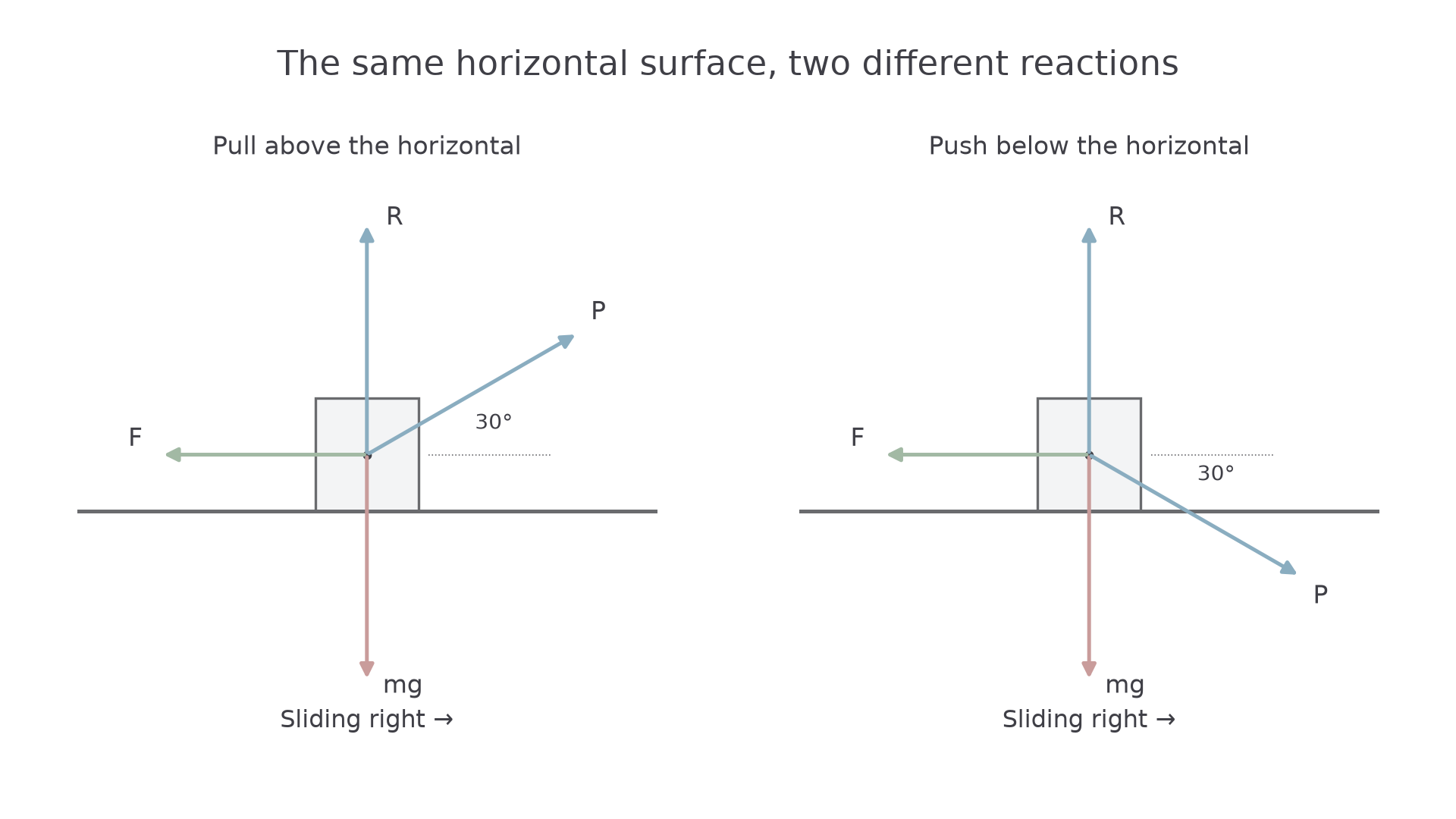
There is no vertical acceleration while the block stays on the horizontal floor. Therefore the vertical components add to zero. This does not imply that the horizontal resultant is zero.
Worked example 1: an upward pull
A block slides right on a horizontal floor. A pull acts at above the horizontal. Find the normal reaction .
Plan. Balance vertical components; the pull partly supports the weight.
Answer. .
Check. The upward total is , equal to the weight.
Change only the vertical direction of the applied force.
Worked example 2: a downward push
The same block slides right, but the force now acts at below the horizontal. Find .
Plan. The floor must now support both the weight and the downward component.
Answer. .
Check. Compared with the first case, changing a upward component to downward increases by .
If a contact calculation gives a negative reaction, the assumed contact cannot persist: an ordinary floor cannot pull the block down towards itself.
Sliding friction equals coefficient times reaction
In the simple rough-surface model, sliding friction has magnitude proportional to the normal reaction. The dimensionless coefficient of friction describes the contact between the two surfaces.
Sliding friction
While the particle slides,
Friction acts opposite to the sliding velocity. Combine this with resultant force in a stated positive direction. Not in the formula booklet: learn it.
An upward pull can reduce friction by reducing . Always find the reaction before substituting into . At rest, friction need not equal ; we will treat that separately in particle equilibrium.
Worked example 3: moving with the pull
A block slides right on a horizontal surface with . A horizontal force acts right. Find its acceleration.
Plan. Take right as positive; friction acts left.
Answer. rightwards.
Check. The resultant equals .
Change only the direction in which the block is currently sliding. The applied force stays rightwards.
Worked example 4: moving against the pull
The same block is sliding left. Find its acceleration while it continues to slide left.
Plan. Keep right positive. Both the applied force and friction now act right.
Answer. rightwards; the leftward speed decreases.
Check. Reversing friction changes the resultant by , so the acceleration increases by , as found.
Friction opposes sliding, not necessarily acceleration. The equation in Example 4 stops describing the motion once the block stops: its friction direction must then be reconsidered.
Continue this lesson.
You’re previewing NovaLearn without an account. Create a free account to read the rest.
Create free account