M2 5.1, M2 5.2 - Rigid-body equilibrium
Balance forces and moments for rods and ladders in equilibrium. Resolve non-parallel forces, choose perpendicular moment arms and distinguish ordinary friction from limiting friction at smooth or rough contacts. Use when a numerical value is needed.
Moments of non-parallel forces
Why can a small horizontal force at the top of a ladder balance its much larger weight? Turning effects depend on distance as well as force, and the relevant distance is perpendicular to the force's line of action.
The moment of a force about a point is its turning effect about that point. Take anticlockwise moments as positive. If a force passes through the point, its moment is zero, however large the force.
Moment of a force
If the position of the force is distance from the pivot and the angle between that position direction and the force is , the moment's magnitude is . Determine clockwise or anticlockwise sense from the diagram. The unit is .
Not in the formula booklet: learn it.
You can either resolve the force perpendicular to the rod or find the perpendicular distance to the force's line. Do not do both: that would introduce the trigonometric factor twice.
Worked example 1: an inclined force on a horizontal rod
Question. A horizontal rod has length . A force acts at , at above the direction from to . Find its moment about .
Plan. Only the force component perpendicular to the rod produces a moment.
Answer. anticlockwise.
Check. The perpendicular distance from to the force's line is ; .
Change only the force's vertical sense, from above to below the rod.
Worked example 2: reversing the turning sense
Question. The same force instead acts at below the direction from to . Find its moment about .
Plan. The perpendicular component now points down, so its moment is clockwise.
Answer. clockwise.
Check. The perpendicular distance remains , so the magnitude is unchanged; the force tends to turn the right end down.
For an inclined rod of length at angle above the horizontal, a vertical force at its end has moment arm . A horizontal force there has arm . These distances are different because the force lines are different.
Watch out
Writing for an inclined force uses the whole rod as a perpendicular arm when it is not perpendicular. Draw the force's line of action before choosing the distance.
Resolving and taking moments
A rigid body in equilibrium has no resultant force and no resultant moment, so both translation and rotation must balance.
Coplanar equilibrium
You may take moments about any point . Choosing a hinge or contact point often eliminates its unknown force from that equation, without asserting that the force is zero.
Not in the formula booklet: learn these conditions.
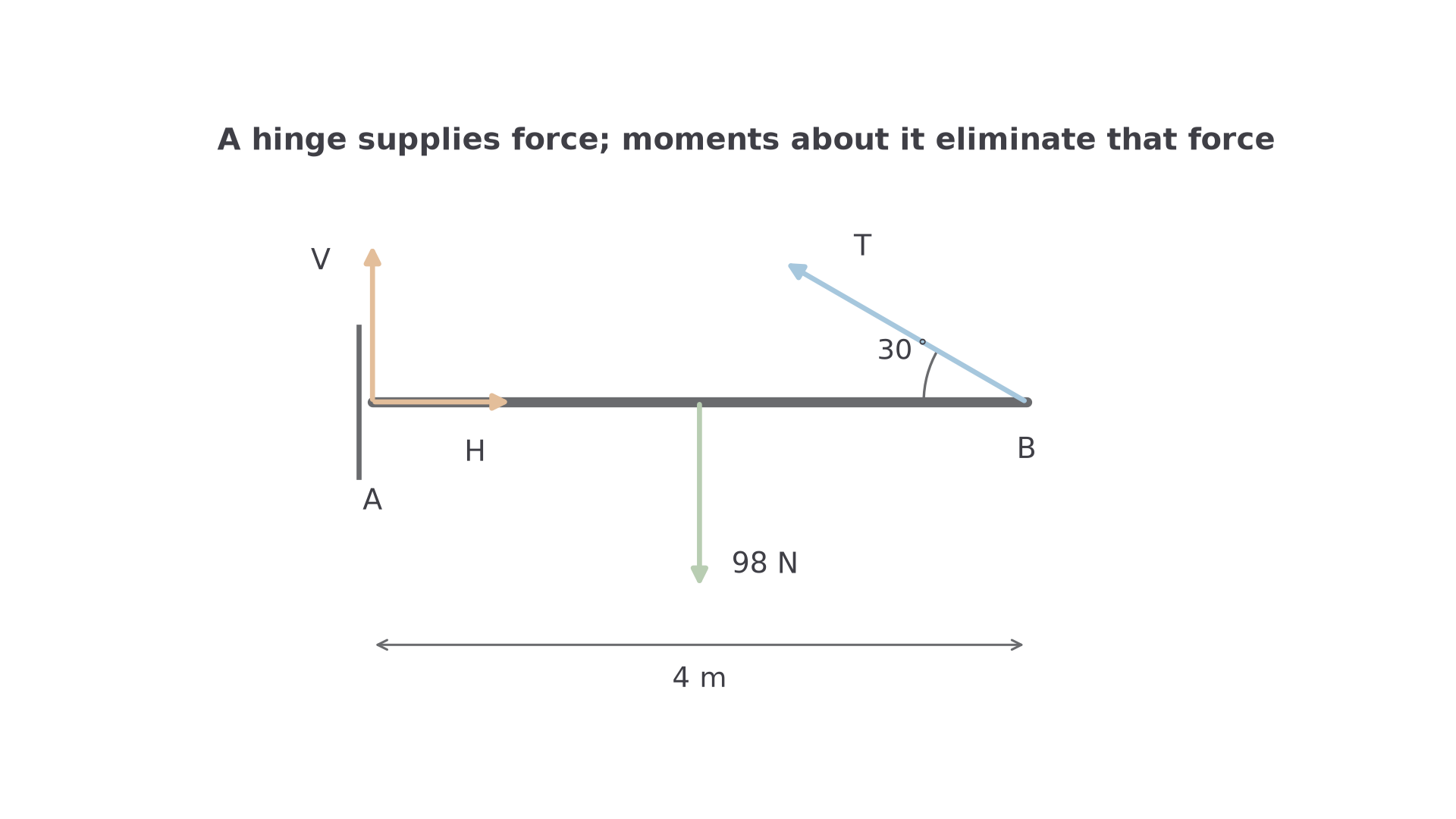
A uniform rod has its weight at its midpoint. A light inextensible string pulls along its length. A freely turning hinge can exert horizontal and vertical reaction components but supplies no couple in this model.
[DIAGRAM: asset_name: Hinged rod force diagram; asset_slug: m2-rigid-hinged-rod; caption: Moments about the hinge eliminate both hinge reaction components.; description: A horizontal four metre uniform rod is hinged at its left end A. Its ninety eight newton weight acts down at the midpoint. A string at the right end B pulls upwards and left at thirty degrees to the rod. Rightward horizontal and upward vertical hinge components H and V are drawn at A.]
Worked example 3: a hinged rod and string
Question. A uniform horizontal rod of length and mass is hinged at . A string at pulls upwards and left at to the rod. Find the tension and the horizontal and vertical components of the hinge force.
Plan. Take moments about for tension, then resolve horizontally and vertically.
Let be rightwards and upwards:
Answer. Tension ; hinge components right and up.
Check. The string's upward component and hinge's upward component are both , balancing the weight.
Change only the load: attach a particle at . Its weight has a different arm from the rod's own weight.
Worked example 4: adding an end load
Question. With that particle attached, find the new tension and hinge components.
Plan. Add the end particle's weight to both the moment equation and the vertical force equation.
Answer. Tension ; hinge components right and up, to three significant figures where needed.
Check. The string's upward component rises by , exactly the added load; the vertical hinge component therefore stays unchanged.
To find the resultant hinge force, use and its direction from the components. If asked for an angle with an inclined rod, first find the force's direction relative to the horizontal and then compare it with the rod's direction.
Ladders against smooth or rough walls
A contact force depends on whether the surface is smooth or rough, so draw each contact before writing equilibrium equations.
At a smooth surface, the contact force is perpendicular to that surface. At a rough surface, add friction along the surface, opposing the tendency to slip. A vertical wall supplies a horizontal normal reaction; horizontal ground supplies a vertical normal reaction. At a smooth rail touching the side of a rod, the reaction is perpendicular to the rod, rather than necessarily vertical.
For a ladder whose foot tends to slip away from the wall, ground friction acts towards the wall and wall friction, if present, acts up the wall. The actual tendency determines the directions; do not add friction in both possible senses.
Continue this lesson.
You’re previewing NovaLearn without an account. Create a free account to read the rest.
Create free account