P1 3.1 - Solving triangles
Find missing sides, angles and areas in triangles that do not contain a right angle. Choose the sine rule or cosine rule from the information available, then connect the result to the area formula.
Sine rule for a side or angle
Two paths of known directions meet at a point you cannot reach directly. Can a measured baseline and two angles determine the missing distance? A triangle does not need a right angle for trigonometry to work.
Label vertices , and label the sides opposite them . This pairing matters: is opposite , regardless of which way the triangle is drawn. For example, if and , then . Knowing any one side then fixes the triangle's scale.
[DIAGRAM: asset_name: Opposite pairs in a triangle; asset_slug: triangle-opposite-pairs; caption: Lower-case side labels are opposite the matching capital-letter angles.; description: A non-right triangle ABC has side a on BC, side b on CA and side c on AB. A dashed perpendicular height from C meets the extended line AB, illustrating how a height connects a sine ratio to a non-right triangle.]
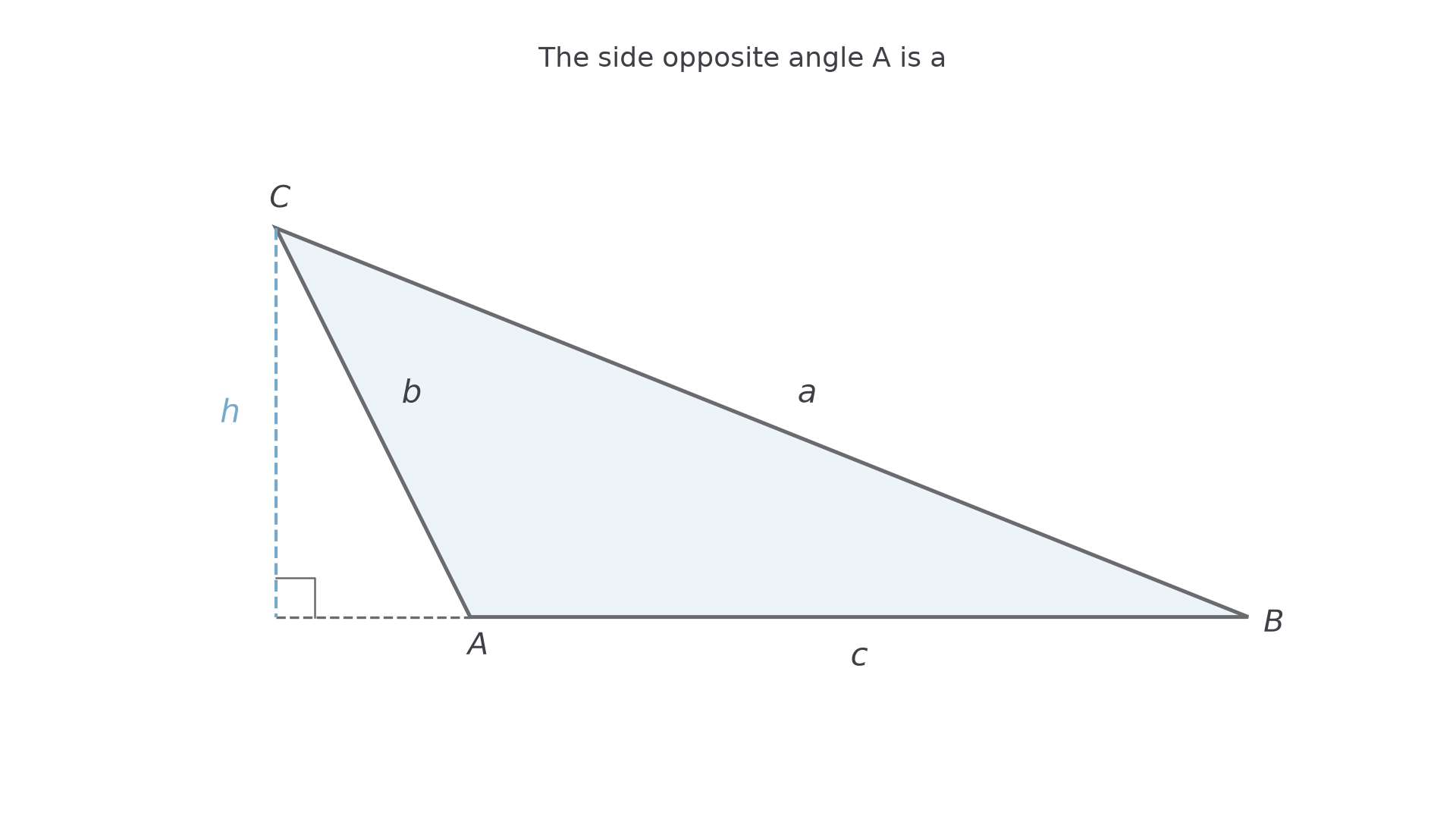
Drawing a perpendicular height gives . Dividing by gives the first equality below; using another height gives the third ratio. If a height falls outside the triangle, the supplementary angle has the same sine, so the rule still works.
Sine rule
For any non-degenerate triangle,
The reciprocal form is equally useful when finding an angle.
Not in the formula booklet: learn it.
Use a ratio containing the unknown and a complete opposite side-angle pair. Here angles are in degrees, so set the calculator to degree mode.
Worked example 1: find a side
Question. In triangle , , and . Find .
Plan. Use the complete pair and the pair containing .
Answer. to significant figures.
Check. , so , as the answer shows. Also , so the two ratios agree.
Keep the complete pair , . Change the information in the other pair: its side is now given and its angle is unknown.
Worked example 2: find an angle
Question. In triangle , , and . Find .
Plan. Find , then use inverse sine and check the triangle's angle sum.
The supplementary candidate is , which would give , so reject it.
Answer. to significant figures.
Check. The remaining angle is . Using the unrounded angle, .
Inverse sine returns one angle, but a second angle can sometimes fit. We will investigate that ambiguity separately; checking is already essential.
Cosine rule for sides and angles
When no complete opposite side-angle pair is known, the sine rule cannot yet give a numerical answer.
Suppose two sides are and and the angle between them is . Those data fix the third side. The cosine rule extends Pythagoras' theorem: at , its cosine term is zero; with an acute included angle the opposite side is shorter than the corresponding right-triangle hypotenuse.
Cosine rule
For side opposite angle ,
For an angle when all three sides are known, rearrange:
The side form, with equivalent labels, is in the formula booklet. The rearrangement follows by algebra.
The angle in the side form must be the included angle, between the two known sides.
Worked example 3: two sides and their included angle
Question. A triangle has , and . Find .
Plan. Use the cosine rule, then take the positive square root because a length is positive.
Answer. .
Check. The triangle inequality gives , or . Also , consistent with an acute included angle.
Keep the two sides and , but replace the given included angle by a given opposite side. The same equation now finds an angle.
Worked example 4: three sides
Question. A triangle has , and . Find .
Plan. Rearrange the cosine rule to isolate , then use inverse cosine.
Answer. .
Check. Substitution gives . The positive cosine agrees with an acute angle.
A negative cosine instead gives an obtuse triangle angle. Inverse cosine gives exactly one value between and , so there is no supplementary-angle choice here.
Triangle area
Two sides and their included angle give an area without first finding a perpendicular height.
Using side as the base, the height is , so becomes . For obtuse , the perpendicular meets the extended base, and the height is still . This explains a useful surprise: angles and give equal areas between the same two side lengths.
Area of a triangle
where is the angle between sides and . Equivalent labels may be used.
Not in the formula booklet: learn it.
Area uses square units. The third side is unnecessary when the two sides enclosing the angle are known.
Worked example 5: an acute included angle
Question. Find the area of a triangle with sides and enclosing .
Plan. Use the two known sides as the factors in the area formula.
Answer. .
Check. The height relative to the base is . Then .
Change only the included angle from to its supplement, . The triangle changes shape, but its height has the same magnitude.
Worked example 6: an obtuse included angle
Question. Find the area of a triangle with sides and enclosing .
Plan. Use the included angle directly; the sine is positive for an obtuse triangle angle.
Answer. , the same area as before.
Check. The acute angle to the extended base is , giving the same perpendicular height .
An angle opposite one of the two side factors is not the included angle. Sketch their positions before substituting.
Selecting a triangle method
A multi-step triangle problem becomes easier when you choose the first rule from the information, rather than trying each formula in turn.
| Information available | Useful next step |
|---|---|
| A complete opposite pair and another side or angle | Sine rule |
| Two sides and their included angle | Cosine rule for the third side; area formula for area |
| Three sides | Cosine rule for an angle |
| Two angles | Subtract from , then use a known side to set the scale |
For an angle from sine, test the supplementary candidate against the angle sum or any given acute/obtuse condition. For an angle from cosine, the calculator's triangle-angle value is unique. Keep full calculator precision between steps; round only the final requested answers.
Worked example 7: unlock a missing angle
Question. In triangle , , and . Find , and the area.
Plan. Use cosine first to create a complete opposite pair, then sine for ; calculate the area directly from the original data.
Since , . An obtuse alternative for cannot be opposite the shortest side.
Answer. , , area .
Check. . The independent cosine-rule calculation gives too.
Change only the included angle to . The choice of methods stays the same, although the shape and numerical results change.
Worked example 8: use the same route on a wider triangle
Question. In triangle , , and . Find , and the area.
Plan. Find the missing opposite side by cosine, retain it unrounded for sine, and use the original included angle for area.
The alternative for is rejected because adding would exceed .
Answer. , , area .
Check. . Since is slightly longer than , its opposite angle should be slightly greater than , as it is.
Our opening distance problem is now within reach: calculate the third angle, pair each required side with its opposite angle, and use the measured baseline in the sine rule.
Quick Recap
- Pair each side with its opposite angle in the sine rule.
- Use cosine for three sides, or two sides and their included angle.
- The area formula uses two sides and the angle between them.
- Check angle sums, side sizes, calculator mode and units; retain working precision until the end.