P2 4.4 - Geometric sequences and finite sums
Find terms and totals when each new term is obtained by multiplying by the same number. You will derive the finite-sum formula, then use logarithms to work backwards from a total to the number of terms.
Nth terms and common ratio
How many terms of are needed before the total first exceeds ? The terms increase by multiplication, so adding a fixed difference will not answer this question. First we need a language for that multiplication.
In , each term is three times the previous term. Four terms require only three multiplications: this is the reason for the in the term formula.
Geometric sequence
A geometric sequence, or geometric progression, has a constant multiplier called the common ratio . For consecutive nonzero terms,
A geometric series is the sum of terms of a geometric sequence. For example, is a sequence; is a series.
Starting with first term , the terms are . The exponent counts how many times you have multiplied after the first term.
Geometric nth term
For first term and common ratio ,
In the formula booklet.
Here is a positive integer. If , write and all later terms as zero directly; there is no need to interpret . A ratio cannot be recovered by dividing by a zero term.
Worked example 1: a positive ratio
Question. Find a formula for the nth term of , and find .
Plan. Divide consecutive terms to find , then count five multiplications for the sixth term.
Answer. and .
Check. Listing the terms gives .
Change only the sign of the common ratio. The magnitudes follow the same pattern, but the signs alternate.
Worked example 2: a negative ratio
Question. Find a formula for the nth term of , and find .
Plan. Keep the negative ratio in brackets so that the power applies to its sign too.
Answer. and .
Check. The terms are : even-numbered terms are negative.
A ratio compares in a particular direction.
Watch out
For , the ratio is , not . Check that multiplying the earlier term by your ratio produces the next term.
Use the sign of the ratio as well as its magnitude.
Deriving the finite-sum formula
Multiplying a geometric sum by its ratio shifts every term one place along the pattern. Subtracting then cancels all the shared terms.
For the four-term sum , multiply by : . The middle three terms cancel when the first line is subtracted from the second, leaving .
[DIAGRAM: asset_name: Cancelling a geometric sum; asset_slug: finite-gp-cancellation; caption: Multiplication by the ratio aligns all but the first and final terms.; description: Two aligned rows show S4 equal to 3 plus 6 plus 12 plus 24 and 2S4 equal to 6 plus 12 plus 24 plus 48. The matching 6, 12 and 24 terms are paired, leaving 2S4 minus S4 equal to 48 minus 3.]
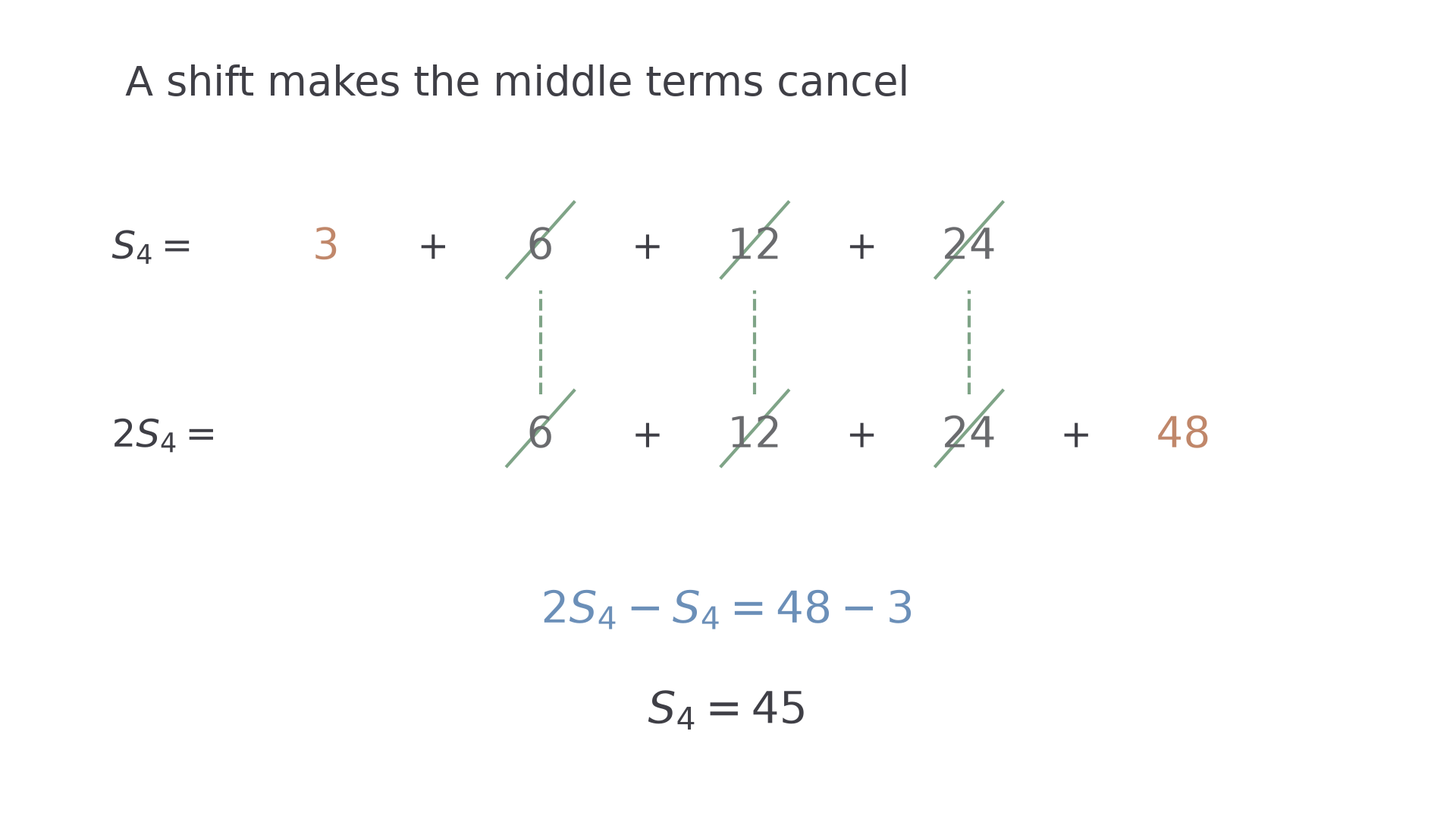
The same cancellation proves the general result. Write exactly terms in each line:
Subtract the second line from the first:
The final step divides by , so it requires . You should be able to reproduce this proof, including the shifted line and cancellation.
Finite geometric sum
For a positive integer and ,
Both forms are equivalent. If , every term is , so .
The first form is in the formula booklet. The case follows directly from the sum.
For , the second form avoids two negative quantities. For negative ratios, either form works if powers and brackets are handled carefully.
Worked example 3: summing positive terms
Question. Find the sum of the first five terms of .
Plan. Use , and in the finite-sum formula.
Answer. .
Check. Direct addition gives .
Change only the ratio from to . The sum formula still works, but the signs now matter.
Worked example 4: summing alternating terms
Question. Find the sum of the first five terms of .
Plan. Substitute as a single bracketed number.
Answer. .
Check. .
The last term uses , while the sum formula uses : that extra power comes from the shifted row in the proof.
Finding the number of terms using logarithms
When the unknown is a term number, rearrange until a single power remains. Logarithms then bring its exponent down.
For our opening series, and , so
This gives a compact equation for the whole total. Taking logs before isolating would leave a subtraction inside the logarithm; there is no log law that splits a difference.
Worked example 5: an exact total
Question. The series has sum for its first terms. Find , showing your working.
Plan. Isolate , then use the power law of logarithms.
Answer. .
Check. Adding gives .
Change the demand from an exact total to the first total exceeding a threshold. Now the logarithm gives a boundary, and must be an integer beyond it.
Worked example 6: the first total above a threshold
Question. Find the smallest number of terms of whose sum exceeds .
Plan. Solve the sum inequality, then check the two neighbouring integers.
The division preserves the inequality because .
Answer. The smallest number is terms.
Check. , while . All terms are positive, so the sums increase; these checks establish the first crossing.
A question about the nth term instead begins with , not . For a decreasing positive sequence, solving may require division by , which reverses the inequality. In either case, keep working precision and check neighbouring integer term numbers. A noninteger answer to an exact-total question may mean that no whole number of terms gives that total.
Quick Recap
- A common multiplier gives .
- Multiply the finite sum by and subtract to prove for .
- When , use .
- Isolate the power before taking logs, then interpret as an integer.
The opening total first exceeds after terms.