P1 5.1, P1 5.2 - Integrating powers
Reverse power differentiation to find indefinite integrals. Understand why every general answer needs an arbitrary constant, use the integration power rule with its exception, and rewrite products and root denominators before integrating.
Reversing differentiation and the arbitrary constant
If a curve's gradient function is , must the curve be ? Consider and : both also differentiate to . Differentiation has lost the constant height shift.
Antiderivative and indefinite integral
An antiderivative of is a function whose derivative is . Indefinite integration finds the family of antiderivatives, written
Here is the expression being integrated and identifies the variable.
For , the whole family is
The constant of integration is arbitrary: it may be any real number. Each choice gives one curve, and differentiating any of them removes .
[DIAGRAM: asset_name: One gradient function and many curves; asset_slug: constant-family; caption: Vertical shifts change the curve's height but leave its tangent gradients unchanged.; description: The three curves y equals x squared minus two, y equals x squared, and y equals x squared plus two are shown with parallel tangents at x equals one. Their marked points have heights negative one, one and three; each tangent gradient is two.]
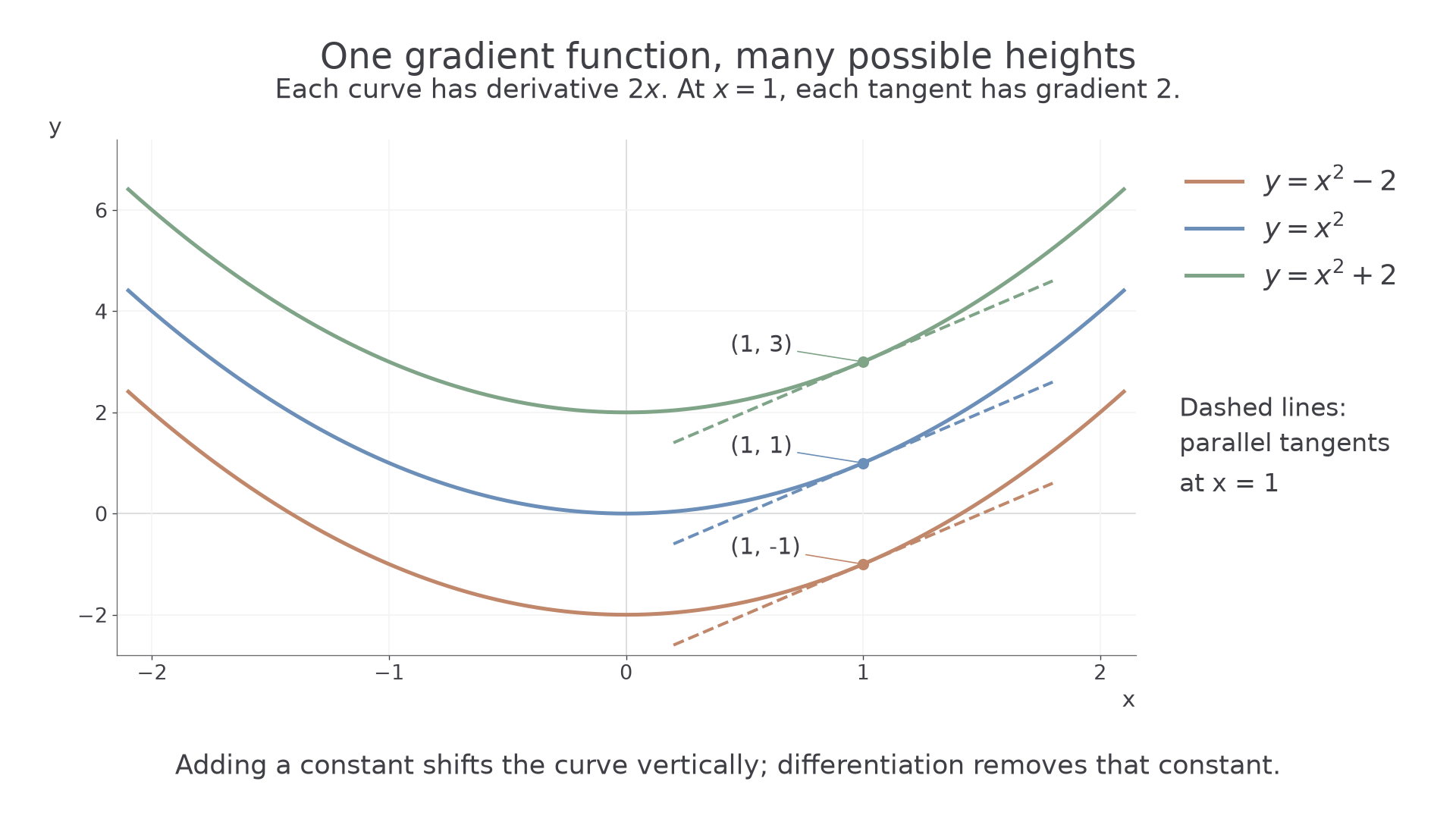
The curves in the picture have different heights at , but their tangents there all have gradient . This is the information a derivative preserves and a vertical shift changes.
Key idea
is one antiderivative of ; is the general antiderivative. Without extra information, there is no reason to choose .
The arbitrary constant belongs to the final function, not to the integrand. There is no remaining integral sign or in the result. If several terms are integrated separately, their constants can be combined into one . Also, : a zero gradient allows any constant height.
Choose the family that includes every vertical shift.
Power rule with n not equal to minus one
To reverse differentiation, increase a power by one and divide by that new power.
Since , an antiderivative of is . Dividing by cancels the multiplier that differentiation will introduce. More generally, differentiating gives , provided .
Power rule for integration
For , on an interval where the powers are real and differentiable,
Integrate sums and differences term by term, with one constant at the end. In particular, .
Not in the formula booklet: learn it.
The rule includes negative and fractional powers. For example, for . The excluded power would require division by zero; this power rule cannot integrate .
Worked example 1: integrate a sum
Question. Find .
Plan. Increase each exponent by one, divide its coefficient by the new exponent, and include .
Answer. .
Check. Differentiating gives , exactly the integrand.
Change only the first exponent from to . The new exponent is , so its coefficient is divided by a negative number.
Worked example 2: a negative power
Question. Find , for .
Plan. Apply the same power rule; the first exponent changes from to .
Answer. .
Check. The derivative of is ; the remaining terms give .
An integrand with exponent is allowed; an integrand with exponent is the exception. Do not confuse the exponent before integration with the exponent after it.
Watch out
, not : integration divides by the new exponent. A constant such as integrates to ; it does not disappear.
Change the first coefficient and check its sign carefully.
Rewriting before integration
The power rule works on separate powers, so expand and divide before using it on a product or a quotient.
You already used this strategy for differentiation. For example, , while division by reduces each of those exponents by . Rewriting changes the form, not the function.
Problem-solving
Before integrating, aim for a sum of terms . Expand a bracketed numerator, split a single-power denominator across every term, and simplify the indices. Then check that none of the resulting powers is .
Start with the squared bracket on its own.
Worked example 3: expand before integrating
Question. Find .
Plan. Expand the square, then integrate the three polynomial terms.
Answer. .
Check. Differentiating gives , matching the original unexpanded integrand.
Change only the denominator: divide the same square by . This introduces fractional powers, but not a new integration rule.
Worked example 4: a root denominator
Question. Find , for .
Plan. Expand, divide every term by , and integrate the resulting powers.
Thus
Why does the last coefficient become ? Dividing by doubles it.
Answer. .
Check. Differentiating the answer gives . Multiplying this by gives , confirming the original quotient.
The opening question has a family of answers: every has gradient . The same arbitrary constant is needed after more complicated integrations too.
Watch out
is not found by integrating numerator and denominator separately and dividing. Here the useful move was algebraic division into powers before integration.
Use the same expansion-and-division method with a new bracket.
Quick Recap
- Indefinite integration reverses differentiation and gives a family of functions.
- The constant records the vertical shift that differentiation cannot detect.
- Increase each exponent by one and divide by that new exponent; this rule excludes an integrand power of .
- Rewrite products and root denominators as sums of powers first, then differentiate your answer to check it.