P2 4.2 - Arithmetic sequences and sums
Find terms and finite sums of arithmetic sequences, and understand the proof behind the sum formula. You will use sigma notation, sum the first natural numbers and recover unknown sequence parameters from given information.
Nth terms
How could you add without writing every addition? First you need to know how many terms there are. Counting the gaps between terms is useful, but the first term must be counted too.
In , every next term is more than the previous one. Starting at , the second term is , the third is , and the fourth is , with . There is one fewer gap than there are terms.
Arithmetic sequence
An arithmetic sequence, or arithmetic progression, has a constant common difference . Write its first term as . A positive gives increase, a negative gives decrease, and gives a constant sequence.
That repeated addition gives the explicit formula.
Arithmetic nth term
For a positive integer ,
In the formula booklet.
To decide whether a number is a term, set equal to that number and solve for . A term position must be a positive integer; do not round a non-integer solution to create a term.
Worked example 1: finding a term and its position
Question. The arithmetic sequence continues. Find its fifteenth term and determine whether is a term.
Plan. Identify , then use the nth-term formula for both questions.
Answer. , and is the twenty-fourth term.
Check. . Also, and adding one common difference gives .
Change only the first term from to , keeping the common difference and the target . The same target may no longer occupy an integer position.
Worked example 2: a target between terms
Question. The arithmetic sequence continues. Find its fifteenth term and determine whether is a term.
Plan. Use and test the calculated position of .
Answer. . The number is not a term, because is not an integer position.
Check. The neighbouring terms are and . The target lies strictly between them.
Count the initial position as well as the gaps.
Watch out
For a final term and nonzero , counts the gaps. The number of terms is , provided that result is a positive integer.
Use a new first term with the same common difference.
Deriving the finite-sum formula
Adding an arithmetic sequence forwards and backwards produces equal column totals, which makes the entire sum easy to find.
For , reverse the terms underneath:
There are five equal column totals, so and . This is two complete copies of the sum, rather than a requirement to divide the original terms into pairs.
[DIAGRAM: asset_name: An arithmetic sum written twice; asset_slug: arithmetic-sum-pairs; caption: Reversing a second copy makes every column sum equal to the first term plus the last.; description: Five columns show forward terms three seven eleven fifteen nineteen and reverse terms nineteen fifteen eleven seven three. Each column totals twenty-two; the five column totals add to one hundred and ten, representing twice the original sum of fifty-five.]
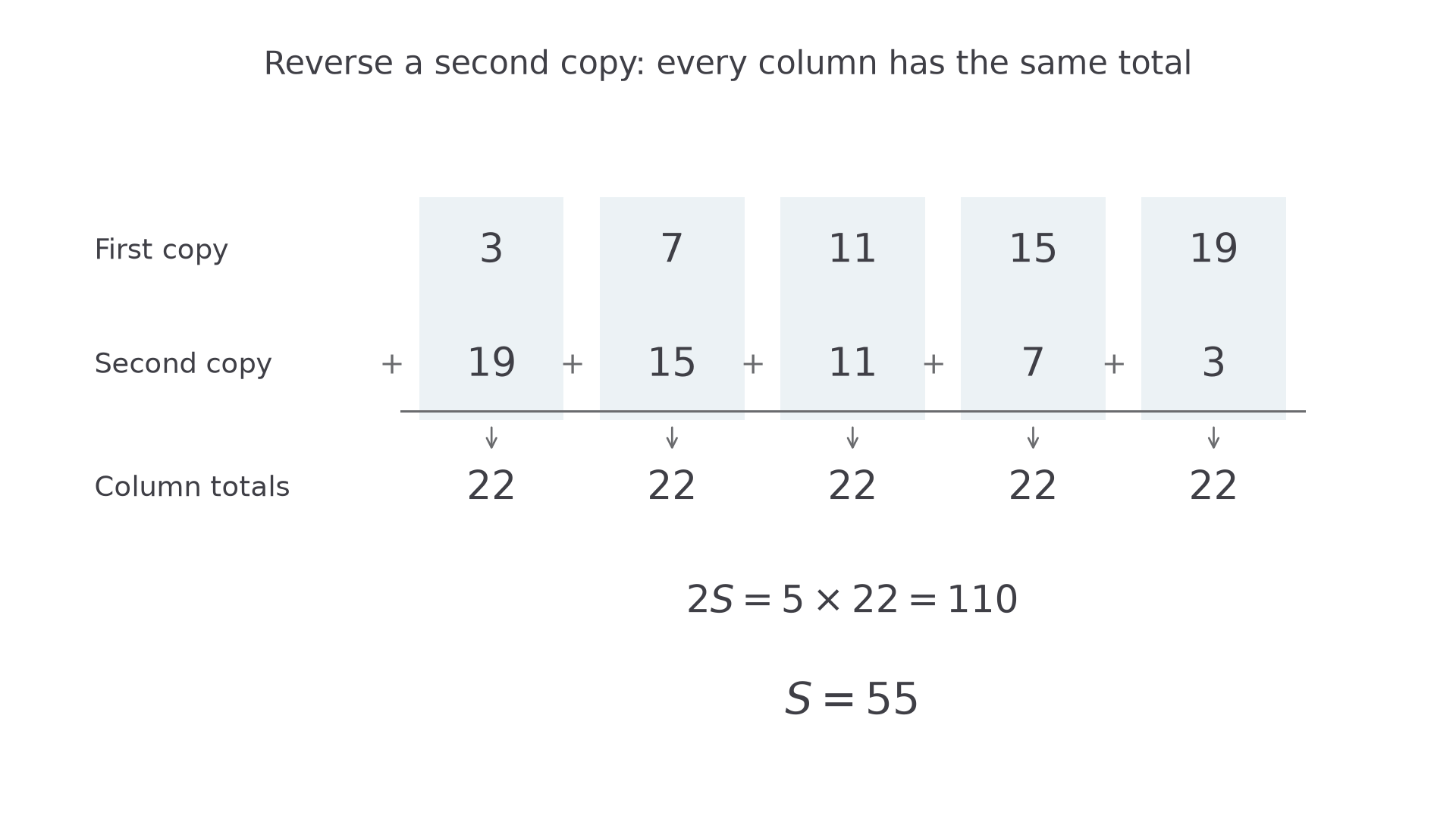
For a general arithmetic series with first term , common difference and last term , write
In every column, the -steps cancel: . There are columns. Adding the two rows therefore gives . Dividing by two proves the formula.
Finite arithmetic sum
For terms, with ,
Both forms are in the formula booklet. Know the proof by reversing a second copy and adding the two rows.
A series is a sum of sequence terms. Thus is one term, while is the sum of the first terms. Choose the first sum form when you know the last term; choose the second when you know .
Worked example 3: summing an even number of terms
Question. Find the sum of the first eight terms of .
Plan. Find the eighth term, then multiply the average of the first and last terms by the number of terms.
Answer. .
Check. Four endpoint pairs each sum to : , , , . Their total is .
Change only the number of terms from eight to nine. The formula still works when the number is odd.
Worked example 4: summing an odd number of terms
Question. Find the sum of the first nine terms of .
Plan. Use the same sum formula, now with .
Answer. .
Check. Add the ninth term to the previous sum: . Also, the middle term is , the average of the endpoints, so nine terms have total .
The derivation used two rows of terms, so it did not assume that was even.
Watch out
The factor does not mean “take half a term”. It comes from halving two copies of the sum, so the formula works for odd as well as even .
The opening sum ends at , which is , the eleventh term. Use that count to finish the calculation.
Sigma notation and natural-number sums
Sigma notation states exactly which terms are being added, so its lower and upper limits must both be read.
For example,
Here takes every integer value from to , inclusive. It is a counter within the sum, not a factor multiplying the whole sum. You could call it instead without changing the result.
Sigma notation
The symbol , capital Greek sigma, means “add”. In , add the values of for . There are terms, for integer limits .
The first natural numbers form an arithmetic sequence with . Substituting into the proved sum formula gives
Sum of the first natural numbers
For a positive integer ,
This follows from the arithmetic sum formula in the booklet; this separate identity is not printed in the P2 section.
You can separate a sum of two expressions and take a constant factor outside:
The constant is added once for each of the terms. For a later lower limit, either subtract the unwanted starting terms or identify the first term, last term and number of terms directly.
Worked example 5: using the natural-number sum
Question. Evaluate .
Plan. Separate the variable contribution from ten copies of the constant.
Answer. .
Check. The terms form an arithmetic series with endpoints and and ten terms. Its sum is .
Change only the lower limit from to . Three unwanted terms must now be removed.
Worked example 6: a later starting index
Question. Evaluate .
Plan. Subtract the terms for from the complete sum in Example 5.
Answer. .
Check. There are terms, starting at and ending at . The arithmetic sum is .
The limits tell you the number of constant contributions too.
Watch out
, not or . Also, is not ; that latter sum begins at .
Move the starting limit by one and check the inclusive count.
Solving for unknown sequence parameters
Information about two terms gives two equations for the first term and common difference; the distance between their positions tells you how many differences separate them.
For instance, from to there are six steps, so . Subtracting the two nth-term equations eliminates the first term. Once is known, substitute back to find , then use the finite sum formula if required.
Problem-solving
Translate each term value into before solving. If a sum is given instead, translate it into . The data become equations in the same unknowns.
Use the given positions as well as the given values.
Worked example 7: recovering parameters from two terms
Question. An arithmetic sequence has and . Find , and .
Plan. Subtract the term equations to find , substitute to find , then sum twelve terms.
Answer. , , .
Check. and , as supplied. The twelfth term is , so the other sum form gives .
Change only the tenth term from to , keeping . Both parameters must be reconsidered.
Worked example 8: changing one piece of term data
Question. An arithmetic sequence has and . Find , and .
Plan. Use the same six-step gap, then substitute into the fourth-term equation.
Answer. , , .
Check. and . The last term is , giving the alternative sum .
Term data are not the only way to find . If and , then
The second equation reduces to . Subtracting twice the first equation gives , so . The sum check is . The method remains “translate, solve, check”.
When , adding terms increases the running sum while the new term is positive, leaves it unchanged for a zero term, and decreases it once the new terms are negative. For , ; and . The largest partial sum is therefore . Check: and , both smaller. If a zero term occurs, the sums immediately before and after adding that term tie. Term counts remain integers throughout.
The opening sum is now explained by both its count and its endpoint average, rather than a long list of additions.
Watch out
spans common differences, not ten or seven. Subtract the positions to count gaps; use a positive integer when interpreting a term or partial sum.
Change the tenth-term value once more and solve the two equations afresh.