M2 2.1 - Centres of mass of particles
Find the centre of mass of particles in one and two dimensions using moments, then use a known centre to find a missing mass or position. Keep every coordinate measured from the same origin.
Weighted positions in one dimension
Where would you balance a light rod carrying at one end and at the other? Halfway is too far from the heavier end: the larger weight needs the shorter lever arm.
Centre of mass
The centre of mass is the point at which the total mass can be regarded as concentrated when calculating the moment of its weight in a uniform gravitational field.
For at and at , balance occurs at : the opposing moments are and .
Taking moments about the origin gives . The common factor cancels; the bar in denotes the centre-of-mass coordinate.
Centre of mass on a line
For masses at coordinates ,
Use signed coordinates from one common origin. This weighted-position formula is not printed in the formula booklet: learn it through moments.
An ordinary average works only when the masses are equal. The total mass is positive, so the centre lies between the smallest and largest coordinates; it is closer to a heavier particle when there are just two.
Worked example 1: unequal masses
Particles of mass and are fixed at coordinates and on a light rod. Find their centre of mass.
Plan. Replace the separate mass moments by the total mass at .
Answer. from the origin towards the heavier particle.
Check. Moments about this point are and , in opposite senses.
Change only the origin, moving it four metres to the right. The physical balance point stays put, while every coordinate decreases by four.
Worked example 2: signed coordinates
The same two particles now have coordinates and from a new origin. Find the centre-of-mass coordinate in this system.
Plan. Use the signed coordinates in the same moment equation.
Answer. to the right of the new origin.
Check. Adding the origin shift gives from the old origin, matching Worked example 1.
A light connecting rod contributes negligible mass. If the rod has appreciable mass, include it at its own centre of mass as an additional contribution.
Watch out
The denominator is total mass, not the number of particles. ignores the unequal masses and does not balance their moments.
Keep the negative coordinate in the next moment sum.
Two-dimensional distributions
For particles in a plane, find the two centre-of-mass coordinates separately, using the same total mass in both equations.
Apply the one-dimensional balance argument to each set of coordinates separately. You can imagine turning the distribution to make either coordinate direction horizontal before balancing it; the centre stays at the same point within the system.
Centre of mass in a plane
Equivalently, . These weighted-position formulae are not printed in the formula booklet: learn them.
A table of mass, horizontal coordinate and vertical coordinate keeps the two equations organised. Negative coordinates still carry their signs.
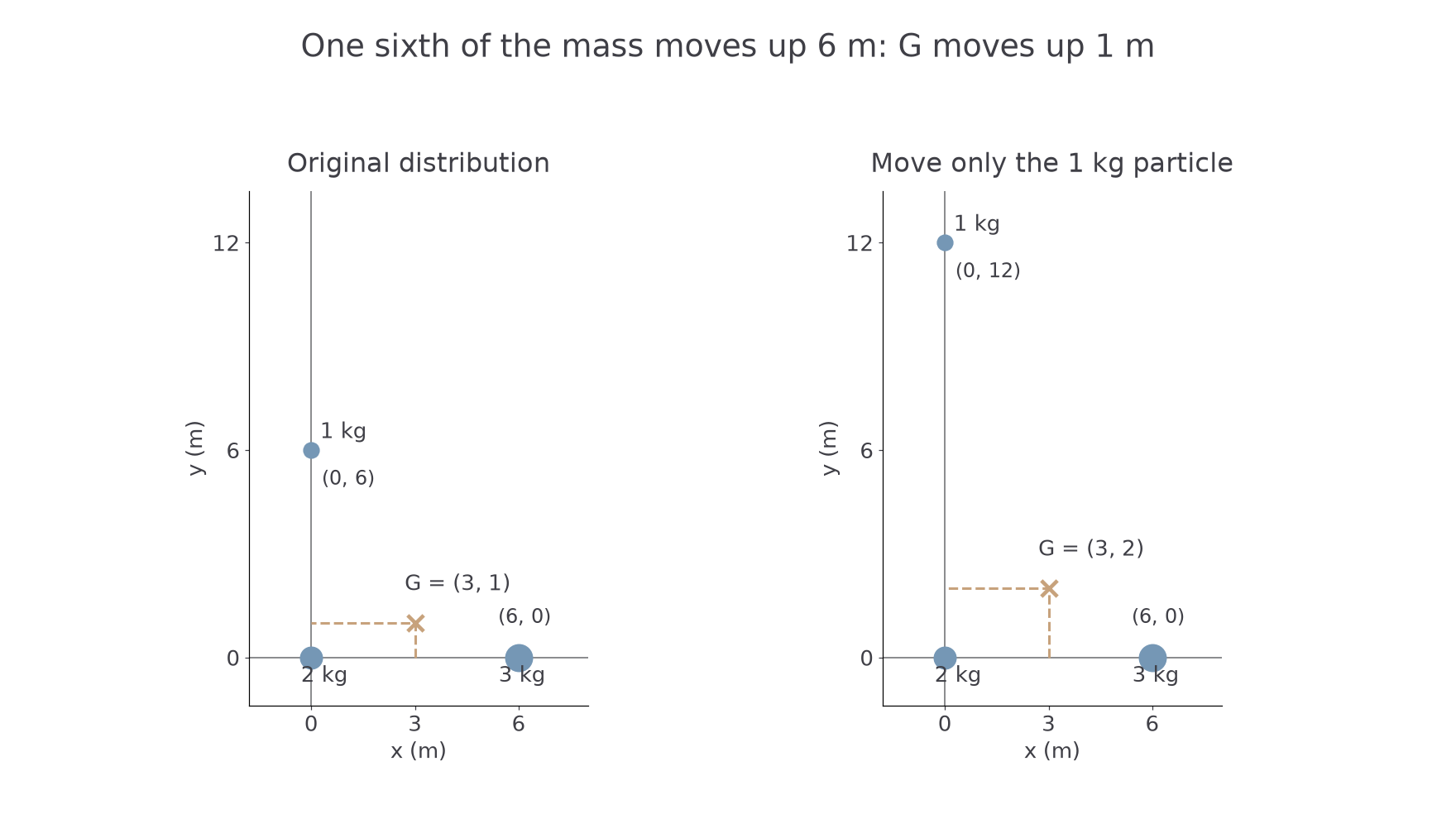
[DIAGRAM: asset_name: A weighted centre in a plane; asset_slug: m2-particle-centre; caption: Moving one particle vertically changes the vertical centre but leaves the horizontal centre unchanged.; description: Two equal-scale coordinate diagrams show masses 2 at the origin, 3 at (6,0), and 1 at (0,6) or (0,12). The centres of mass are marked at (3,1) and (3,2), with dashed coordinate projections.]
Continue this lesson.
You’re previewing NovaLearn without an account. Create a free account to read the rest.
Create free account