P3 2.1, P3 2.2 - Inverse functions and identities
Sine takes an angle to a number, but many angles give the same number. P3 2.1 uses restricted domains to make arcsine, arccosine and arctangent genuine inverse functions and explain their graphs. P3 2.2 then extends the Pythagorean identity to secant, cosecant and cotangent.
Arcsine arccosine arctangent and restricted domains
Both and have sine . An inverse function must return just one angle for each input, so we first restrict the original trigonometric function to a one-to-one branch.
Inverse trigonometric functions
The standard branches are:
| Inverse | Input domain | Output range in radians | Output range in degrees |
|---|---|---|---|
| All real |
For example, means with in the stated principal range.
On a calculator, , and normally denote these inverse functions. They return angles. They do not mean reciprocals: , whereas .
The composition holds for . Reversing the order gives only when lies in the selected sine branch. Outside it, the output is the principal angle with the same sine. The corresponding restrictions apply to cosine and tangent.
Worked example 1
Find the exact value of .
Plan. Evaluate sine, then choose the angle in arcsine's output range.
Answer. .
Check. This angle is between and , and its sine is , so it meets both conditions in the inverse definition.
Change only the original angle to . It has the same sine but lies outside the restricted branch.
Worked example 2
Find the exact value of .
Plan. Use the sine value, then choose its principal angle rather than cancelling the two function names.
Answer. , not .
Check. exceeds arcsine's maximum output ; is allowed and gives the required sine.
Cosine's inverse can return an obtuse angle: . Tangent's inverse instead returns a negative acute angle when its input is negative: . A calculator's single principal angle is a starting point for solving a periodic equation, not a complete list of its solutions.
Inverse graphs
An inverse graph swaps every input and output, so it reflects the chosen branch of the original graph in . The domain of the inverse is the range of the original branch; its range is the branch's domain.
[DIAGRAM: asset_name: Principal inverse trigonometric graphs; asset_slug: inverse-trig-graphs; caption: Each inverse reflects one selected branch; arctangent approaches horizontal asymptotes without reaching them.; description: Three panels show arcsine, arccosine and arctangent with their restricted original functions reflected across y equals x. Arcsine endpoints are minus one minus pi over two and one pi over two; arccosine endpoints are minus one pi and one zero; arctangent has open horizontal asymptotes at plus and minus pi over two.]
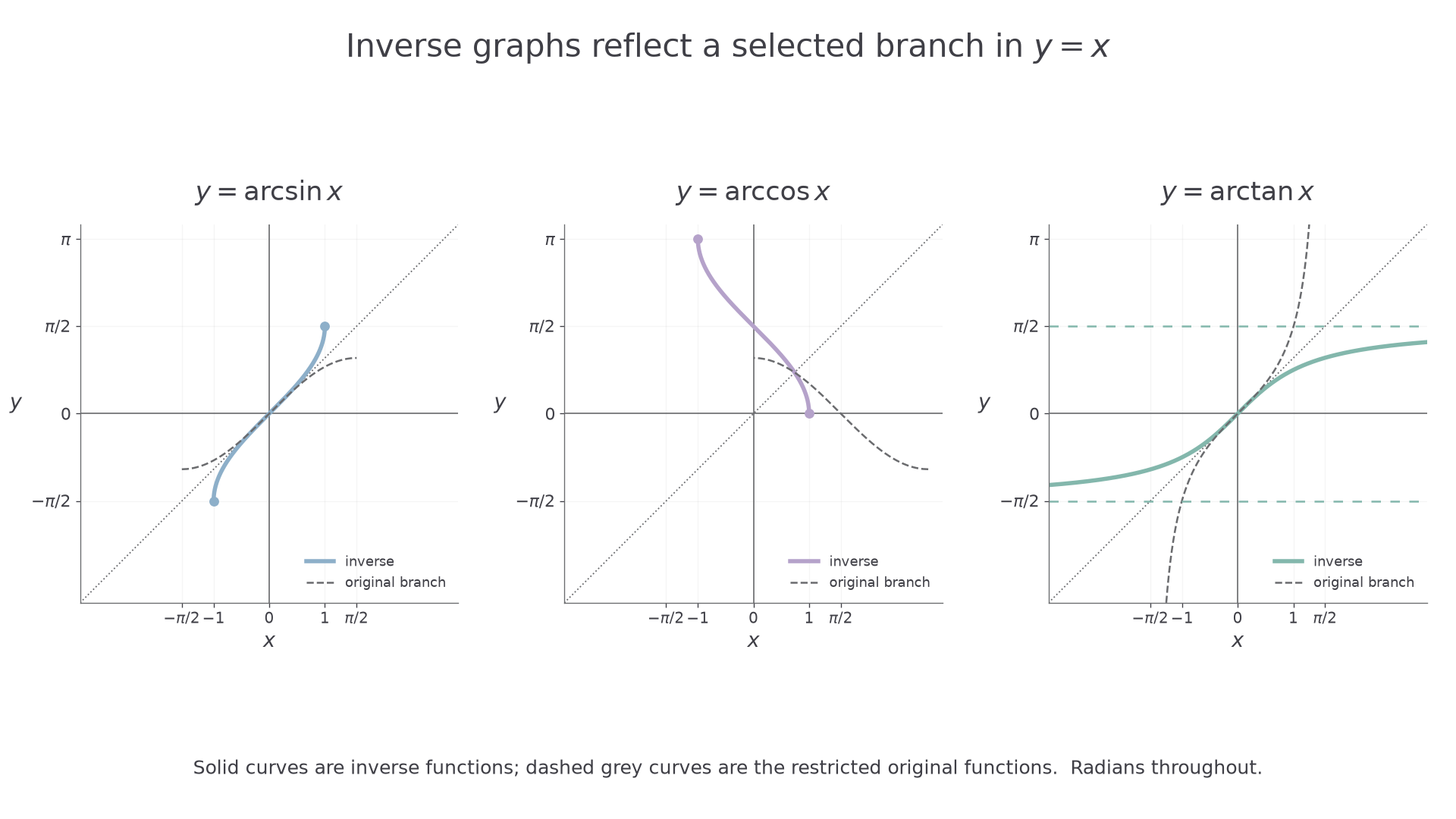
Arcsine increases from through to , including both endpoints. Arccosine decreases from through to . Neither graph repeats: restricting the original function removed that ambiguity.
For arctangent, the restricted tangent graph has vertical asymptotes at . Reflection turns these into horizontal asymptotes . Thus arctangent is defined for every real input, increases through , and approaches but never reaches those limiting output values.
Continue this lesson.
You’re previewing NovaLearn without an account. Create a free account to read the rest.
Create free account