P4 5.2 - Connected rates and differential equations
Connect changing quantities with the chain rule, then translate a physical rate statement into a differential equation. Learn to choose signs, constants, units and initial conditions so that the equation describes the stated model.
Linking rates by the chain rule
If a balloon gains the same volume every second, does its radius also increase at a constant rate? A larger sphere needs more added volume for the same small increase in radius, so the answer should be no.
For a sphere, , hence . The volume rate and radius rate are linked by the chain rule:
Connected rates
If depends on , which depends on time , then
For a sphere, this becomes .
The general chain rule is not in the formula booklet: learn it. The sphere's volume formula is assumed knowledge in the specification and is also often supplied in questions.
Use the radius at the specified instant after differentiating. Substituting it into the volume formula first would turn a changing quantity into a fixed number.
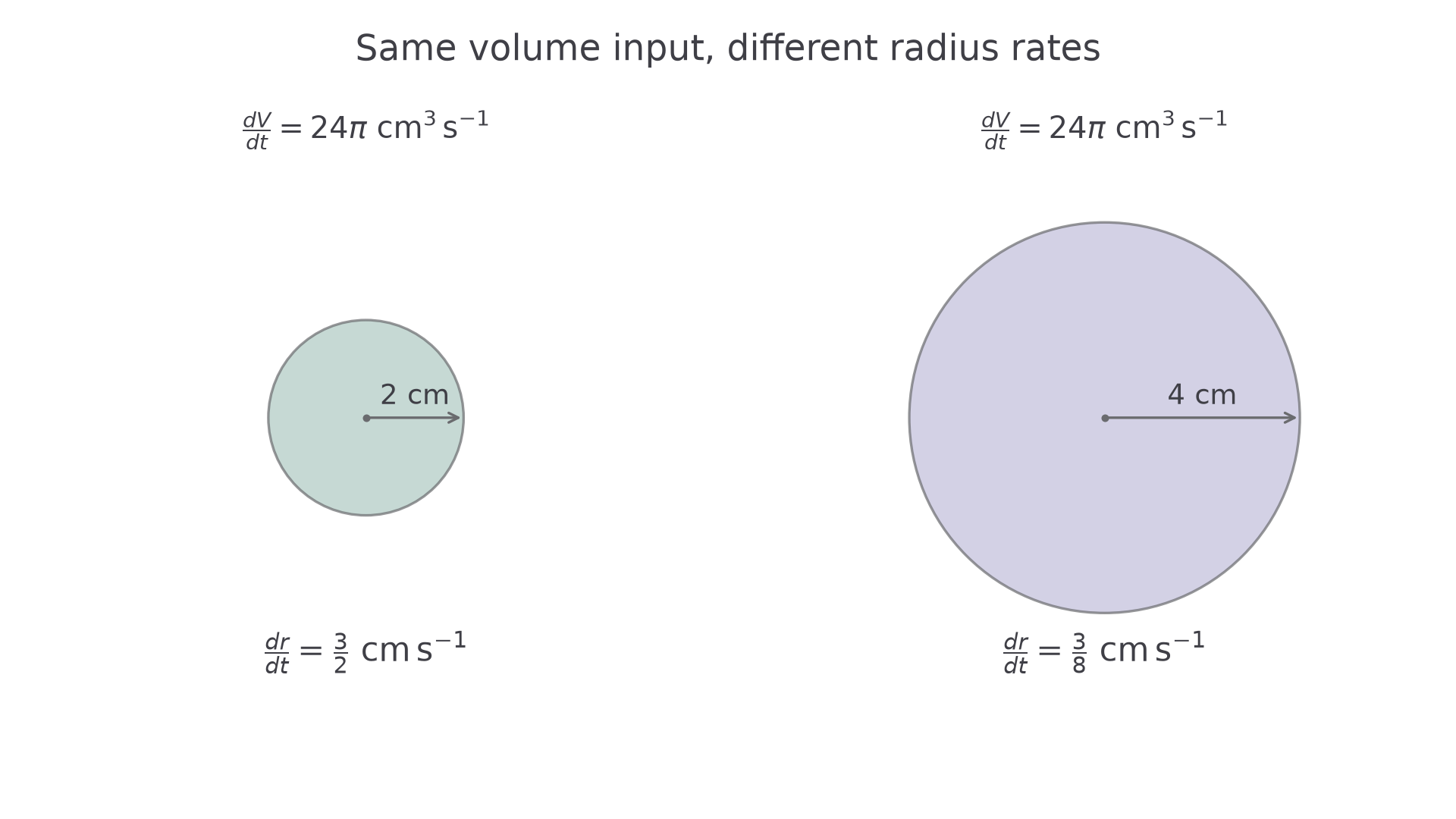
[DIAGRAM: asset_name: Equal volume rates and unequal radius rates; asset_slug: sphere-rates; caption: With the same volume input, doubling the radius quarters its instantaneous rate of increase.; description: Two circles representing spherical balloons at radii 2 cm and 4 cm, with labelled equal volume rates 24 pi cubic centimetres per second and respective radius rates 3/2 and 3/8 centimetres per second.]
Worked example 1: a radius rate
Question. A spherical balloon gains volume at . Find when .
Plan. Differentiate volume with respect to radius, then use the chain rule and the instantaneous radius.
Answer. The radius increases at .
Check. , recovering the supplied volume rate with consistent units.
Change only the instantaneous radius from to . The same volume input is spread over a larger spherical surface.
Worked example 2: a larger balloon
Question. With the same volume rate , find at .
Plan. Keep the chain-rule relationship and substitute the new radius.
Answer. .
Check. Doubling multiplies by , so must be a quarter of , namely .
In general, for constant positive volume rate ,
Since is constant, the radius rate is inversely proportional to . For a shrinking sphere at volume-loss rate , use ; the signed radius rate is negative and its magnitude is .
Watch out
A rate of decrease given as a positive magnitude needs a minus sign in the derivative. A volume decreasing by has .
Use the radius at the stated instant in the differentiated relationship.
Translating proportional rates
A differential equation relates an unknown function to one or more of its derivatives. Forming one means describing the rate correctly; solving it to find the whole function is a later task.
“Rate of increase of is proportional to ” translates to , with . A rate of decrease proportional to gives . “Inversely proportional to ” means a factor , not . The independent variable could also be distance rather than time.
Constant of proportionality
In , the constant of proportionality does not vary with or within the model. Find it from a supplied value of the rate and the corresponding quantities. Its units depend on the equation.
The quantity after “proportional to” must be read carefully: current amount and remaining capacity lead to different models.
Worked example 3: rate proportional to the current volume
Question. A controlled tank has volume litres at time minutes. Its volume increases at a rate proportional to . When , it is increasing at . Form the equation and find the model's rate at .
Plan. Write , determine , then use the same constant at the new volume.
At , the rate is .
Answer. ; the rate is .
Check. Tripling the volume triples the rate in a direct-proportionality model: .
Change only the proportional quantity to the unfilled capacity of a -litre tank. Keep the same calibration point.
Worked example 4: rate proportional to a remaining amount
Question. The tank now follows a model in which its rate of increase is proportional to . At , the rate is . Form the equation and find the rate at .
Plan. Use the remaining capacity in the equation before finding .
At , the remaining capacity is , so the rate is .
Answer. ; the rate at is .
Check. The remaining capacity falls from to , one third as large, so its proportional rate falls from to . At , the model gives rate zero.
A proportionality constant is fixed by the model, not recalculated arbitrarily at each later point.
Watch out
“Proportional to ” does not mean . The constant multiplies the entire stated quantity: .
Calibrate the model from the given volume and its simultaneous rate.
Continue this lesson.
You’re previewing NovaLearn without an account. Create a free account to read the rest.
Create free account