P1 3.1 - The ambiguous sine rule
Decide when two sides and a non-included angle determine no triangle, one triangle or two triangles. Find both sine-rule candidates, test them geometrically and finish each valid triangle without losing a solution.
Two possible angles
Can two different triangles have , and ? They can: a side of fixed length can swing into two positions while the given angle stays fixed.
Recall that is opposite , and is opposite . These data are two sides and an angle opposite one of them, often called SSA. They differ from two sides and their included angle, which fix a unique triangle.
The sine of a triangle angle is its height ratio. Angles and , for example, give the same positive height ratio. Thus a calculator's inverse-sine result need not be the only triangle angle.
Supplementary candidates
For , if and , the two candidates are
They are supplementary: they add to . If , both expressions give the same , so there is only one candidate. If , no triangle angle is possible.
These are candidates, not yet accepted solutions: each must leave room for the other two positive triangle angles. Use degree mode throughout this lesson.
Worked example 1: find both candidates
Question. A triangle is to have , and . Find the two candidate values of before testing the angle sum.
Plan. Use the sine rule to find , then form the supplementary angle.
Answer. The candidates are and to significant figures; retain the unrounded values for later work.
Check. In degree mode, both and equal .
Change only the opposite side from to . The sine ratio increases, so the acute candidate increases and the obtuse candidate decreases.
Worked example 2: move the candidates closer
Question. A triangle is to have , and . Find the candidate values of .
Plan. Find the new sine ratio, then use the same two-candidate procedure.
Answer. Candidates and , to significant figures.
Check. Each candidate gives , restoring the given side .
The inverse-sine key returns an angle, not the number of triangles. That decision needs geometry.
Testing the angle sum
A candidate angle is valid only if the remaining angle is positive.
For example, and a candidate already total , so they cannot belong to a triangle. Equality is also invalid: leaves , a flattened shape with no area. If two candidates survive, keep two separate rows of working so their remaining angles and sides are not mixed.
Worked example 3: reject one candidate
Question. Solve triangle given , and .
Plan. Find both candidates, reject any nonpositive remaining angle, then use the sine rule for .
Since , only is valid. Then
Answer. One triangle: , , , to significant figures.
Check. With the unrounded , the independent cosine rule gives , hence .
Change only from to . The obtuse candidate becomes small enough to fit, and both triangles must be completed.
Worked example 4: keep both triangles
Question. Solve triangle given , and .
Plan. Test each sine-rule angle separately, then pair each accepted with its own and .
Both rows below have :
| First triangle | Second triangle | |
|---|---|---|
Answer. Two triangles: , or , to significant figures.
Check. The side inequalities give ; both values satisfy this. Independently, the cosine rule using , and each unrounded returns its own listed .
Rounding the obtuse angle to a whole degree before subtraction can badly affect a small remaining angle. Keep the calculator value until all sides are found.
Zero one or two triangles
The number of solutions can often be predicted from a perpendicular height before any inverse-sine calculation.
Fix an acute angle , draw side , and let lie on the ray forming angle with . The perpendicular distance from to that ray is . The unknown point must be at distance from , so it lies where a circle of radius , centred on , meets the ray.
[DIAGRAM: asset_name: Two positions for the third vertex; asset_slug: ambiguous-triangles; caption: With A equal to thirty degrees, b equal to ten and a equal to seven, the circle reaches the ray twice.; description: Two triangles share A and C. A ray from A contains two possible vertices B1 and B2, each seven units from C. AC is ten units and makes thirty degrees with the ray. A dashed perpendicular from C to the ray has height five.]
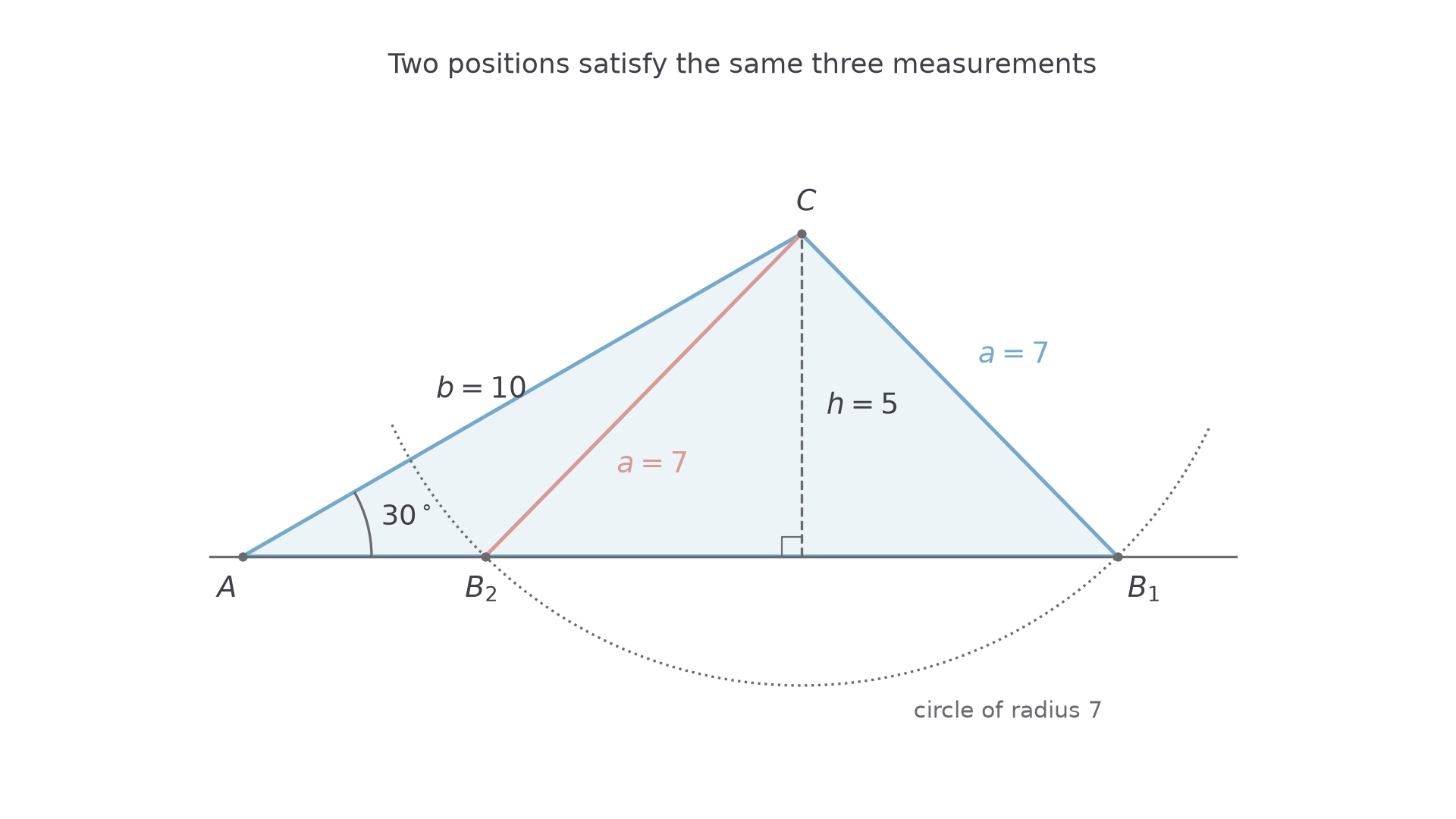
For acute , the geometry gives the following complete classification. All side lengths are positive.
| Comparison | Number of triangles | Reason |
|---|---|---|
| None | The circle cannot reach the ray | |
| One | The circle touches the ray; | |
| Two | Two intersections lie ahead of | |
| One | The second intersection is at or behind it |
When , its opposite side must be the longest: there is one triangle if , and none if . Do not apply the acute-angle table without first checking .
Worked example 5: the side cannot reach
Question. Can a triangle have , and ?
Plan. Compare the opposite side with the perpendicular distance to the ray.
Answer. No triangle exists.
Check. The sine rule would require , which is impossible for a real angle.
Change only from to . The circle now just touches the ray: two candidates meet at a single right angle.
Worked example 6: the boundary gives one triangle
Question. Can a triangle have , and ? If so, find its remaining angles and side.
Plan. Recognise , then complete the right triangle.
Answer. Exactly one triangle: , , .
Check. Pythagoras gives , with correctly the hypotenuse.
For our opening data, , so two triangles exist. Their angles are and ; both leave a positive third angle.
Quick Recap
- In an SSA problem, find both supplementary sine candidates.
- Retain only candidates leaving a positive third angle; keep each triangle's values together.
- A sine ratio greater than gives no triangle; a ratio of gives one candidate, not two.
- For an acute given angle, compare with and ; for an obtuse given angle, its opposite side must be longest.