P2 6.2 - Solving trigonometric equations
Find every solution of a trigonometric equation in a stated interval, including shifted angles, multiple angles and quadratic expressions. You will use the interval throughout the calculation and check that algebra has neither lost valid solutions nor introduced undefined ones.
All solutions in a specified interval
Why can have two solutions in one interval and four in another? A calculator gives one inverse-trig value, but the graph repeats: the interval determines how many answers to keep.
In one full turn, sine is positive in quadrants I and II. The reference angle therefore gives and . Adding or subtracting gives further solutions with the same sine.
[DIAGRAM: asset_name: Sine solutions in a wider interval; asset_slug: sine-interval-solutions; caption: Four intersections lie in the interval from minus 360 degrees inclusive to 360 degrees exclusive.; description: The sine graph from minus 360 to 360 degrees intersects y equal to one half at minus 330, minus 210, 30 and 150 degrees. The four intersection points are labelled, showing two periods rather than only one calculator answer.]
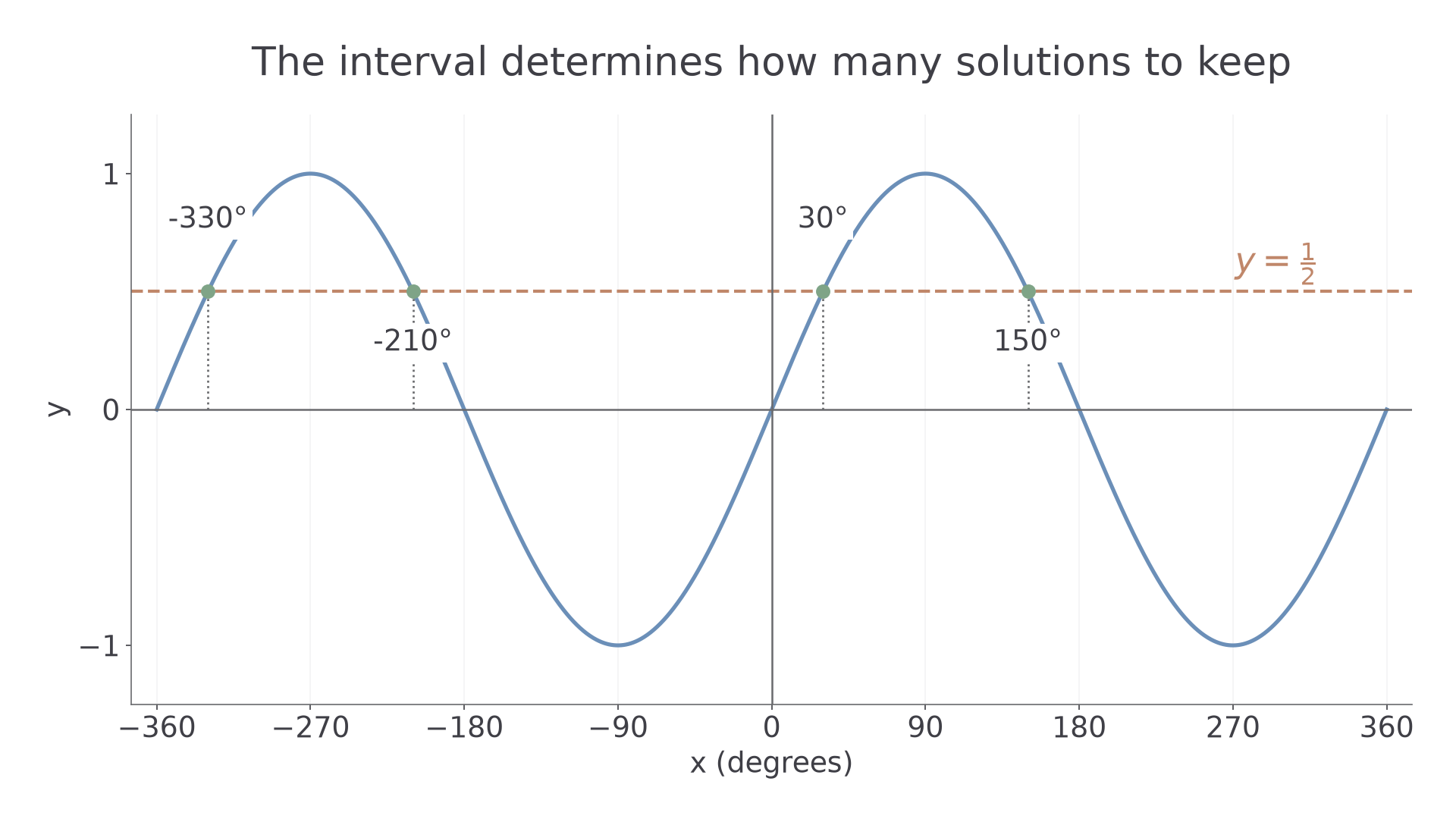
Use the graph or quadrant signs to find the other angles. For a positive acute reference angle , the usual locations in one turn are:
| Equation | Solutions in one turn, when the stated value is positive |
|---|---|
For a negative value, choose the quadrants with the required sign. Sine and cosine repeat every , or radians; tangent repeats every , or radians. Add or subtract complete periods until every angle in the specified interval is included.
Worked example 1: one full turn
Question. Solve for .
Plan. Find the reference angle, then use the two quadrants where sine is positive.
Answer. .
Check. Both angles have sine . The sine graph crosses this positive level twice in the stated full turn.
Change only the interval: include a second full turn on the negative side of zero.
Worked example 2: two full turns
Question. Solve for .
Plan. Start with the two solutions from one turn, then subtract and retain all values in range.
Answer. .
Check. Adding to either negative answer produces its positive partner, with the same sine. The graph above shows exactly four intersections.
Endpoints matter. In , is allowed and is excluded. For example, has answers in that interval, but also if the upper inequality is changed to . Special axis values need not give two different answers per turn.
Set your calculator to the angle unit requested. Keep exact standard angles as fractions of when radians are required.
Shifted and multiple angles
When the function contains an angle such as , solve for that whole angle first. Its interval changes too.
If , then . This wider interval contains more cycles than the interval for . Solving only for an inverse-trig principal value will miss answers.
Problem-solving
Set equal to the whole angle. Transform both interval endpoints, find every allowed , then undo the shift and multiplication in reverse order.
This method treats the expression inside the function as one angle. It does not require expanding a trigonometric function of a sum.
Worked example 3: a shifted angle in degrees
Question. Solve for .
Plan. Set , solve for in its shifted interval, then subtract .
Cosine is at in this interval. Hence
Answer. .
Check. Their original angles are and , both with cosine ; both -values lie strictly within the original interval.
Change only to inside the angle. The transformed interval is now twice as long.
Worked example 4: a multiple angle in degrees
Question. Solve for .
Plan. Set , list every cosine solution in the transformed interval, then use .
Therefore
Answer. .
Check. Substitution gives whole angles , all with cosine . All four -values satisfy the strict interval.
Radians use the same process. Tangent has period , which lets you list its whole-angle solutions especially efficiently.
Worked example 5: a tangent multiple angle
Question. Solve for , giving exact answers.
Plan. Use , so , and add periods of to .
Answer. .
Check. Doubling gives and , whose tangents are both . Two tangent periods occur in the interval for .
Change only the shift in the whole angle, from zero to .
Worked example 6: a shifted tangent multiple angle
Question. Solve for , giving exact answers.
Plan. Transform the interval before choosing the tangent solutions.
The values are in this interval; the next, , is above it. Therefore
Answer. .
Check. Substitution gives , respectively, so both satisfy the original equation and interval.
The shift is undone before division by the multiplier. Writing here would subtract too much; it must be .
Continue this lesson.
You’re previewing NovaLearn without an account. Create a free account to read the rest.
Create free account