P3 3.1, P3 3.2 - The exponential and natural logarithm
The exponential function always produces a positive value, and its inverse tells us which exponent produced that value. P3 3.1 develops the graph of and its transformations; P3 3.2 introduces the natural logarithm and uses the inverse relationship to solve equations with careful domain checks.
The function e to x and transformed graphs
Could ever equal zero or a negative number? It cannot: it is a positive-base exponential, so each of its outputs is positive, even when the exponent is negative.
The exponential function
The number is an irrational constant, approximately . The exponential function uses this fixed base. Its domain is all real numbers, its range is , and it passes through .
Like the positive-base exponentials studied in P2, it obeys the index laws: and . Since , its graph increases: it tends to zero as becomes very negative and grows without bound as becomes very positive. The line is a horizontal asymptote, not part of the curve.
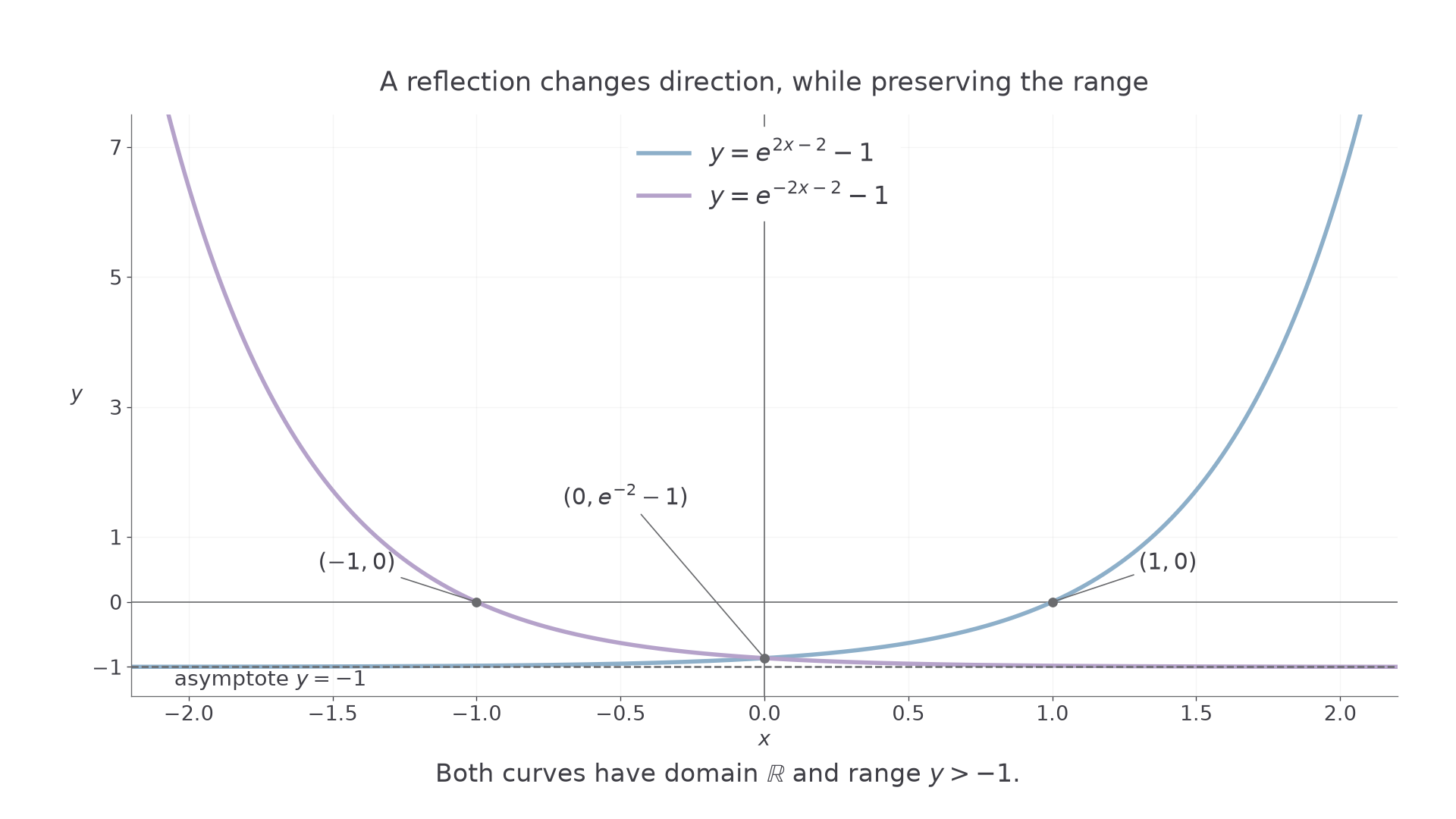
For with , the exponential part stays positive, so the domain is all real numbers, range , and horizontal asymptote . The curve increases if and decreases if . Setting gives a useful anchor with height ; setting gives the vertical-axis intercept . If , the expression is the constant , a separate case.
[DIAGRAM: asset_name: Exponential graphs with a horizontal asymptote; asset_slug: exponential-transformations; caption: Changing the sign of x in the exponent reflects the curve in the vertical axis; both ranges remain above minus one.; description: Two accurately plotted curves y equals e to the power 2x minus 2 then minus one and y equals e to the power negative 2x minus 2 then minus one are reflections in the y axis, share intercept e to the power minus two minus one and horizontal asymptote y equals minus one, and cross the x axis at plus one and minus one respectively.]
Worked example 1
Describe , giving domain, range, horizontal asymptote, both axis intercepts and whether it increases or decreases.
Plan. Use positivity for the range, inspect the exponent's coefficient for direction, and substitute at each axis.
The domain is all real , and , so . The asymptote is , approached as becomes very negative. The coefficient makes the curve increasing.
Answer. Domain ; range ; asymptote ; intercepts and ; increasing.
Check. At , the original expression gives . At , , above the asymptote.
Change only the sign of the coefficient of inside the exponent. This reflects the whole previous curve in the vertical axis.
Worked example 2
Describe , giving the same features.
Plan. Retain the positive-exponential range but reverse the direction of change and the horizontal coordinates.
The domain is , range , and asymptote , now approached as becomes very positive. Since , the graph decreases.
Answer. Domain ; range ; asymptote ; intercepts and ; decreasing.
Check. Replacing by in the first example gives this function exactly. The intercept's horizontal coordinate changes sign while the vertical-axis intercept stays fixed.
A shift inside the exponent belongs to the exponent: , whereas is a different function.
Natural logarithm as inverse
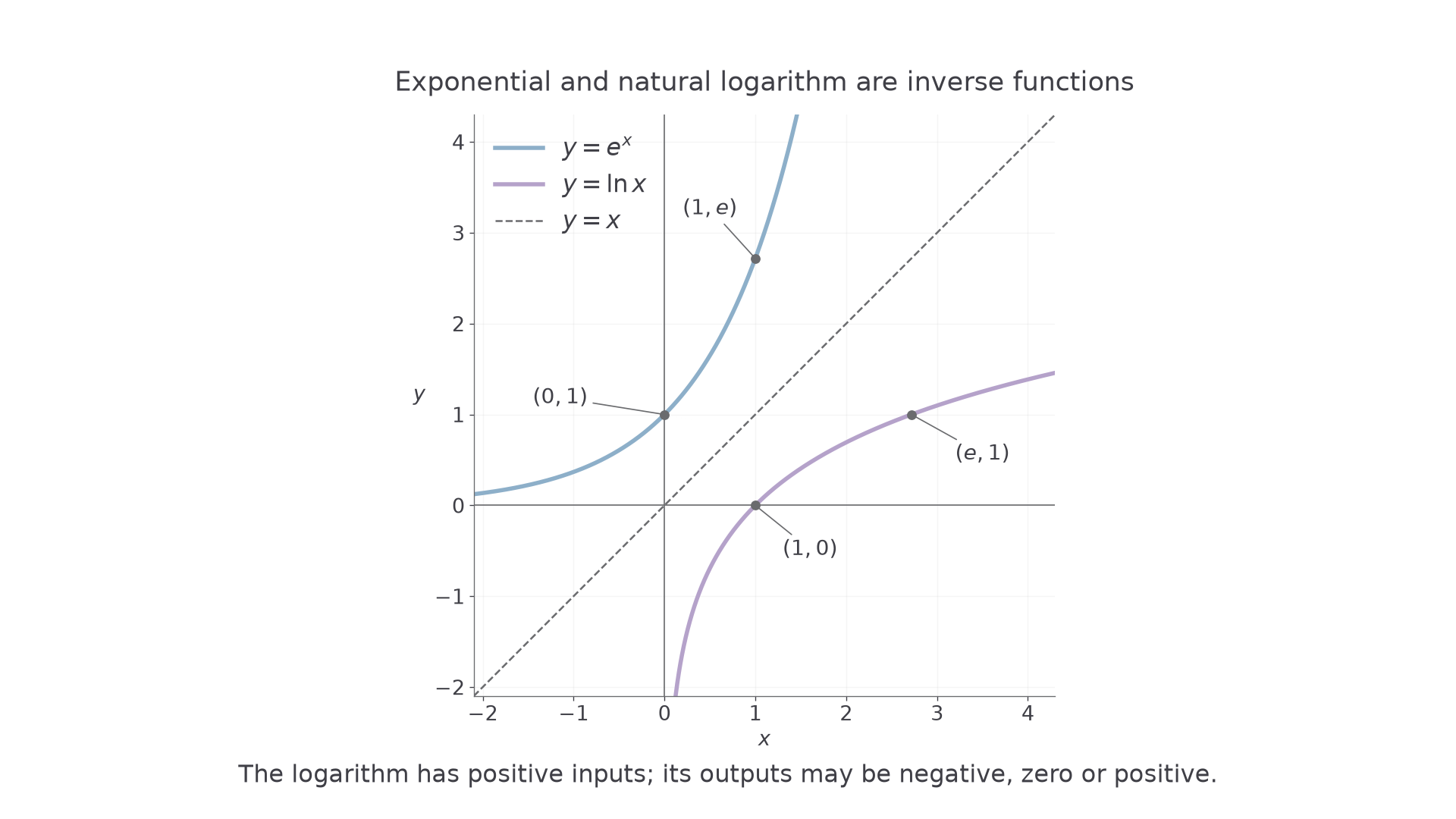
The equation has one real solution because increases through every positive output. The natural logarithm, written , names that exponent: .
Natural logarithm
Thus . The two inverse statements are
Reflecting in gives . The points reflect to . Hence logarithm inputs must be positive, but outputs may be positive, zero or negative. Its domain is , range all real numbers, and vertical asymptote . It increases, dropping without bound as a positive input approaches zero.
[DIAGRAM: asset_name: Exponential and logarithm as inverse graphs; asset_slug: exponential-log-inverse; caption: Swapping the coordinates reflects the exponential graph into the natural-log graph.; description: Equal-scale axes show y equals e to x and y equals natural log x reflected in y equals x. Corresponding points zero one and one zero, one e and e one are marked. The positive domain of natural logarithm and the exponential positive range are visible.]
Natural logarithms obey the P2 log laws, with the same positive-input conditions:
In particular, , , and . A sum inside a logarithm does not split: is generally not . The booklet supplies for positive ; it connects another positive base to the natural exponential.
Continue this lesson.
You’re previewing NovaLearn without an account. Create a free account to read the rest.
Create free account