P3 2.1 - Reciprocal trigonometric functions
A sine value can be small while its reciprocal is large. In P3 2.1 you will connect secant, cosecant and cotangent to familiar trigonometric functions, explain their graph branches and asymptotes, and use the relationships to solve equations in degrees and radians.
Secant cosecant and cotangent
If , what is ? It is , even though cosine itself cannot exceed . Taking a reciprocal creates a different function with a different range.
Reciprocal trigonometric functions
The names are secant, cosecant and cotangent. Where both sides are defined, .
A reciprocal preserves the sign of a nonzero number. Thus secant has cosine's sign, and cosecant has sine's sign. Do not interchange their names: secant is the reciprocal of cosine.
Cotangent's quotient definition matters at : , even though tangent is undefined there. Use only where tangent exists and is nonzero. These are reciprocal functions, not the inverse functions that return angles.
Worked example 1
Given and , find exact values of , and .
Plan. Reciprocate cosine and sine separately, then divide cosine by sine for cotangent.
Answer. , respectively.
Check. Multiplying the first two answers by their original cosine and sine gives each. Also , recovering cosine.
Change only the sign of cosine, placing the angle in quadrant II. The reciprocal rules stay the same.
Worked example 2
Given and , find exact values of , and .
Plan. Retain the negative sign when reciprocating cosine and when forming the quotient.
Answer. .
Check. Secant times cosine is . Cosecant stays positive because sine has not changed sign, while negative cosine divided by positive sine gives negative cotangent.
A calculator may require entering rather than a separate secant key. Choose degree or radian mode to match the angle before evaluating.
Graphs and asymptotes
To build a reciprocal graph, locate the zeros of the original denominator first. At those inputs the new function is undefined. Close to a zero, a small positive or negative denominator gives a very large value of the corresponding sign: this produces a vertical asymptote, a vertical line approached by a branch of the graph.
[DIAGRAM: asset_name: Reciprocal trigonometric graphs; asset_slug: reciprocal-trig-graphs; caption: Zeros of the denominator become vertical asymptotes, while cotangent can equal zero.; description: Three panels on the interval minus pi to pi show secant with faint cosine, cosecant with faint sine, and cotangent. Dashed vertical asymptotes occur at odd half multiples of pi for secant and integer multiples of pi for cosecant and cotangent. Key turning values plus or minus one and cotangent zeros at plus or minus pi over two are indicated.]
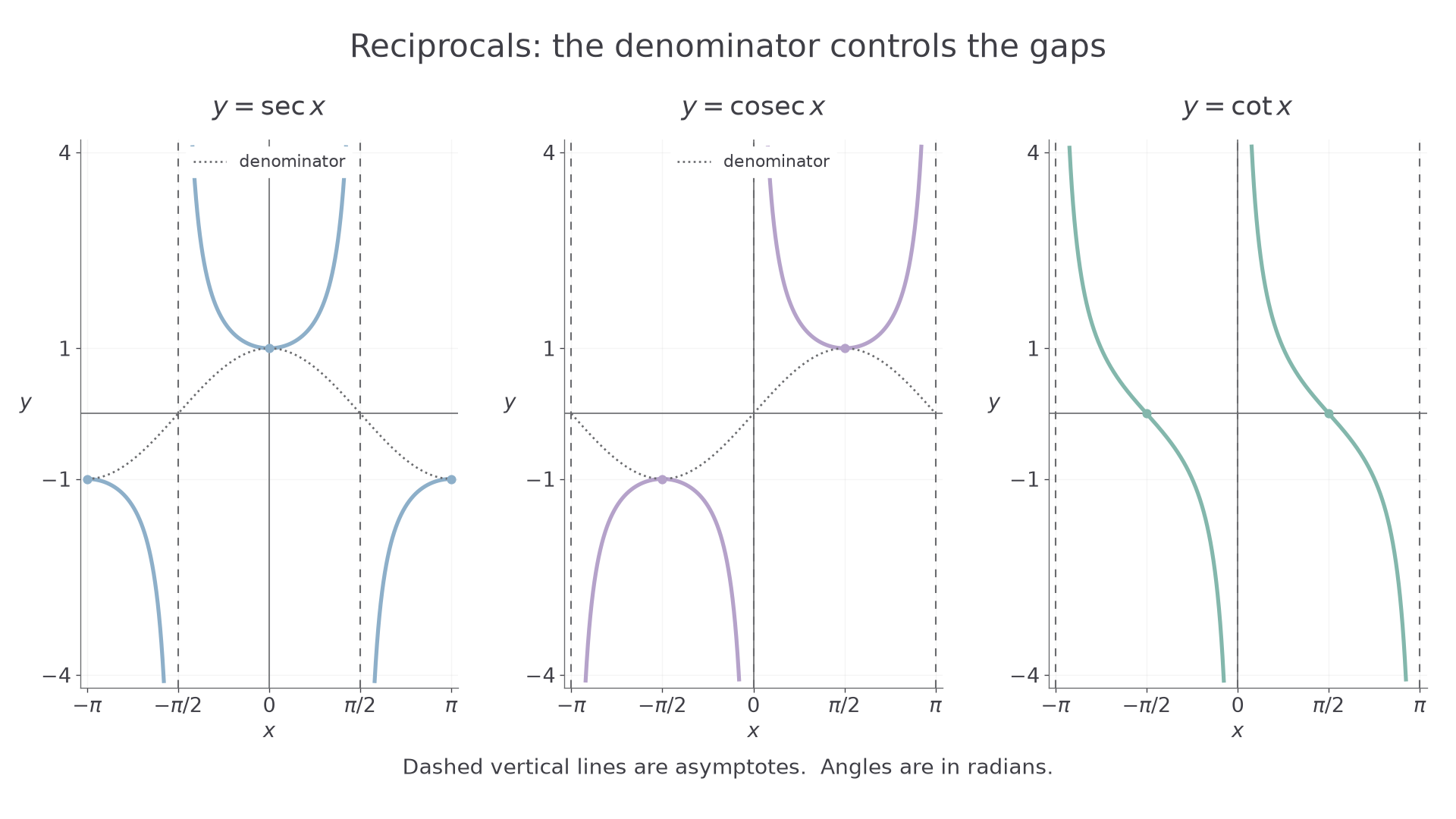
For any integer , the principal features are:
| Function | Excluded inputs and vertical asymptotes | Range | Period |
|---|---|---|---|
| , or | or | , or | |
| , or | or | , or | |
| , or | All real values | , or |
Continue this lesson.
You’re previewing NovaLearn without an account. Create a free account to read the rest.
Create free account