M2 1.1, M2 1.2 - Projectile motion
Model a projectile by separating its horizontal and vertical motion, find flight times and heights, and eliminate time to describe its path. Use the physical flight interval when deciding whether it reaches a target.
Independent horizontal and vertical motion
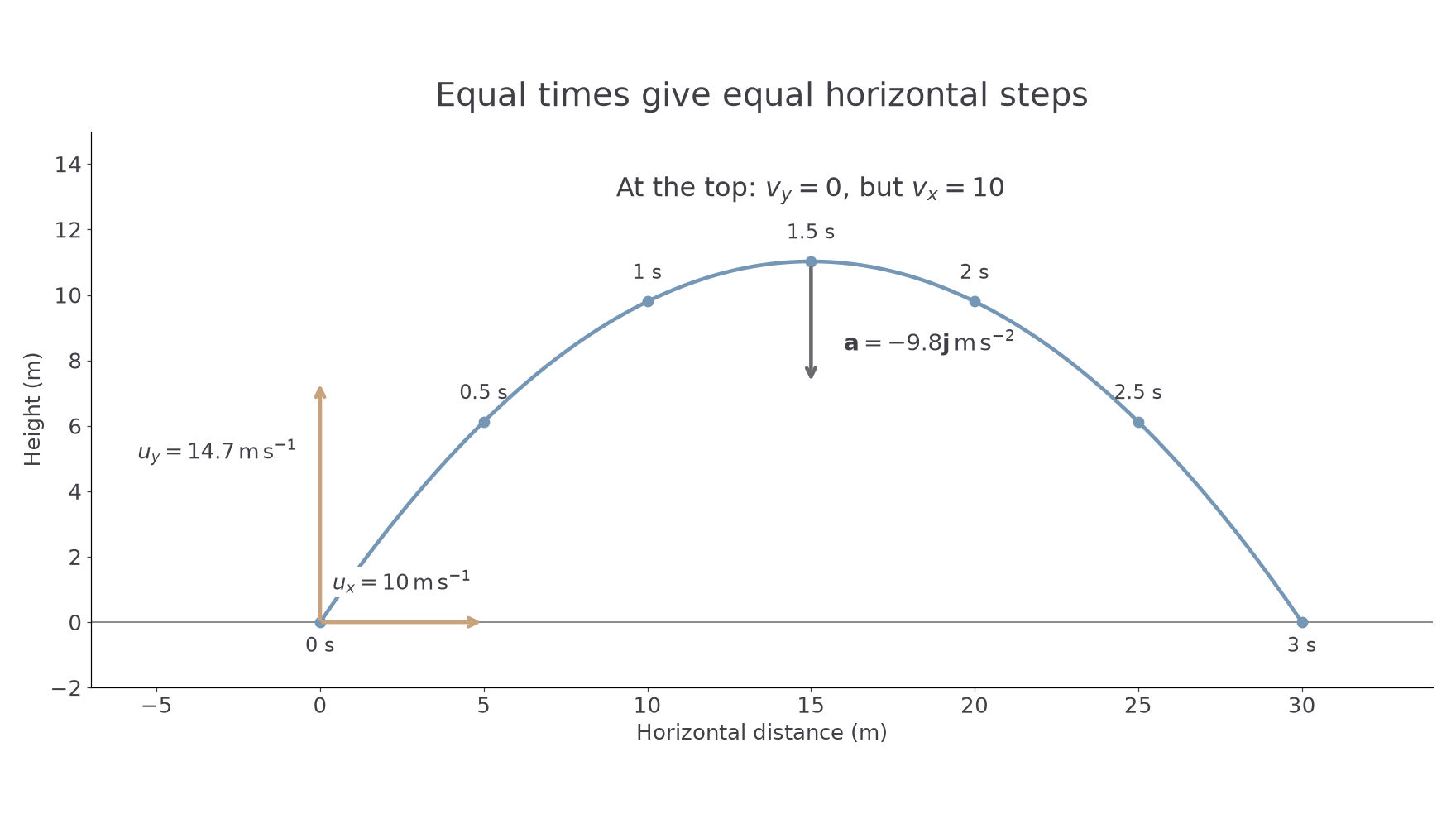
A ball is moving horizontally at the top of its flight. Has gravity stopped acting? No: its vertical velocity is zero for an instant, but its downward acceleration continues throughout the flight.
A projectile is modelled here as a particle moving freely under gravity after release. Neglect air resistance and take gravity as constant and vertically downward. There is no horizontal force, so horizontal velocity stays constant. Choose horizontally towards the target and vertically upwards. Throughout this lesson use .
Resolve a launch speed at angle above the horizontal into horizontally and vertically. Apply constant-acceleration equations separately, using the same elapsed time in both directions.
Projectile components
From starting position ,
These results follow from constant horizontal velocity and vertical acceleration . They are not separately printed in the formula booklet: learn how to obtain them.
A horizontal projection has , so its initial vertical velocity is zero. For example, release from height with horizontal speed gives , .
[DIAGRAM: asset_name: Independent projectile components; asset_slug: m2-projectile-components; caption: Horizontal steps stay equal while downward acceleration changes the vertical steps.; description: A projectile launched with horizontal velocity 10 and vertical velocity 14.7 metres per second has its parabolic path marked at equal half-second intervals. Horizontal and vertical initial components are shown, with a downward acceleration arrow at the apex where vertical velocity is zero.]
Worked example 1: position after one second
A particle is projected from ground level at , at above the horizontal. Find its position and velocity after one second.
Plan. Resolve the launch velocity, then use horizontal acceleration zero and vertical acceleration .
Answer. Position ; velocity .
Check. The upward component is still positive, so the particle is just before its highest point, at time .
Change only the launch height. The same velocity produces the same change of position, but a different height above the ground.
Worked example 2: launch above the ground
The same particle is instead launched from height . Find its position relative to the ground below the launch point and its velocity after one second.
Plan. Add the initial height to the vertical position equation; keep the velocity equations unchanged.
Answer. Position ; velocity .
Check. Subtracting the initial position gives the same displacement as in Worked example 1.
If drag were significant, the horizontal velocity would generally change and this model would need replacing. It is the force assumptions that justify the component equations.
Watch out
At the highest point , but usually is not zero and still holds. The particle is neither at rest nor free from acceleration.
Resolve a new launch before using one second of flight.
Time height and range
The flight ends at the surface the particle actually hits, which need not be at its launch height.
At maximum height, . At ground impact, if height is measured from that ground. Horizontal range is the horizontal velocity multiplied by the flight time. For return to the launch level, the upward and downward parts are symmetric; this symmetry fails when the landing level differs.
Return to the launch level
For a launch above the horizontal with , returning to the same height,
Here is the rise above launch, not necessarily height above ground. These results are not separately printed in the formula booklet: obtain them from the component equations.
The time to the top is ; substituting it into the vertical displacement gives . For a different landing level, solve the actual height equation instead of using .
Worked example 3: landing at the launch level
A particle is launched from horizontal ground at , at an angle with , . Find the flight time, range and maximum height.
Plan. Resolve once, then use the vertical motion to find the relevant times.
Answer. , , maximum height , to three significant figures.
Check. The top is reached at , halfway through the flight; its vertical displacement is .
Change only the launch height to . The rise above launch stays the same, but the flight lasts longer.
Worked example 4: lower landing level
The particle from Worked example 3 is launched from height above horizontal ground. Find its flight time, range and maximum height above ground.
Plan. Solve the new ground-height equation and discard its negative-time root.
Answer. , , and , respectively, to three significant figures.
Check. At , . The other root, , belongs to a backwards extension before release.
Keep unrounded values in calculations involving , then give the final numerical answers to the requested precision; two or three significant figures is normal when is used.
Continue this lesson.
You’re previewing NovaLearn without an account. Create a free account to read the rest.
Create free account