P4 7.7 - The scalar product
Use the scalar product to connect vector components with angles and perpendicular directions. Choose the correct arrows for an angle, distinguish vectors from lines, and solve geometric problems by finding a perpendicular foot.
Component and angle definitions
How can component arithmetic tell us whether two directions make an acute angle or an obtuse one? A single number, the scalar product, carries this information.
Take and . The products of matching components add to . Reverse , and the same calculation gives . The sign responds to direction, even though neither arrow's length changes.
Scalar product
For and , their scalar product, or dot product, is
The answer is a scalar, not a vector. In two dimensions, omit the third product.
For nonzero vectors, draw both arrows from one point and let , between and , be their angle. The cosine rule gives
Expanding the squared components of gives the same first two terms, followed by . Comparing the expressions explains the angle form.
Geometric scalar product
The component and angle forms are not printed in the P1–P4 formula booklet: learn them.
The component definition also gives and . It distributes over addition, so . Expanding therefore gives the useful check .
Worked example 1: a negative scalar product
Question. For and , find .
Plan. Multiply corresponding entries and add the three products, retaining their signs.
Answer. .
Check. , giving squared magnitude . Independently, .
Change only the last component of . This changes just one of the three products.
Worked example 2: a positive scalar product
Question. For the same and , find .
Plan. Keep the first two products and recalculate the final signed product.
Answer. .
Check. , giving squared magnitude ; independently, .
Because both magnitudes are positive, the sign of the scalar product is the sign of : positive when , zero at , and negative when . The endpoints and describe parallel arrows pointing in the same and opposite directions respectively.
Watch out
is a sum of component products. It is not the column , and it does not generally equal .
Calculate one scalar for the next pair.
Angles between vectors and lines
An angle between directed vectors can be obtuse, while the acute angle between their lines ignores which way each direction arrow points.
Rearrange the geometric product to find the vector angle:
Use in the requested angle unit. Keep exact scalar products and magnitudes until the final calculation. A value outside indicates an error, apart from a tiny rounding discrepancy at an endpoint.
Smaller angle between lines
For nonzero direction vectors and , the smaller angle between the lines satisfies
The same direction comparison works for skew lines after translating their direction arrows to a common point. This form is derived from the scalar product and is not separately printed in the formula booklet.
The endpoint describes parallel directions, and describes perpendicular directions. If a question instead names a triangle angle, use arrows pointing away from its stated vertex; that angle can be obtuse.
[DIAGRAM: asset_name: Reversing an arrow changes the vector angle; asset_slug: p4-vector-line-angles; caption: Reversing one arrow makes the vector angle supplementary, while the smaller line angle stays the same.; description: Two panels show a horizontal vector a and a vector b with angle theta equal to arccos four ninths, about 63.6 degrees. The second reverses b, giving vector angle 180 minus theta, about 116.4 degrees. Dashed extensions show the underlying lines and retain the same acute angle.]
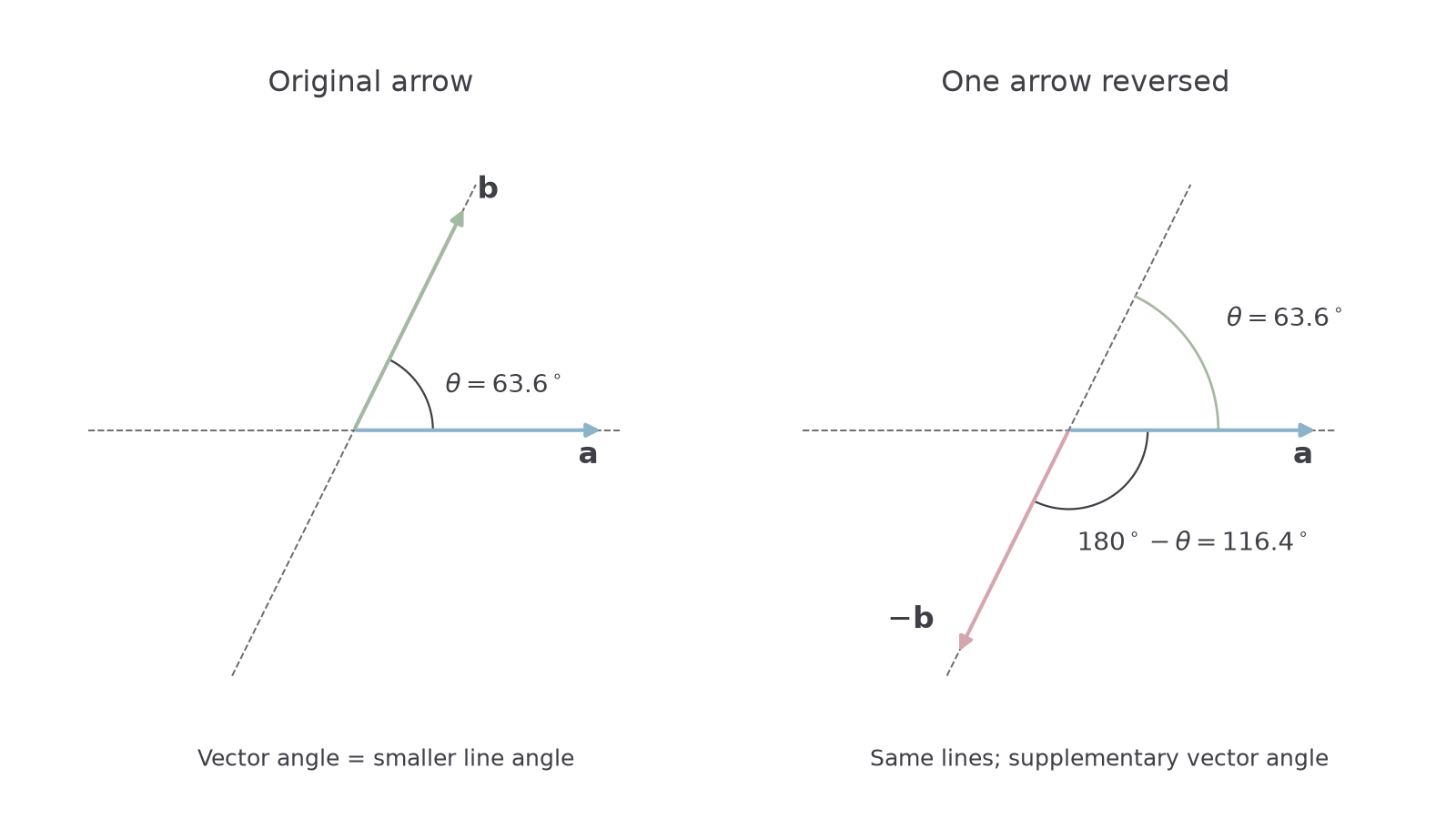
Worked example 3: an acute vector angle
Question. For and , find their vector angle and the acute angle between lines in their directions. Give angles to one decimal place.
Plan. Calculate the product and both magnitudes, then use the angle formula.
Answer. The vector angle and the acute line angle are both .
Check. The scalar product is positive, so the vector angle must be acute. Also before rounding.
Reverse only . This keeps its line and magnitude, but changes the sign of the product.
Worked example 4: an obtuse vector angle
Question. With the same and , find their vector angle and the acute angle between lines in their directions, to one decimal place.
Plan. Use the signed product for vectors and its absolute value for the smaller line angle.
Answer. Vector angle ; acute line angle , to one decimal place.
Check. The two vector angles add to . Reversing a direction vector cannot change the underlying line.
The direction vectors determine the line angle; the starting position vectors do not.
Continue this lesson.
You’re previewing NovaLearn without an account. Create a free account to read the rest.
Create free account