P2 3.1 - Equations of circles
Connect a circle's equation to its centre and radius, complete squares to reveal that information, and determine equations from given points. Keeping squared distances visible prevents unnecessary square roots and helps you check the geometry.
Centre-radius form
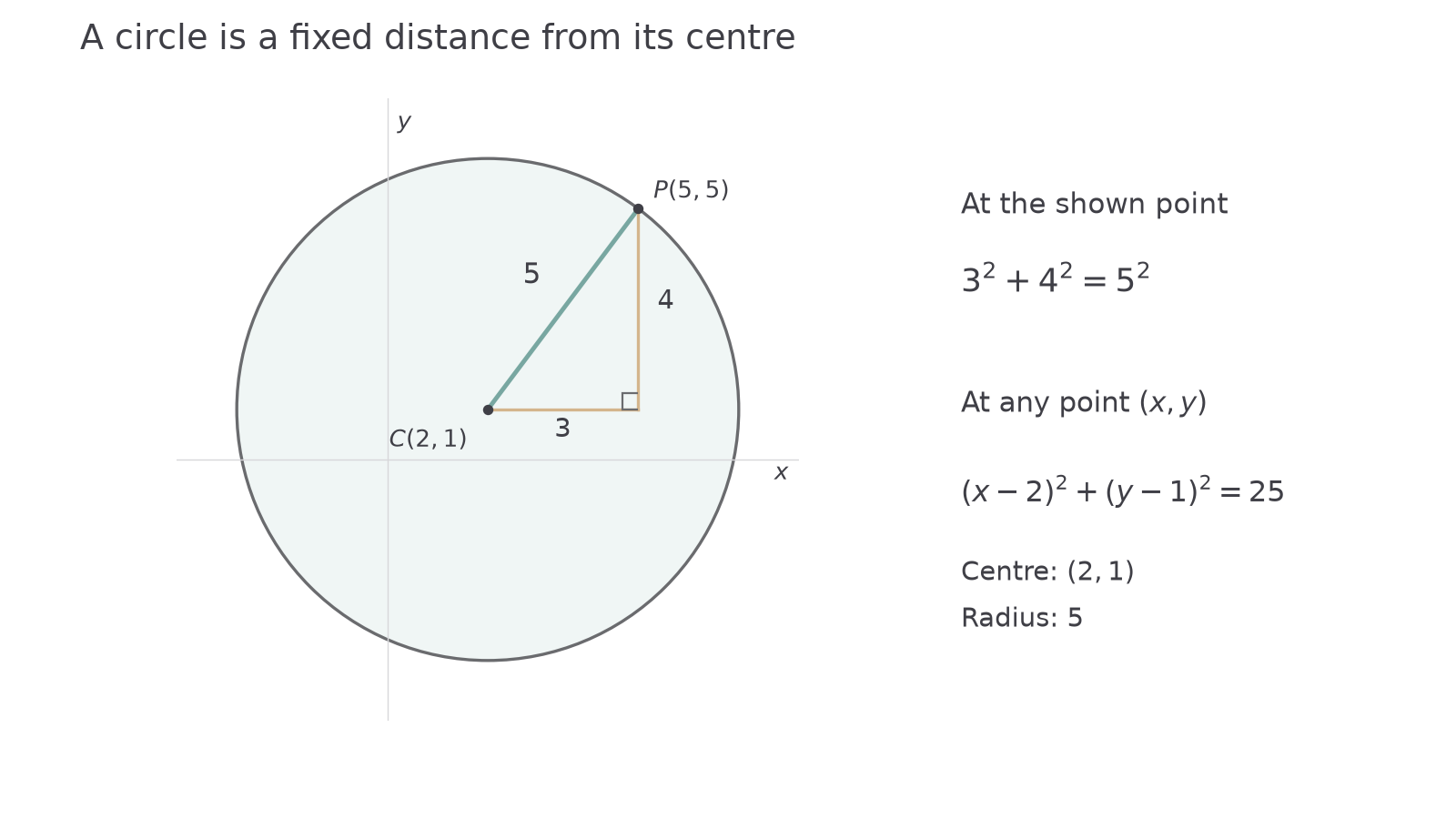
How can one equation describe every point exactly units from ? For the point , the horizontal and vertical differences from are and . Pythagoras gives .
Replace that particular point by a moving point . Its squared distance from is , so setting this equal to describes the whole circle.
[DIAGRAM: asset_name: A circle as a fixed distance; asset_slug: circle-fixed-distance; caption: The differences from the centre form a right triangle whose hypotenuse is a radius.; description: Equal-scale coordinate diagram showing centre C at (2,1), point P at (5,5), a radius of length 5, and horizontal and vertical components 3 and 4. The circle has equation (x-2) squared plus (y-1) squared equals 25.]
Centre-radius equation
A circle with centre and radius has equation
A point lies on the circle exactly when its coordinates satisfy this equation. A smaller squared distance places it inside; a larger one places it outside.
Not in the formula booklet: learn it.
The signs in the brackets express differences from the centre, not the centre's coordinates directly.
Worked example 1: writing an equation
Question. Find the equation of the circle with centre and radius .
Plan. Subtract the centre coordinates from and equate the sum of squares to .
Answer. .
Check. The rightmost point is . Substitution gives , and its distance from the centre is .
Change only the sign of the centre's first coordinate. The horizontal bracket changes from subtraction to addition.
Worked example 2: a negative centre coordinate
Question. Find the equation of the circle with centre and radius .
Plan. Use , retaining the same vertical difference and radius.
Answer. . Reading this equation backwards gives centre and radius .
Check. Its rightmost point is . Substitution gives ; the horizontal distance from to is .
A circle's centre is usually not on its circumference: substituting the centre makes the left-hand side zero.
Watch out
In , the centre is , not , and the radius is , not . The right-hand side is the radius squared.
Read both pieces of information from this new equation.
Completing squares
An expanded circle equation hides its centre, but completing one square in and one in reveals it.
Recall . The subtracted compensates for the extra introduced by expanding the bracket. Complete both squares before collecting constants.
Expanded circle equation
For
completion of squares gives
The centre is . A positive right-hand side gives a circle, zero gives a single point, and a negative value gives no real points.
Not in the formula booklet: learn it.
The equal coefficients of and matter. If they share a common nonzero coefficient, divide it out first. An equation such as is not a circle.
Worked example 3: revealing centre and radius
Question. Find the centre and radius of .
Plan. Group by variable and complete both squares.
Answer. Centre , radius .
Check. Expanding the final equation gives , or .
Change only the original constant from to . The linear terms, and therefore the centre, stay the same; the radius changes.
Worked example 4: changing the constant
Question. Find the centre and radius of .
Plan. Complete the same squares, but keep the new constant on the right.
Answer. Centre , radius .
Check. The point is units from the centre. The original left-hand side is , as required.
The constant controls the size only after the square-completion adjustments have been included.
Watch out
The line is wrong: the right side contains an extra . Use . A missed compensation changes the radius.
Complete both squares before taking a square root.
Circle through given points
A known centre and one point determine the radius; the endpoints of a known diameter determine both the centre and the radius.
If the centre is and lies on the circle, then . If are opposite ends of a diameter, the centre is their midpoint. Either use the distance from that midpoint to an endpoint, or divide the squared diameter by .
Diameter endpoints
For diameter endpoints , ,
This uses the midpoint rule and .
Not in the formula booklet: learn it.
Two points stated only to lie on a circle do not determine a unique circle. You must use the additional information, such as “diameter” or a condition on its centre.
Worked example 5: diameter information
Question. and are the endpoints of a diameter. Find the circle's equation.
Plan. Find the midpoint, then find the squared radius from the centre to .
Answer. .
Check. The squared diameter is . Substituting either endpoint into the circle equation gives .
Move only 's vertical coordinate from to . Both the midpoint and radius must be recalculated.
Worked example 6: an exact radius and an extreme point
Question. and are the endpoints of a diameter. Find the circle's equation and the exact point on it nearest the -axis.
Plan. Find its centre and squared radius, then look at the lowest point of the circle.
Its lowest height is , so the whole circle lies above the -axis. The nearest point is directly below the centre, one radius away.
Answer. The equation is , and the nearest point is .
Check. At that point, the squared differences are and , so it lies on the circle. The other vertical extreme, , is farther from the axis.
“Lowest point” and “nearest the -axis” coincide here because the circle is wholly above that axis. A circle crossing the axis has distance zero at its intersection points instead.
Watch out
The distance between diameter endpoints is . If you calculate the squared distance between them, divide by , not by , to obtain .
Use the stated diameter rather than treating the endpoints as a centre and a point.
Quick Recap
- A circle is a set of points at a fixed distance from its centre.
- Read its centre and squared radius from .
- Complete both squares to reveal an expanded equation's geometry.
- A diameter's midpoint is the centre; its length is twice the radius.
The opening set of points is exactly the circle .