P2 6.1 - Using trigonometric identities
Connect sine, cosine and tangent so that an expression involving several trigonometric functions can be written in a simpler form. You will use signed values in different quadrants and prove identities by transforming one side into the other.
Sine cosine and tangent relation
If and , can you find without finding the angle? The signs place the angle in the second quadrant, but the link between the three functions gives the value directly.
For an acute angle in a right-angled triangle,
The common hypotenuse cancels. The relation extends to other angles using signed coordinates: sine supplies the vertical coordinate and cosine the horizontal coordinate on a circle of radius .
Sine cosine and tangent relation
Tangent is undefined when , for example at and .
Not in the formula booklet: learn it.
Signs therefore matter. In quadrant II, sine is positive and cosine negative, so tangent is negative. In quadrant III, both are negative, so tangent is positive.
Worked example 1: positive sine and cosine
Question. Given and , find .
Plan. Divide sine by cosine, cancelling the common denominator.
Answer. .
Check. , so .
Change only the sign of cosine. This is the opening question, and it changes the sign of tangent.
Worked example 2: a negative horizontal coordinate
Question. Given and , find .
Plan. Keep the minus sign when dividing by cosine.
Answer. .
Check. . The negative tangent also agrees with quadrant II.
Division has an order: cosine divided by sine is generally a different value.
Pythagorean identity
On a circle of radius , a point at angle has coordinates . Its squared horizontal and vertical coordinates add to the squared radius.
[DIAGRAM: asset_name: Unit circle identities; asset_slug: unit-circle-identities; caption: Signed coordinates give sine and cosine; the radius gives their squared identity.; description: A unit circle has a radius to a point in quadrant two with coordinates minus four fifths and three fifths. Horizontal and vertical projections show cosine theta equals minus four fifths and sine theta equals three fifths. The radius is one, and the labels connect the coordinate squares to one and their quotient to tangent minus three quarters.]
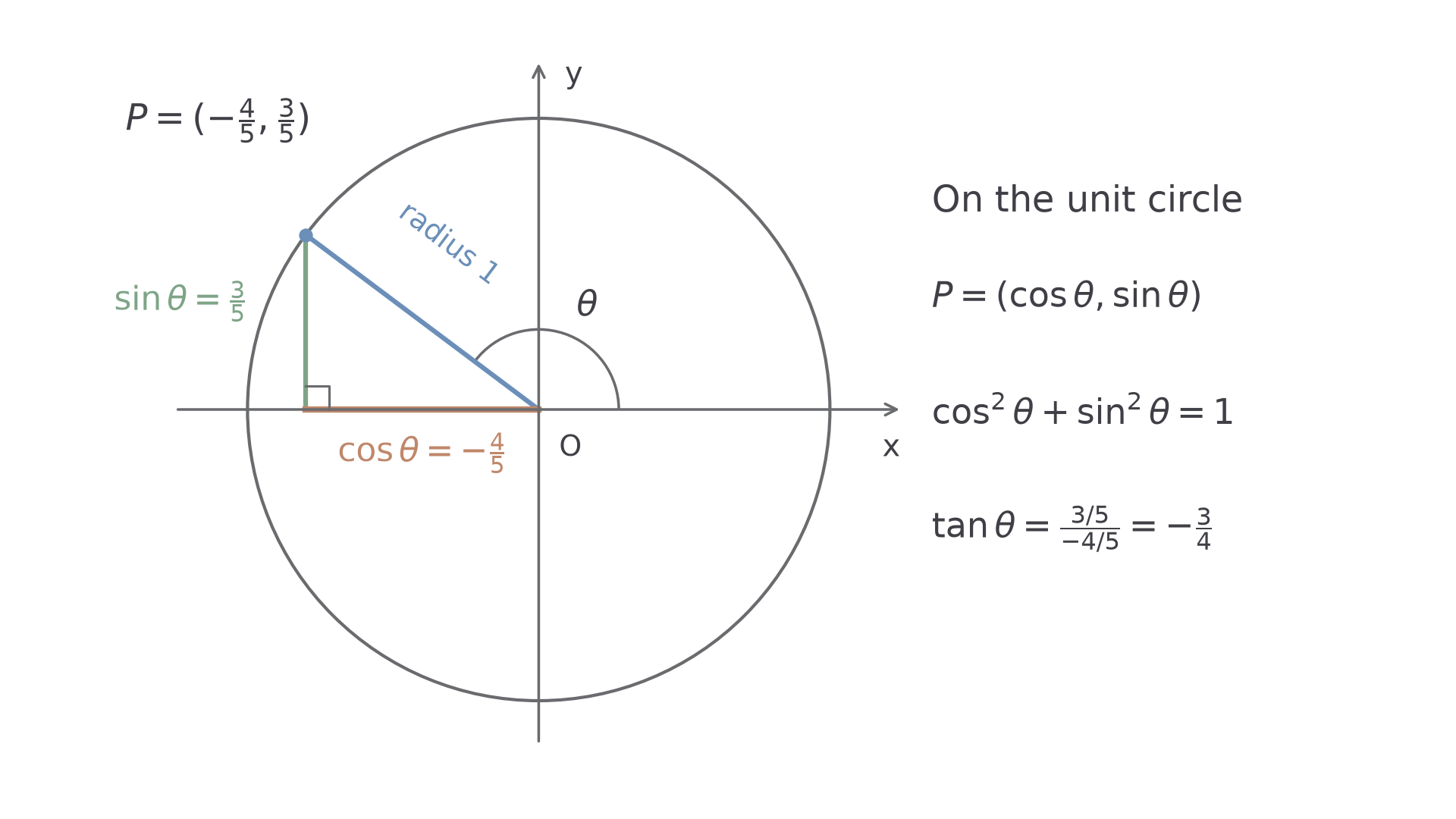
Pythagoras gives . Squaring removes the signs, so the result holds in every quadrant, including points on the axes.
Pythagorean identity
Here means , not .
Useful rearrangements are and .
Not in the formula booklet: learn it.
The identity finds a missing square. To find the unsquared value, use the quadrant to decide its sign. Writing only the positive square root can lose a valid negative value.
Worked example 3: choosing a positive root
Question. Given and , find exact values of and .
Plan. Find , choose the sign from quadrant I, then divide sine by cosine.
Answer. and .
Check. , and the three values are positive as expected for an acute angle.
Change only the stated quadrant. The supplied cosine is unchanged, but sine and tangent must now be negative.
Worked example 4: choosing a negative root
Question. Given and , find exact values of and .
Plan. Use the same squared identity, then choose the quadrant IV sign before finding tangent.
Answer. and .
Check. , while negative divided by positive gives a negative tangent.
Continue this lesson.
You’re previewing NovaLearn without an account. Create a free account to read the rest.
Create free account