P4 6.5 - Areas from parametric equations
Calculate area without eliminating a curve's parameter. Convert vertical-strip widths using the derivative of its x-coordinate, match parameter limits to the required boundaries, and keep the direction and sign of each contribution consistent.
Converting y dx to a parameter
If a curve is given by , , why is not its area under the curve? The height is correct, but an equal step in does not give an equal horizontal width.
For example, increasing from to changes from to . The strip width is , not . Infinitesimally, , so . Multiply the height by this horizontal-width factor.
[DIAGRAM: asset_name: Parametric strips need horizontal width; asset_slug: parametric-strip-width; caption: The area strip has width delta x, which differs from the change in t.; description: The supplied curve x equals t squared and y equals t plus one runs from zero comma one to four comma three. The area under the curve is pale blue. A highlighted vertical strip between x equals one and one point two one corresponds to t increasing from one to one point one; its horizontal width is labelled delta x equals zero point two one, and the parameter change is delta t equals zero point one.]
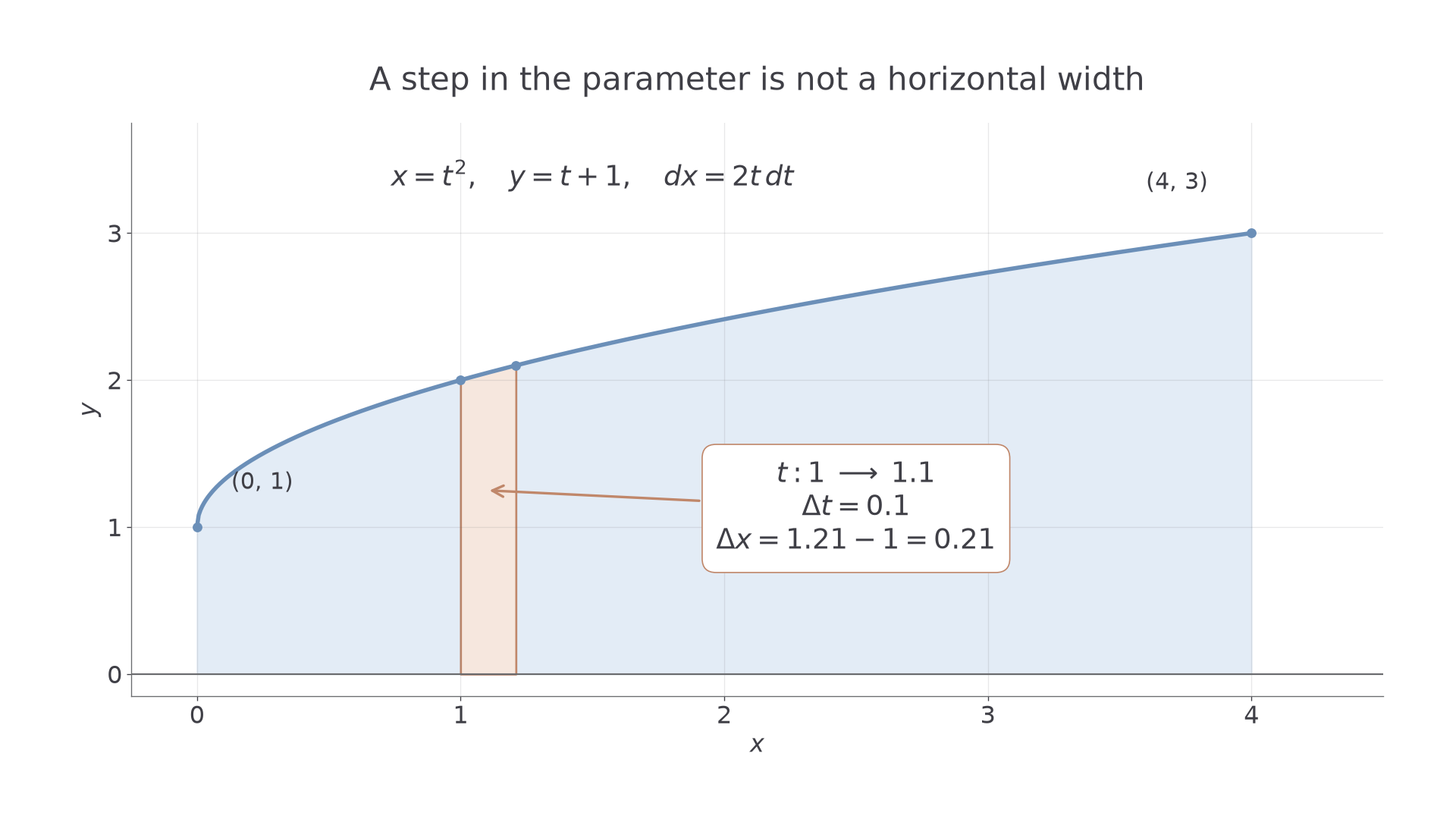
The sketch is supplied to explain the strip; you do not need to sketch a curve from its parametric equations for this unit.
Parametric integration
For , ,
When the curve is traversed once from left to right and stays above the axis, this gives its area above the axis. Choose parameter limits corresponding to the required x-boundaries.
Not in the formula booklet: learn it.
Substitution has changed the variable used to describe the width, while retaining the same geometric strips.
Worked example 1: a changing horizontal speed
A curve has , , . Find the area bounded by it, the x-axis, the y-axis and .
Plan. Use , with at and at .
For this range, increases and , so
Answer. square units.
Check. Eliminating the parameter here gives , so , independently confirming the parametric method.
Change only to , keeping the same parameter interval and heights. The region becomes three times as wide.
Worked example 2: a horizontal stretch
For , , , find the corresponding area above the x-axis between the endpoint verticals.
Plan. Multiply each height by ; the endpoint verticals are now and .
Answer. square units.
Check. Each horizontal coordinate is three times its previous value while each height is unchanged. The area is therefore .
A zero at the endpoint causes no problem here. The curve still moves monotonically to the right on the full interval.
Watch out
uses parameter width, not horizontal width. Include ; replacing it with computes a different integral.
Change only the horizontal scale again.
Parameter limits and direction
Increasing the parameter can move a curve leftwards. Match limits to the intended left-to-right area calculation, rather than automatically writing the smaller parameter first.
For , , , increasing moves from to , because . An integral in that direction is negative, although the region is above the axis. To add positive widths from to , let run from down to .
Worked example 3: decreasing parameter limits
For , , , find the area above the x-axis between and .
Plan. Use at the left endpoint and at the right endpoint, with .
Answer. square units.
Check. Here . Reflecting horizontally preserves the area from Worked example 1. The integral with limits to would be its negative.
Change only the left boundary from to . Solve for its new parameter rather than using .
Worked example 4: convert a vertical boundary
For the same curve, find the area above the x-axis between and .
Plan. Solve in the allowed parameter interval, then integrate left to right.
The left endpoint has ; the right endpoint still has . Thus
Answer. square units.
Check. The interval width is , with heights between and . The result lies between and . Direct integration of from to gives the same value.
Continue this lesson.
You’re previewing NovaLearn without an account. Create a free account to read the rest.
Create free account