P1 1.4 - Counting real roots
Use the discriminant to decide how many real roots a quadratic has before solving it. Then turn requirements such as “two distinct real roots” into conditions on an unknown coefficient.
Meaning of the discriminant
How can have two real roots, one repeated root, and no real roots, when only the constant changes?
Completing the square makes the difference visible. The three left sides are , and . Their graphs cross, touch or miss the -axis. The quadratic formula provides one number that detects these three cases directly from the coefficients.
Discriminant
For a quadratic , where , its discriminant is
It is the expression under the square root in .
If , the positive and negative square-root choices produce two different real values. If , those choices both give . This is one distinct real root, called a repeated root, which counts twice when multiplicity is recorded. If , a real square root does not exist, so the equation has no real roots.
[DIAGRAM: asset_name: Discriminant and axis crossings; asset_slug: discriminant-crossings; caption: Changing the constant moves the parabola through the three possible real-root cases.; description: Three panels show y equals x squared minus 4x plus 3 with D equals 4 crossing at x equals 1 and 3; y equals x squared minus 4x plus 4 with D equals 0 touching at x equals 2; and y equals x squared minus 4x plus 5 with D equals negative 4 staying above the axis. Vertices are (2,negative 1), (2,0) and (2,1).]
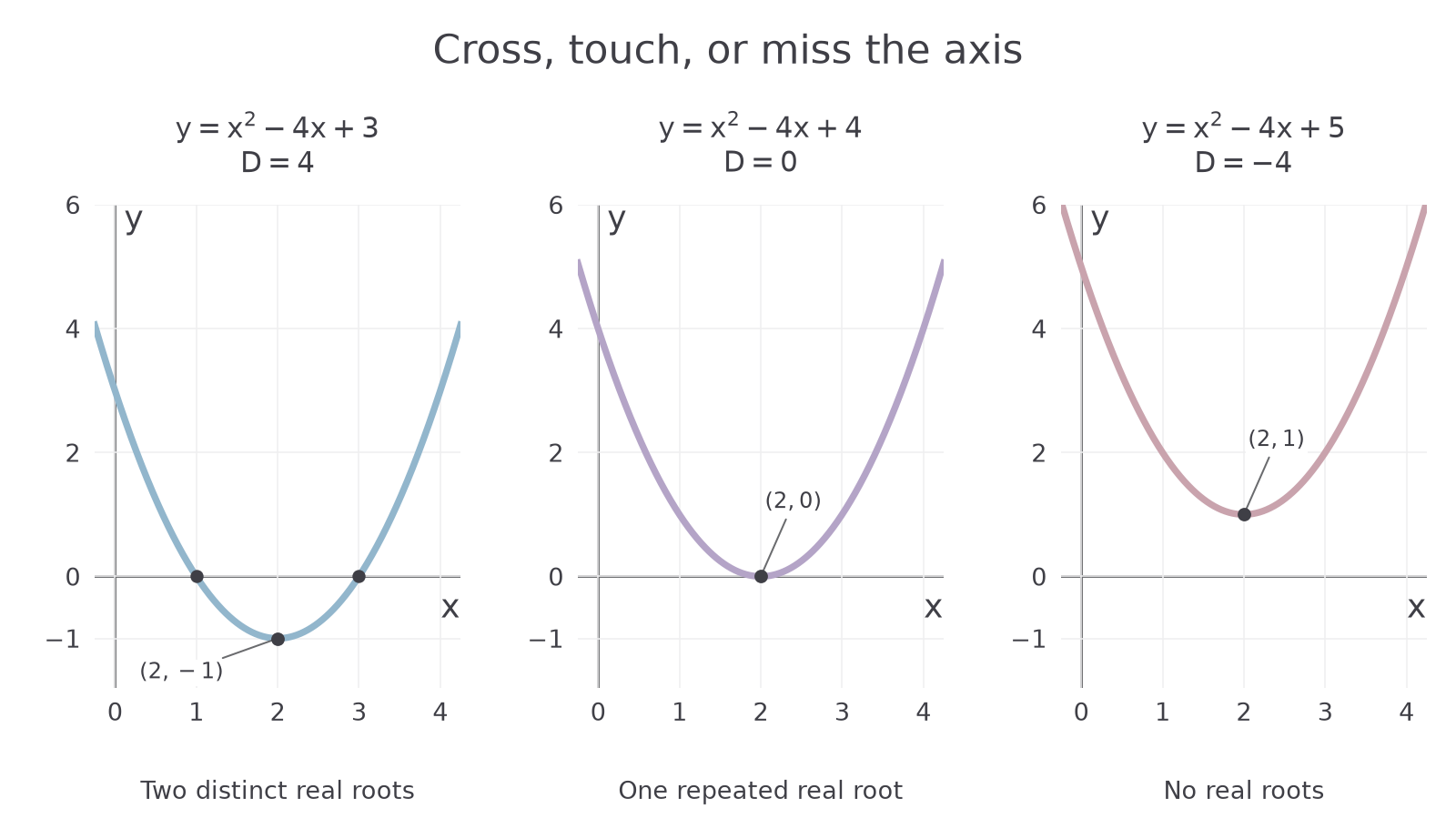
The leading coefficient may be positive or negative. A downward-opening parabola can also cross, touch or miss the axis: the discriminant rule is unchanged.
Real-root conditions
For real , with ,
“Real roots” without the word “distinct” allows equality: use .
Not in the formula booklet: learn it.
The square-root argument counts roots without requiring their values.
Two repeated or no real roots
Calculate the discriminant from a zero-form equation, keeping each coefficient's sign, and then state the root conclusion in words.
For , the discriminant is , so there are two distinct real roots. You do not need to finish the quadratic formula to establish that conclusion. Squaring means squaring its whole signed value: .
Worked example 1: detecting a repeated root
Determine the nature of the roots of .
Plan. Substitute , , into .
Answer. There is one repeated real root. Its value, if needed, is .
Check. The polynomial factorises as , so its graph touches the axis only at .
Change only the constant from to . The graph rises by , and the discriminant becomes negative.
Worked example 2: detecting no real roots
Determine the nature of the roots of .
Plan. Keep the same , but use .
Answer. There are no real roots.
Check. Completing the square gives , so the left side cannot be zero for any real .
This also distinguishes the nature of the roots from the shape of the graph.
Watch out
A negative leading coefficient does not imply no real roots. For , , and the roots are and .
State both the calculated discriminant and what it means.
Parameters and root conditions
When a coefficient contains an unknown parameter, a root condition becomes an equation or inequality involving that parameter.
For the opening family ,
Two distinct real roots require , giving . A repeated root requires ; no real roots require . This explains all three opening equations at once.
If the leading coefficient contains a parameter, first exclude values that make it zero. At such a value the equation is linear or constant, so the quadratic discriminant rule cannot decide its roots.
Worked example 3: two distinct roots
Find all real values of for which has two distinct real roots.
Plan. Form the discriminant and require it to be strictly positive.
The square exceeds when is more than units from zero, on either side.
Answer. or .
Check. At , ; at , . At the excluded boundary , the equation becomes , giving a repeated root instead of two distinct roots.
Change only the root condition from “two distinct real roots” to “no real roots”. The same discriminant now needs the opposite strict sign.
Worked example 4: no real roots
Find all real values of for which has no real roots.
Plan. Require and locate the values whose squares are less than .
Answer. .
Check. gives , which has no real roots. At , the polynomial is , agreeing with the interval. The endpoints again give repeated roots, so they are excluded.
The boundary between the two cases belongs to neither strict condition.
Watch out
From , keep both branches: or . Using only discards negative values whose squares are also greater than . If any real roots are allowed, replace by and include the boundary values.
The next equation includes a leading-coefficient boundary; check that before reporting a quadratic root condition.
Quick Recap
- is the square-root argument in the quadratic formula.
- Positive, zero and negative mean two distinct, one repeated and no real roots respectively.
- A repeated root is one distinct root that occurs twice in the factorisation.
- Translate a parameter condition into the correct sign of , and first ensure the equation stays quadratic.
For , the three opening cases are separated by the boundary .